State-Led Subsidized Bus Schemes for Women Mobility and Welfare
Source:Indian Express ↗
Why It Matters
Subsidized public transport for women acts as a crucial case study for UPSC aspirants analyzing state welfare schemes. It highlights the intersection of urban mobility, female labor force participation, and the debate surrounding the socio-economic impacts of 'freebies' versus targeted social justice initiatives.
Summary
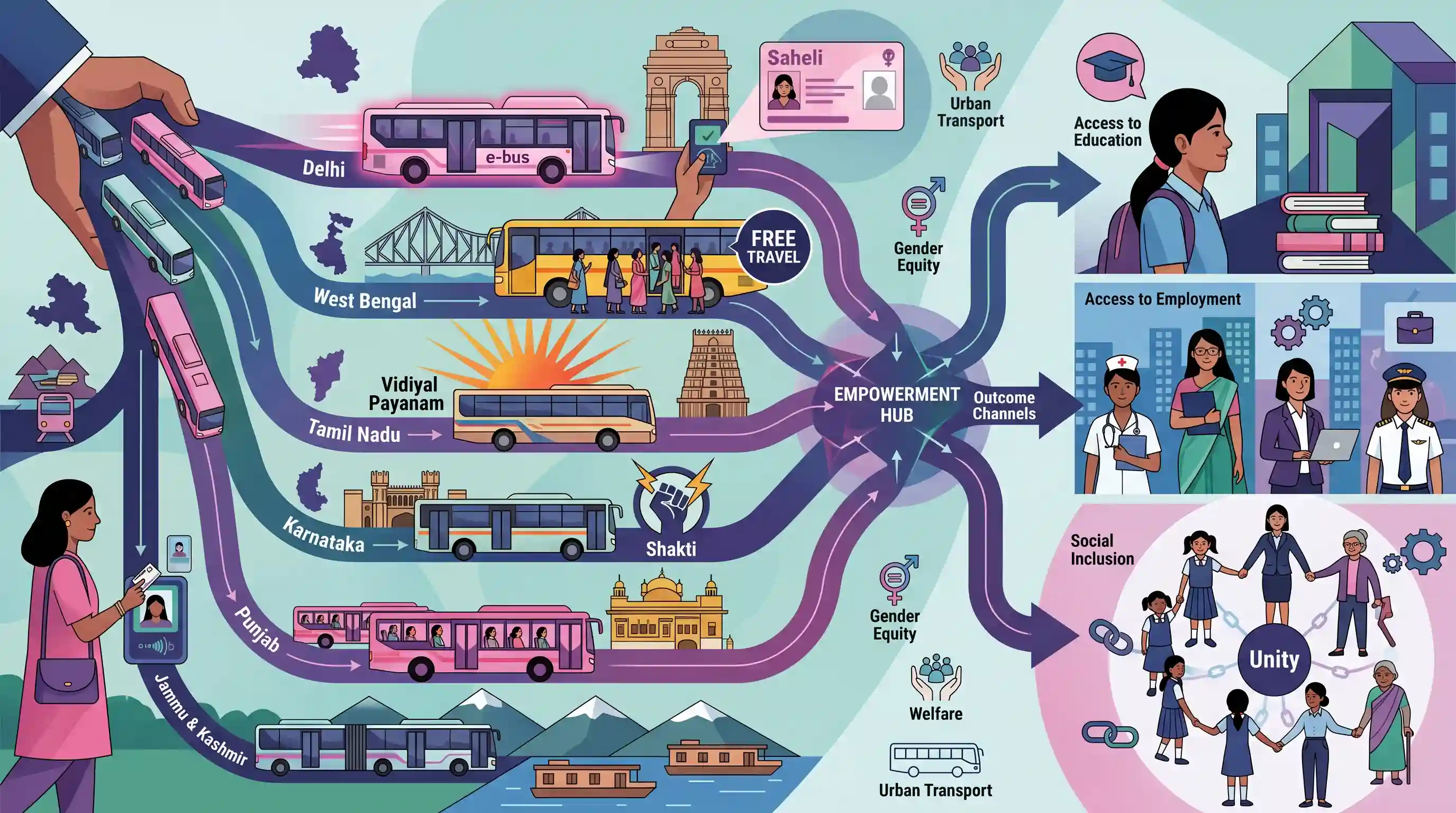
Several Indian states are increasingly utilizing free or subsidized public transport initiatives to boost women's mobility, social inclusion, and access to education and employment. Delhi is digitizing its existing program with the upcoming "Pink Saheli Smart Card," while West Bengal prepares to launch a free travel scheme in June. These join successful ongoing programs like Tamil Nadu's "Vidiyal Payanam", Karnataka's "Shakti Scheme", and specific initiatives in Punjab and Jammu & Kashmir, highlighting a broader policy trend of utilizing transport infrastructure as a tool for women's empowerment and welfare.
Key Points
- Several Indian states are introducing or upgrading free and subsidized bus travel schemes for women to improve mobility, safety, and financial independence.
- Delhi is transitioning its 2019 'Pink Ticket' scheme to a digital 'Pink Saheli Smart Card' to digitally record journeys.
- West Bengal is rolling out free bus travel for women starting June 1, potentially using a zero-fare ticketing system.
- Other notable state initiatives include Tamil Nadu's 'Vidiyal Payanam' (2021) and Karnataka's 'Shakti Scheme' (2023), both of which have heavily impacted female commuters.
- Punjab and Jammu & Kashmir have also launched dedicated free bus services focused on social inclusion and safer transport options.
Important Terms
Shakti Scheme

A Karnataka government initiative providing free intra-state travel for women and transgender persons in non-luxury state-run buses to boost economic participation and mobility.
UPSC context
GS II (Welfare Schemes) and GS III (Inclusive Growth); tests gender-responsive infrastructure and social empowerment through mobility.
Vidiyal Payanam
Tamil Nadu's welfare program providing free travel for women, transgender persons, and persons with disabilities in ordinary-fare government buses, aiming to reduce commuting costs.
UPSC context
GS II (Governance/Welfare); examines the "Dravidian Model" and impact of public subsidies on women's socio-economic mobility.
Pink Ticket scheme
Delhi's 2019 initiative allowing women free travel in DTC and cluster buses via manual paper tickets, with costs reimbursed by the state government.
UPSC context
GS II (Welfare) and GS III (Urban Infrastructure); evaluates targeted subsidies in increasing women's presence in public spaces.
Pink Saheli Smart Card
The digital successor to Delhi's Pink Ticket, integrated with the National Common Mobility Card (NCMC) framework to streamline subsidy distribution and track ridership data.
UPSC context
GS III (Infrastructure/Digital India); tests knowledge of "One Nation One Card" and digital welfare delivery systems.
Delhi Transport Corporation (DTC)
The primary public transport operator in Delhi, implementing major social initiatives like women-only and free-travel schemes through its extensive bus fleet.
UPSC context
GS III (Urban Transport); relevant for topics on sustainable urban mobility, pollution control, and inclusive planning.
Free Bus Travel (Punjab)
A Punjab government program launched in 2021 providing free travel to women residents in state-owned buses like PRTC and PUNBUS to promote social inclusion.
UPSC context
GS II (Welfare Schemes); highlights state-level efforts to improve female access to healthcare, education, and employment.
Prelims Trap
Free urban transit for women is a Centrally Sponsored Scheme funded under the Nirbhaya Fund.
These are exclusively State Sector Schemes funded by respective state exchequers (e.g., Delhi, TN, Karnataka), not centralized initiatives or Nirbhaya-funded.
Static Concepts Connected
What is Gender Budgeting in India's fiscal policy?
- Core Concept: Not a separate budget, but an analytical tool dissecting the overarching government budget to assess its gender-differential impacts.
- Part A vs B: Part A contains 100% women-specific schemes; Part B contains schemes where at least 30% of the allocation specifically benefits women.
- Policy Translation: It translates gender equity commitments into budgetary allocations, effectively using fiscal policy (like state transport subsidies) to correct historical imbalances.
How does the "Spatial Mismatch" hypothesis affect urban female employment?
- The Hypothesis: The geographical disconnect between low-income or marginalized households in urban peripheries and suitable job opportunities located in commercial centers.
- Gender Penalty: Women suffer disproportionately due to safety fears, lower disposable incomes, and restricted mobility, often keeping them out of the formal urban labor market.
- Transit Solution: Subsidized public transport lowers commuting costs and safety barriers, effectively bridging the spatial gap and connecting women to employment hubs.
Cross-Topic Patterns
FLFP stagnation and Urbanization
Despite rapid urbanization, India's urban female labor force participation often lags behind rural rates. Subsidized transit directly targets this "urban mobility penalty" to bring women into formal jobs.
E-Governance yielding Gender Data
Delhi's shift to digital Smart Cards transforms simple welfare into e-governance, generating vital gender-disaggregated data to optimize future transport routes and safety infrastructure.

Expect a GS-2 Mains question analyzing state transit subsidies: balancing 'competitive welfarism' with genuine female economic empowerment.
Linked PYQs · 3
Linked PYQs · 3
- 2019MainsGS1
How is efficient and affordable urban mass transport key to the rapid economic development of India?
- 2024MainsGS1
Distinguish between gender equality, gender equity and women's empowerment. Why is it important to take gender concerns into account in programme design and implementation?
- 2019MainsGS2
Performance of welfare schemes that are implemented for vulnerable sections is not so effective due to absence of their awareness and active involvement at all stages of policy process. Discuss.
