Delhi Schools Launch Year Long Air Pollution Awareness Drive
Source:Indian Express ↗
Why It Matters
This article illustrates a practical application of environmental administration where high-level statutory frameworks (CAQM, DPCC) are translated into bottom-up grassroots awareness campaigns. Understanding the specific monthly calendar of different NCR pollution sources (such as stubble burning in Nov-Dec and dust in autumn) is vital for writing analytical Mains answers on seasonal air pollution trends and public policy interventions.
Summary
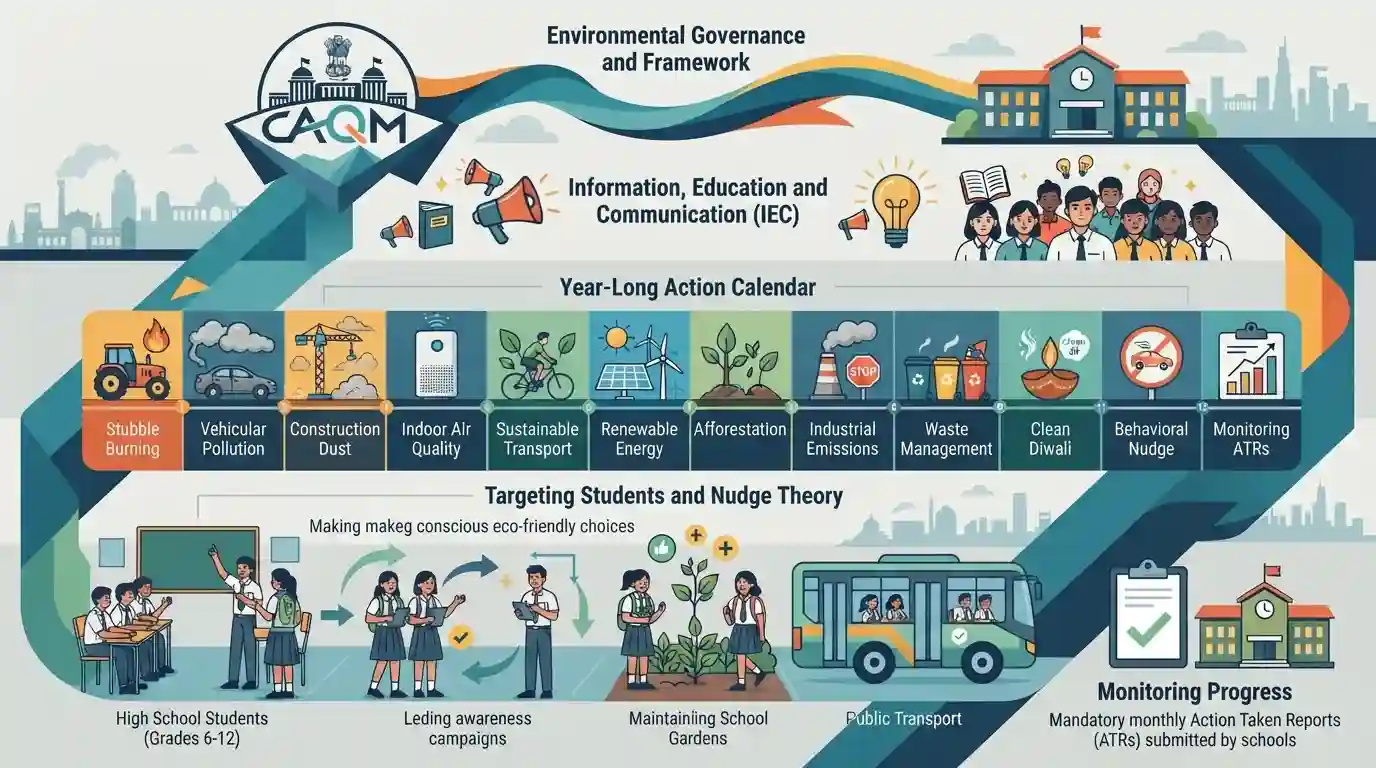
The Delhi government has directed all schools in the capital to execute a year-long air pollution awareness drive under its Information, Education, and Communication (IEC) Action Plan. Aligned with the regulatory framework of the Commission for Air Quality Management (CAQM) and Delhi Pollution Control Committee (DPCC) instructions, this initiative targets students (principally from Classes 6 to 12) to nurture eco-friendly behaviors. The campaign deploys a monthly calendar tackling specific pollution vectors (such as stubble burning, vehicular exhaust, and construction dust) while monitoring school-level progress via mandatory monthly Action Taken Reports (ATRs).
Key Points
- Year-Long Awareness Drive: The Delhi government's Directorate of Education has launched a systematic, year-long campaign inside schools to target the sources and health impacts of air pollution in the national capital.
- Structured Monthly Calendar: The IEC Action Plan assigns specific monthly themes based on key seasonal pollution sources: Vehicular emissions (monthly), Road dust (July-September), Construction dust (September-November), Municipal Solid Waste (MSW) & Stubble Burning (November-December), Industrial emissions (January), Thermal power plants (February), and Diesel Generator (DG) sets (March).
- Youth Engagement & Pedagogy: Students primarily from Classes 6 to 12 will participate in hands-on activities like poster-making, slogan writing, essay writing, speech contests, and street plays to foster environmental citizenship and encourage behavioral nudges in households.
- Institutional Synergy: Prepared in compliance with the CAQM framework and Delhi Pollution Control Committee (DPCC) directives, the campaign aligns municipal governance with central statutory guidelines.
- Ban on Glass-coated Manjha: The drive additionally mandates raising awareness among students regarding the ecological and physical hazards of using sharp glass-coated string ('manjha') for kite flying.
- Accountability Mechanism: District education officers must submit monthly Action Taken Reports (ATRs) complete with photographs to the Directorate’s Science Branch by the 25th of every month.
Important Terms
Commission for Air Quality Management (CAQM)

A statutory body established under the CAQM Act, 2021, to coordinate, monitor, and enforce measures for improving air quality in the National Capital Region (NCR) and adjoining states.
UPSC context
GS Paper III (Environment & Pollution Control), crucial for understanding regional, collaborative governance structures to combat transboundary air pollution.
Delhi Pollution Control Committee (DPCC)
An autonomous regulatory body created in 1991 to enforce air, water, and noise pollution control laws at the ground level in Delhi, executing powers delegated by the Central Pollution Control Board.
UPSC context
GS Paper III (Environment & Pollution), highlights the role of state-level bodies in executing environmental mandates and localizing CPCB policies.
Information, Education and Communication (IEC)
A public policy intervention strategy utilizing diverse media to disseminate knowledge, raise awareness, and catalyze behavioral and social change regarding critical public health, environmental, and developmental issues.
UPSC context
GS Paper II (Social Sector & Governance) and GS IV (Behavioral Change), testing strategies for citizen participation and policy implementation.
Commission for Air Quality Management in National Capital Region and Adjoining Areas Act, 2021
A legislative framework passed to centralize air quality governance in Delhi-NCR, empowering the CAQM with overriding, legally-binding authority over state pollution control boards and state departments.
UPSC context
GS Paper II (Regulatory Bodies) and GS III (Environmental Legislation), critical for analyzing regional environmental federalism and centralized enforcement mechanisms.
Prelims Trap
Directions issued by the Commission for Air Quality Management (CAQM) are advisory, leaving execution to state-level Pollution Control Boards.
Under the CAQM Act 2021, the Commission's directions are statutory and binding. They override any conflicting state laws or orders in the NCR and adjoining states.
Static Concepts Connected
What is the Commission for Air Quality Management (CAQM)?
- Statutory Status: Established under the CAQM Act 2021, replacing the EPCA to coordinate and monitor air quality in NCR.
- Binding Powers: Its directions are statutory and binding, overriding state-level pollution control board decisions in case of conflict.
- Jurisdiction: Covers Delhi-NCR and adjoining areas of Punjab, Haryana, Rajasthan, and Uttar Pradesh to address airshed pollution.
How does Nudge Theory operate in environmental policy?
- Cognitive Framework: Uses positive reinforcement and indirect suggestions to steer public behavior without forbidding options or changing economic incentives.
- Policy Application: Deploys school-level campaigns to influence household waste-segregation, energy conservation, and eco-friendly consumer choices.
Cross-Topic Patterns
Behavioral economics + Environmental governance
Using children as green ambassadors leverages peer-and-family nudges to bypass weak legal enforcement of civic environmental norms.
Airshed management + Cooperative federalism
Trans-boundary air pollution in NCR tests the limits of central regulatory mandates like CAQM against state-level executive execution.

CAQM's binding powers versus state autonomy in implementing GRAP is highly likely to feature as a federalism-cum-environment GS-II/III question.
Linked PYQs · 2
Linked PYQs · 2
- 2020MainsGS3
What are the key features of the National Clean Air Programme (NCAP) initiated by the Government of India?
- 2022PrelimsGS1
In the context of WHO Air Quality Guidelines, consider the following statements: 1. The 24-hour mean of PM2.5 should not exceed 15 µg/m³ and annual mean of PM2.5 should not exceed 5 µg/m³. 2. In a year, the highest levels of ozone pollution occur during the periods of inclement weather. 3. PM10 can penetrate the lung barrier and enter the bloodstream. 4. Excessive ozone in the air can trigger asthma. Which of the statements given above are correct?
