Delhi Riots UAPA Bail Jurisprudence and Speedy Trials
Source:The Hindu ↗
Why It Matters
The article exemplifies the tension between national security laws like the UAPA and constitutional guarantees of personal liberty. It is highly relevant for GS Paper II (Fundamental Rights, Judiciary) and GS Paper III (Internal Security), illustrating the complexities of bail jurisprudence, the rights of undertrials to a speedy trial, and the boundaries of peaceful protest in a democracy.
Summary
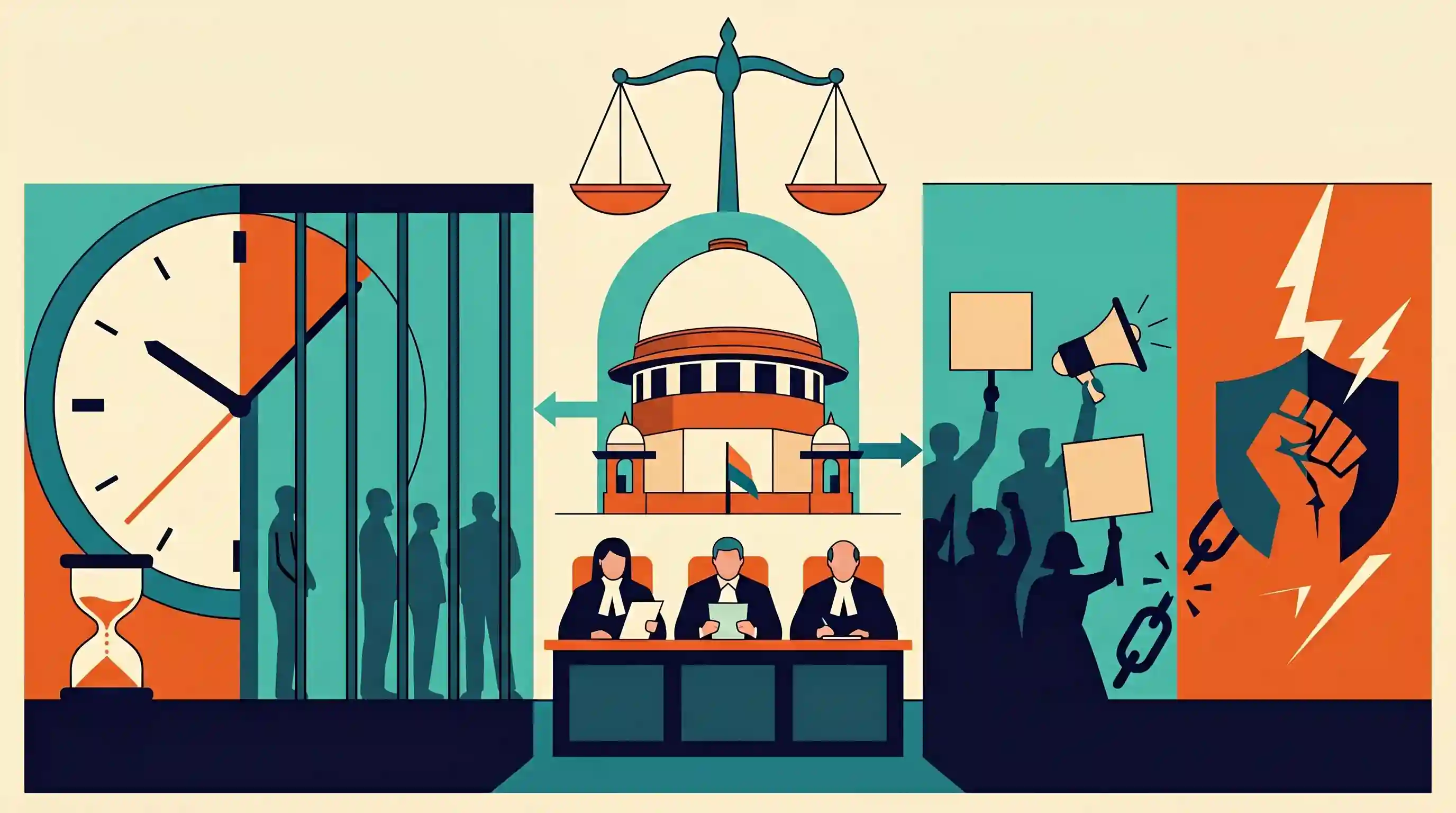
The Supreme Court is currently hearing the bail pleas of activists, including Umar Khalid and Sharjeel Imam, who are accused under the Unlawful Activities (Prevention) Act (UAPA) for their alleged roles in the 2020 northeast Delhi riots conspiracy. Having spent over five years in custody without the start of a trial, the accused argued against the Delhi Police's claims that they caused the delays, revealing they were only told of the probe's conclusion in September 2024. The hearings bring to the fore arguments regarding prolonged undertrial incarceration, the right to a speedy trial under Article 21, and the distinction between peaceful anti-CAA protests and violent conspiracies.
Key Points
- Several activists have been incarcerated for over five years under the Unlawful Activities (Prevention) Act (UAPA) in connection with the 2020 Delhi riots conspiracy case, without their trial commencing.
- The accused contested the Delhi Police's assertion that they were responsible for trial delays, stating they were only officially informed of the investigation's completion in September 2024.
- Defense counsels argued that prolonged undertrial detention acts as a pre-conviction punishment, emphasizing the violation of the fundamental right to life and personal liberty under Article 21.
- While the prosecution claims the anti-CAA protests were a front to incite communal riots, the defense maintains the accused were exercising their legitimate democratic right to peaceful protest and dissent.
Important Terms
Unlawful Activities (Prevention) Act (UAPA), 1967

India's primary anti-terror law (1967) used to tackle activities threatening national sovereignty and integrity. Amendments in 2004 and 2019 expanded it to include terrorist acts and individual designations.
UPSC context
GS Paper 3: Internal Security. Tests knowledge of anti-terror frameworks, individual rights, and state powers during investigation.
Article 21 of the Indian Constitution
Guarantees the Right to Life and Personal Liberty. The Judiciary has interpreted this to include the 'Right to a Speedy Trial' and protection against prolonged undertrial incarceration.
UPSC context
GS Paper 2: Polity & Governance. Tests understanding of fundamental rights and judicial activism in protecting civil liberties.
Citizenship (Amendment) Act (CAA), 2019
A 2019 law granting fast-tracked citizenship to persecuted religious minorities (excluding Muslims) from Afghanistan, Bangladesh, and Pakistan who entered India before December 31, 2014.
UPSC context
GS Paper 2: Polity. Relevant for citizenship laws, secularism debates, and constitutional challenges to legislation.
Undertrial Prisoners
A person in judicial custody while awaiting trial or the conclusion of legal proceedings. In India, undertrials constitute over 75% of the total prison population.
UPSC context
GS Paper 2: Social Justice/Judiciary. Concerns prison reforms, judicial delay, and the principle of 'innocent until proven guilty.'
Section 43D(5) of UAPA
A stringent provision in the UAPA that bars bail if the court finds accusations 'prima facie true' based on the police report, effectively reversing the standard 'bail is the rule' dictum.
UPSC context
GS Paper 2/3: Legal Issues. Tests technical knowledge of how special laws override general criminal procedures regarding personal liberty.
Supreme Court of India
The apex judicial body in India that acts as the guardian of the Constitution, final interpreter of laws, and protector of fundamental rights.
UPSC context
GS Paper 2: Judiciary. Focuses on the Court's original and appellate jurisdiction and its role in judicial review.
Prelims Trap
"Under UAPA, courts have absolutely no power to grant bail if the allegations are prima facie true."
Constitutional courts (High Courts and the SC) can still grant bail citing Article 21 (speedy trial violation) despite statutory embargoes, per the K.A. Najeeb judgment.
Static Concepts Connected
How does the Supreme Court interpret the Right to a Speedy Trial?
- Implicit Right: Established in the landmark Hussainara Khatoon (1979) case as an implicit fundamental right under Article 21 (Right to Life and Personal Liberty).
- Bail Override: In Union of India v. K.A. Najeeb (2021), the SC ruled that prolonged incarceration without trial violates Art 21, allowing constitutional courts to override statutory bail embargoes.
- De facto Punishment: Courts view prolonged pre-trial detention as a violation of the presumption of innocence, effectively acting as an unconstitutional pre-conviction punishment.
What makes bail under the UAPA, 1967 exceptionally difficult?
- Section 43D(5) Embargo: Under Section 43D(5), courts are mandated to deny bail if there are reasonable grounds to believe the police accusations are 'prima facie true'.
- Evidentiary Burden: Unlike regular criminal law, courts cannot deeply analyze or weigh evidence during bail hearings; they must rely primarily on the allegations in the police chargesheet.
- Extended Detention: The Act allows investigative agencies to detain an accused for an extended period of up to 180 days before even filing a chargesheet.
Cross-Topic Patterns
Undertrials & Prison Overcrowding
UAPA trial delays directly fuel India's prison crisis. NCRB data shows ~75% of inmates are undertrials, linking strict anti-terror laws to systemic judicial and infrastructural backlogs.
PMLA vs. UAPA Bail Embargoes
The stringent bail conditions under UAPA (Section 43D(5)) mirror the 'twin conditions' of the PMLA. Both laws are increasingly tested together against Article 21 in constitutional challenges.

Expect a GS2 Mains question on the clash between strict statutory bail laws (UAPA/PMLA) and the Article 21 right to a speedy trial.
Linked PYQs · 2
Linked PYQs · 2
- 2019MainsGS3
Indian Government has recently strengthened the anti-terrorism laws by amending the Unlawful Activities (Prevention) Act (UAPA), 1967 and the NIA Act. Analyze the changes in the context of prevailing security environment while discussing the scope and reasons for opposing the UAPA by human rights organizations.
- 2023MainsGS2
“The Constitution of India is a living instrument with capabilities of enormous dynamism. It is a constitution made for a progressive society.” Illustrate with special reference to the expanding horizons of the right to life and personal liberty.
