Supreme Court Bail Jurisprudence under Anti Terror Laws
Source:Indian Express ↗
Why It Matters
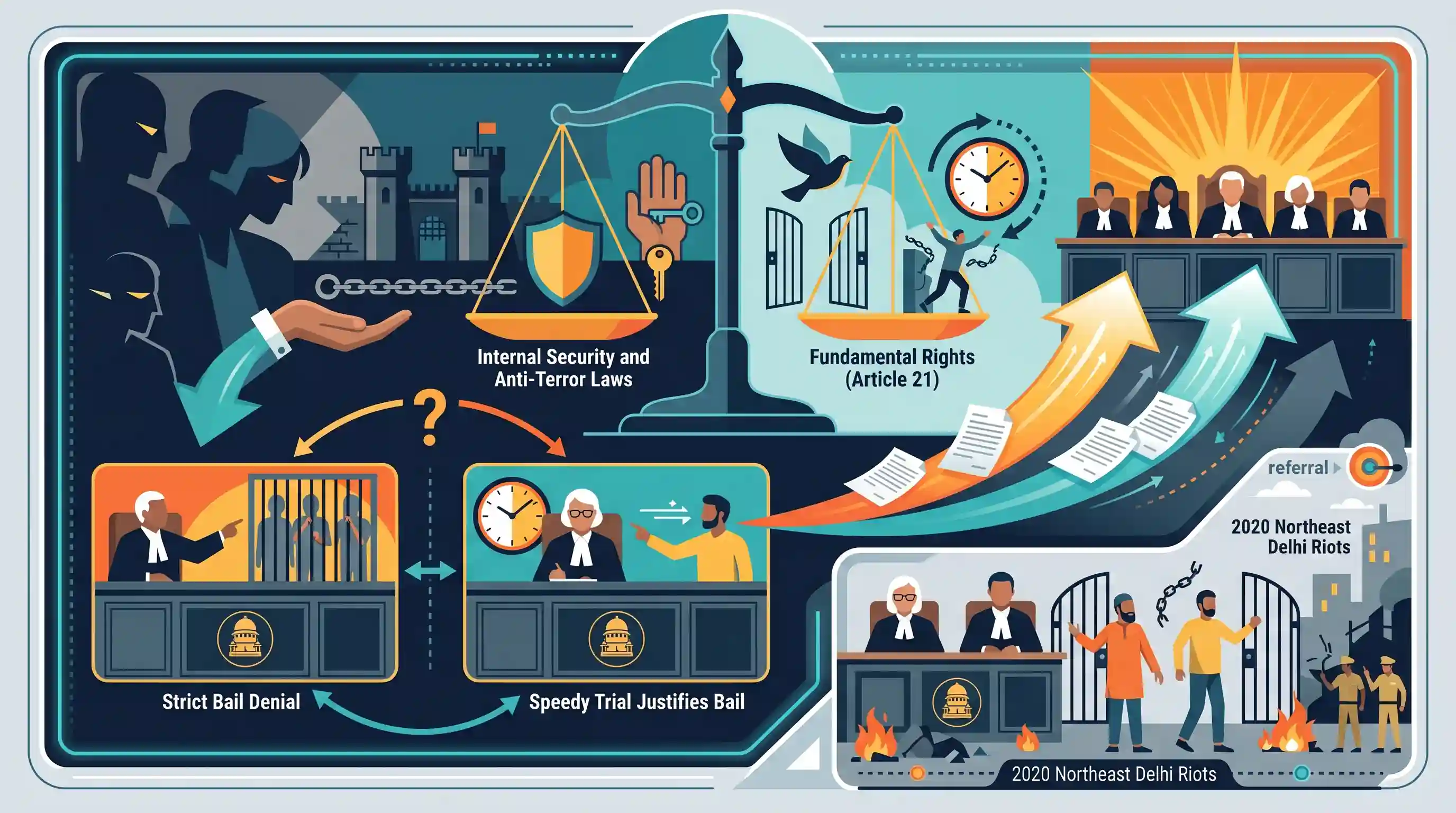
The Supreme Court's impending larger bench ruling will set a crucial precedent on bail jurisprudence under the UAPA, providing clarity on how courts must balance the stringent statutory restrictions on bail against a citizen's fundamental right to life, liberty, and a speedy trial under Article 21 of the Constitution.
Summary
The Supreme Court of India has referred questions regarding the correctness of bail denials under the Unlawful Activities (Prevention) Act (UAPA) to a larger bench. The referral stems from conflicting interpretations by different two-judge benches—one asserting that the fundamental right to a speedy trial can justify bail under UAPA, and another upholding strict bail denials for key conspirators. Concurrently, the Court granted interim bail to Tasleem Ahmed and Khalid Saifi in the 2020 Northeast Delhi riots case. The proceedings underscore the complex balancing act between enforcing stringent national security laws and upholding constitutional guarantees of individual liberty and speedy trial.
Key Points
- The Supreme Court referred the legal question surrounding UAPA bail conditions to a larger bench due to conflicting views of different two-judge benches.
- The SC granted interim bail to two accused, Tasleem Ahmed and Khalid Saifi, in the 2020 Northeast Delhi riots conspiracy case.
- One two-judge bench previously ruled that violation of fundamental rights, such as a speedy trial, is grounds for bail even under stringent laws like the UAPA.
- Another bench had denied bail to key accused in the Delhi riots, noting they stood on a 'higher footing' of participation.
- The case highlights the ongoing judicial debate weighing individual liberty and fundamental rights against the safety of the community in terrorism and conspiracy trials.
Important Terms
Unlawful Activities (Prevention) Act (UAPA)

A 1967 law aimed at preventing unlawful activities and terrorism. It empowers the government to designate individuals/organizations as terrorists and provides for special procedures like extended detention without chargesheets.
UPSC context
GS Paper 2 (Governance/Laws) and GS Paper 3 (Internal Security); critical for discussions on national security versus civil liberties.
Article 21
A Fundamental Right in the Indian Constitution guaranteeing that no person shall be deprived of life or personal liberty except according to procedure established by law.
UPSC context
GS Paper 2 (Polity/Fundamental Rights); essential for understanding judicial protection of individual freedom during incarceration.
Section 43D(5) of UAPA
A stringent UAPA provision mandating that an accused cannot be granted bail if the court finds the accusation 'prima facie true.' This effectively reverses the 'bail is the rule' standard.
UPSC context
GS Paper 2/3 (Judiciary/Internal Security); a frequent focal point for judicial interpretation regarding strict anti-terror laws.
National Investigation Agency (NIA)
A statutory body under the NIA Act 2008, functioning as India's federal counter-terrorism agency. It has concurrent jurisdiction to investigate terror-related offenses across states without prior state permission.
UPSC context
GS Paper 3 (Security Forces and Agencies); vital for understanding India's counter-terror investigative framework.
Larger Bench
A judicial committee of the Supreme Court comprising more judges than a previous bench. It is constituted to resolve conflicts between co-equal benches or reconsider established legal precedents.
UPSC context
GS Paper 2 (Judiciary); significant for understanding the Doctrine of Precedent and how legal stability is maintained.
Interim Bail
Temporary bail granted for a short period while the regular bail application is pending, providing immediate relief from custody under specific circumstances or during legal transitions.
UPSC context
GS Paper 2 (Judiciary/Polity); tests understanding of different forms of judicial relief and types of bail in India.
Prelims Trap
Constitutional courts are entirely barred from granting bail if UAPA Section 43D(5) conditions are not met.
This is false. The Supreme Court has ruled that statutory restrictions under UAPA cannot override a constitutional court’s power to grant bail if Article 21 (speedy trial) is violated.
Static Concepts Connected
What dictates the referral of a case to a 'larger bench' in the Supreme Court?
- Coordinate bench rule: A bench cannot overrule the judgment of another bench of equal strength (e.g., a two-judge bench cannot overrule another two-judge bench).
- Referral to CJI: If a disagreement arises between coordinate benches, judicial discipline requires referring the matter to the Chief Justice to constitute a larger bench.
What were the key changes introduced by the UAPA (Amendment) Act, 2019?
- Individual designation: Empowered the Central Government to designate individuals as terrorists. Previously, only organizations could be designated as such.
- NIA property seizure: The Director General of the NIA can approve the seizure of properties related to terrorism without needing the state DGP's approval.
- Investigating officers: Empowered officers of the rank of Inspector in the NIA to investigate UAPA offenses (previously restricted to DSP/ACP or above).
Cross-Topic Patterns
PMLA twin conditions vs UAPA bail
Both laws invert the 'innocent until proven guilty' principle, making bail the exception. UPSC often tests these stringent statutory bars against constitutional liberties under Article 21.
NIA jurisdiction and federal friction
UAPA cases investigated by the NIA bypass the need for state government consent, linking national security mandates directly to ongoing Center-State federalism debates.

Expect a GS2/GS3 Mains question weighing UAPA's Section 43D(5) bail restrictions against the fundamental right to a speedy trial.
Linked PYQs · 2
Linked PYQs · 2
- 2019MainsGS3
Indian Government has recently strengthened the anti-terrorism laws by amending the Unlawful Activities (Prevention) Act (UAPA), 1967 and the NIA Act. Analyze the changes in the context of prevailing security environment while discussing the scope and reasons for opposing the UAPA by human rights organizations.
- 2017MainsGS2
Examine the scope of Fundamental Rights in the light of the latest judgement of the Supreme Court on Right to Privacy.
