Delhi Winter Weather Conditions and Severe Air Pollution Crisis
Source:The Hindu ↗
Why It Matters
The recurrent winter air pollution crisis in Delhi provides a prime case study for GS3 Environmental Conservation and Pollution topics. Understanding the underlying meteorological factors, such as temperature inversions, cold northerly winds, and western disturbances, connects to GS1 Climatology and Geography.
Summary
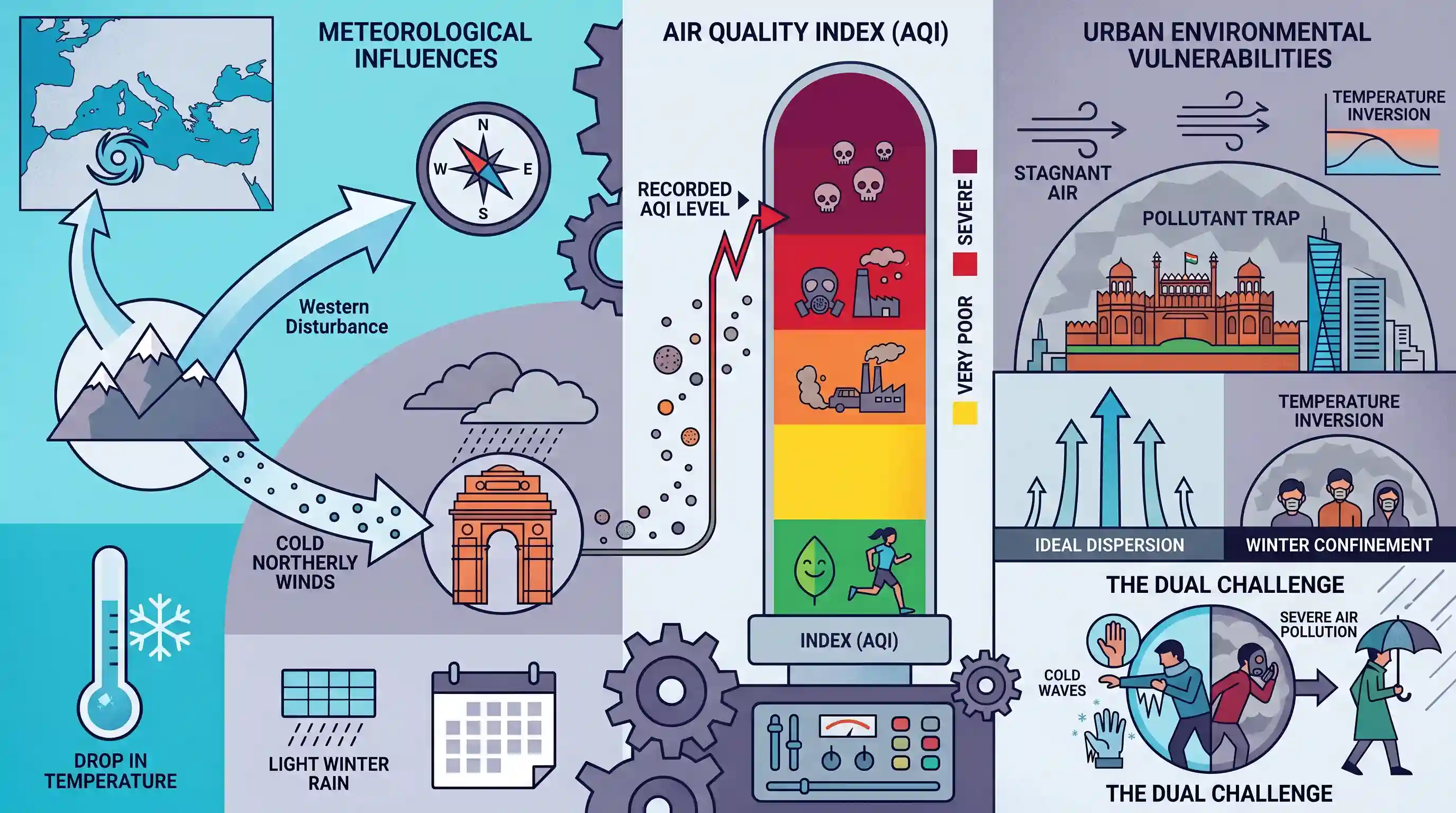
Delhi welcomed the New Year with chilly, cloudy weather and a 'very poor' Air Quality Index (AQI). The city recently recorded its coldest December day in years, and meteorological forecasts predict a further drop in temperature due to cold northerly winds originating from the Himalayan region. Additionally, light winter rain is expected, highlighting the typical regional weather patterns influenced by western disturbances. The dual challenge of cold waves and severe urban air pollution underscores the city's complex wintertime environmental vulnerabilities.
Key Points
- Delhi experienced a chilly start to the New Year, continuing a trend of biting cold from late December.
- The Air Quality Index (AQI) remained firmly in the 'very poor' category, reflecting ongoing severe winter pollution challenges in the National Capital.
- Cold northerly winds descending from the Himalayan region are expected to push temperatures down further.
- Forecasts suggest light rain, typical of the winter precipitation brought by western disturbances over North India.
Important Terms
Air Quality Index (AQI)

A numeric tool (0-500) that transforms complex data on eight pollutants (like PM2.5, PM10, and Ozone) into a single number and color to communicate health risks.
UPSC context
GS Paper III (Environment); tested for pollution monitoring tools, health impacts, and the 'One Number-One Color-One Description' initiative.
Western Disturbances
Extra-tropical storms originating in the Mediterranean region that bring sudden winter precipitation to Northwest India; they are vital for the Rabi crop season, particularly wheat.
UPSC context
GS Paper I (Geography); essential for understanding non-monsoonal rainfall patterns and their socio-economic impact on Indian agriculture.
Central Pollution Control Board (CPCB)
A statutory organization under the Ministry of Environment, Forest and Climate Change, established in 1974 to prevent and control air and water pollution across India.
UPSC context
GS Paper II/III (Governance & Environment); relevant for statutory bodies, environmental regulations, and the implementation of air quality standards.
India Meteorological Department (IMD)
The principal agency under the Ministry of Earth Sciences responsible for meteorological observations, weather forecasting (monsoons, heat/cold waves), and issuing alerts for natural disasters.
UPSC context
GS Paper I/III (Geography & Disaster Management); focuses on weather-dependent activities like agriculture and disaster preparedness through color-coded warnings.
National Clean Air Programme (NCAP)
A time-bound national strategy launched in 2019, now aiming for a 40% reduction in particulate matter concentrations by 2026 across 131 identified 'non-attainment' cities.
UPSC context
GS Paper III (Environment); key policy framework for urban air quality management and performance-based grants for million-plus cities.
Cold Wave
A weather phenomenon marked by a rapid fall in temperature; for plains, the IMD declares it when minimum temperatures reach ≤4°C or deviate 4.5°C-6.4°C from normal.
UPSC context
GS Paper I (Geography); relates to extreme climatic events and the 'Core Cold Wave Zone' affecting North and Central India.
Prelims Trap
"The National Air Quality Index (AQI) includes Carbon Dioxide (CO2) as one of its primary measured pollutants."
The AQI measures 8 specific pollutants (PM10, PM2.5, NO2, SO2, CO, O3, NH3, Pb). It measures Carbon Monoxide (CO), but completely excludes greenhouse gases like CO2.
Static Concepts Connected
What is Temperature Inversion and how does it worsen pollution?
- Mechanism: Normally, temperature decreases with altitude. An inversion reverses this, creating a layer of warm air resting over colder surface air.
- Impact: The warm inversion layer acts as an atmospheric 'lid', preventing vertical mixing and trapping particulate matter and smog close to the ground.
What are the core mechanics of Western Disturbances?
- Origin: They are extratropical (non-monsoonal) cyclones that originate over the Mediterranean Sea during the winter months.
- Carrier: They are steered into north-western India by Subtropical Westerly Jet Streams, bringing crucial light rain for rabi crops and altering cold wave dynamics.
Cross-Topic Patterns
Delhi's Topography & Air Quality
The Indo-Gangetic basin, flanked by the Himalayas and Aravallis, creates a geographical "bowl." This topography severely restricts horizontal wind dispersion during low-wind winter months, compounding the crisis.
CAQM vs. State Pollution Boards
The Commission for Air Quality Management (CAQM) is a statutory body (2021) with overriding powers over state pollution control boards to enforce GRAP, highlighting centralized governance for transboundary environmental issues.

Expect a 2026 multi-statement Prelims question interlinking Western Disturbance mechanics, temperature inversion, and the 8 AQI pollutants.
Linked PYQs · 3
Linked PYQs · 3
- 2021MainsGS3
Describe the key points of the revised Global Air Quality Guidelines (AQGs) recently released by the World Health Organisation (WHO). How are these different from its last update in 2005? What changes in India's National Clean Air Programme are required to achieve these revised standards?
- 2020MainsGS3
What are the key features of the National Clean Air Programme (NCAP) initiated by the Government of India?
- 2015PrelimsGS1
Consider the following statements: 1. The winds which blow between 30° N and 60° S latitudes through-out the year are known as westerlies. 2. The moist air masses that cause winter rains in North-Western region of India are part of westerlies. Which of the statements given above is/are correct?
