शहरी सुरक्षा की कमज़ोरियां और वाइट कॉलर आतंक मॉड्यूल
स्रोत:द हिंदू ↗
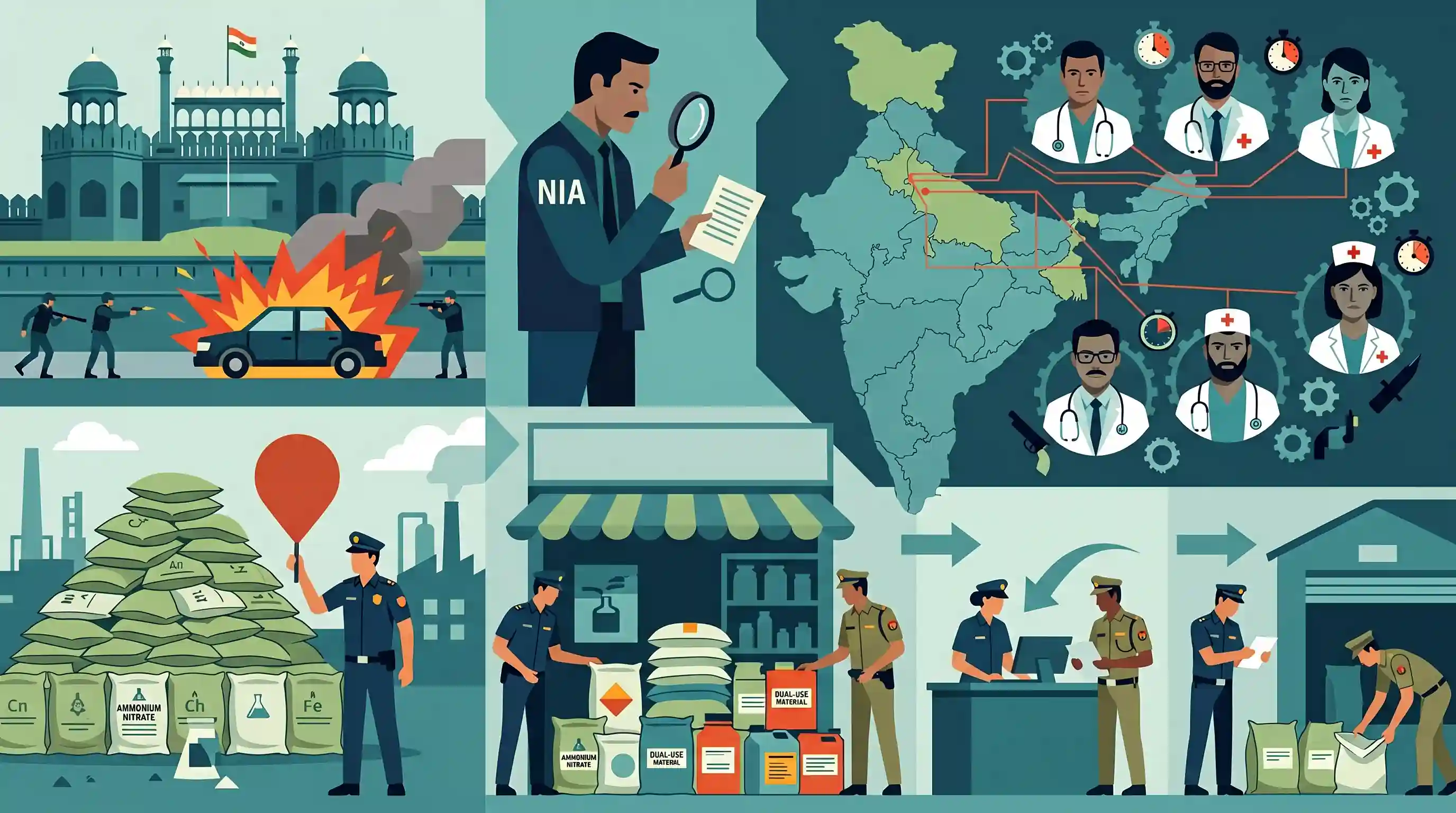
क्यों मायने रखता है
The involvement of highly educated professionals (doctors) points to a dangerous evolution in radicalization (white-collar terrorism). Furthermore, the execution of a Vehicle-Borne Improvised Explosive Device (VBIED) attack in the national capital underscores critical vulnerabilities in urban security, the need for robust domestic intelligence sharing, and stricter regulation of dual-use materials like ammonium nitrate.
सारांश
National Investigation Agency (NIA) ने पुष्टि की है कि हाल ही में दिल्ली में लाल किले के पास हुआ कार विस्फोट डॉ. उमर उल नबी द्वारा किया गया एक वाहन-जनित आत्मघाती हमला था। जांच में सात सदस्यीय अंतर-राज्यीय "व्हाइट कॉलर" आतंकी मॉड्यूल का खुलासा हुआ है, जिसमें मुख्य रूप से जम्मू-कश्मीर, हरियाणा, उत्तर प्रदेश और दिल्ली में सक्रिय चिकित्सा पेशेवर शामिल हैं। अधिकारियों ने फरीदाबाद से 2,900 किलोग्राम अमोनियम नाइट्रेट सहित भारी मात्रा में विस्फोटक बरामद किया है। इसके बाद, आतंकवादी गतिविधियों के लिए दोहरे उपयोग वाली सामग्रियों के विचलन (diversion) को रोकने के लिए बहु-राज्य पुलिस इकाइयों ने रसायन और उर्वरक डीलरों का सख्त सत्यापन शुरू कर दिया है।
मुख्य बिंदु
- The NIA confirmed the recent car explosion near Delhi\'s Red Fort was the capital\'s first vehicle-borne suicide attack.
- आत्मघाती हमलावर और कई साजिशकर्ताओं की पहचान शिक्षित चिकित्सा पेशेवरों (डॉक्टरों) के रूप में की गई है, जो एक चिंताजनक 'white collar' टेरर मॉड्यूल को रेखांकित करता है।
- The inter-state terror network spans across Jammu & Kashmir, Haryana, Uttar Pradesh, and Delhi.
- Around 2,900 kg of explosives, including ammonium nitrate, were recovered during raids in Faridabad linked to this module.
- Police have intensified verifications of automobile dealers and fertilizer/chemical shops to prevent the diversion of dual-use chemicals for Improvised Explosive Devices (IEDs).
महत्वपूर्ण शब्द
National Investigation Agency (NIA)

India's premier counter-terror law enforcement agency, empowered to investigate and prosecute offenses affecting national security and sovereignty across state borders without requiring special permission from state governments.
UPSC context
GS पेपर III (आंतरिक सुरक्षा)। विशिष्ट एजेंसियों और सीमा पार तथा घरेलू आतंकवाद से निपटने में उनकी भूमिका के ज्ञान का परीक्षण करता है।
काउंटर इंटेलिजेंस कश्मीर (CIK)
A specialized intelligence wing of the Jammu and Kashmir Police focused on counter-intelligence, monitoring radicalization, and dismantling terror networks through local ground-level intelligence and surveillance.
UPSC context
GS Paper III (Security Forces and Agencies). Relevant for questions on J&K security architecture and state-level intelligence capabilities.
White Collar Terror Module
A terror cell comprising highly educated professionals who exploit their societal status and academic/professional networks to provide funding, logistics, and technical support for terror activities while evading suspicion.
UPSC context
GS Paper III (Radicalization). Focuses on the changing profile of terrorists and the challenges of detecting radicalization among educated professionals.
Dual-use Materials
Chemicals or goods that have both legitimate commercial/industrial applications and potential for military use or the production of improvised explosive devices (IEDs).
UPSC context
GS Paper III (Security Challenges). Tests understanding of regulatory frameworks (like the Explosives Act) and the diversion of materials for terror.
Ministry of Home Affairs (MHA)
The central ministry responsible for India's internal security, acting as the administrative authority for the NIA, Delhi Police, and all Central Armed Police Forces.
UPSC context
GS पेपर II (शासन) और III (सुरक्षा)। राष्ट्रीय सुरक्षा की प्रशासनिक संरचना और अंतर-एजेंसी समन्वय के लिए महत्वपूर्ण।
Ammonium Nitrate
A nitrogenous chemical compound used extensively as a fertilizer and in commercial blasting, but strictly regulated in India as an explosive precursor due to its potential use in IEDs.
UPSC context
GS पेपर III (सुरक्षा प्रबंधन)। विस्फोटक पदार्थों के नियंत्रण और रसायनों के विपथन (chemical diversion) को रोकने में पुलिस की भूमिका को समझने के लिए महत्वपूर्ण।
Jammu & Kashmir Police
The primary law enforcement agency of the Union Territory of Jammu and Kashmir, critical for ground-level counter-insurgency, intelligence gathering, and maintaining law and order in conflict-prone areas.
UPSC context
GS पेपर III (सुरक्षा बल)। आंतरिक सुरक्षा में राज्य पुलिस की भूमिका और केंद्रीय एजेंसियों के साथ समन्वय का परीक्षण करता है।
Delhi Police
दिल्ली राष्ट्रीय राजधानी क्षेत्र की प्रमुख कानून प्रवर्तन एजेंसी, जो राज्य सरकार के बजाय सीधे केंद्रीय गृह मंत्रालय (Union Home Ministry) को रिपोर्ट करने के कारण विशिष्ट है।
UPSC context
GS Paper II (Federalism/Governance). Highlights the unique administrative status of the national capital and its security implications.
प्रारंभिक ट्रैप
"Ammonium Nitrate is completely banned for civilian and agricultural use in India."
Ammonium Nitrate is a dual-use chemical widely used as agricultural fertilizer. It is not banned but strictly regulated under the Ammonium Nitrate Rules, 2012.
संबंधित अवधारणाएँ
What are the jurisdictional powers of the National Investigation Agency (NIA)?
- स्वत: संज्ञान की शक्तियां: Can suo motu take over investigations of scheduled offences anywhere in India without requiring prior consent from state governments.
- Extraterritorial jurisdiction: 2019 के संशोधन द्वारा भारत के बाहर भारतीय नागरिकों या हितों के विरुद्ध किए गए अनुसूचित अपराधों की जांच के लिए सशक्त किया गया।
- Scheduled Offences: Includes offences under the UAPA, Explosive Substances Act, Anti-Hijacking Act, and cyber terrorism.
How is Ammonium Nitrate regulated as a dual-use chemical in India?
- विस्फोटक प्रकृति: यह एक नाइट्रोजन-युक्त ऑक्सीडाइज़र है जो फ्यूल ऑयल के साथ मिश्रित होने पर एक अत्यधिक विस्फोटक यौगिक (ANFO) बनाता है।
- Regulatory framework: इसे विस्फोटक अधिनियम, 1884 के तहत कड़ाई से विनियमित किया जाता है और विशेष रूप से अमोनियम नाइट्रेट नियम, 2012 द्वारा शासित किया जाता है।
- Threshold limit: In India, any mixture or compound containing more than 45% ammonium nitrate by weight is legally classified as an explosive.
अंतर-विषय पैटर्न
Rise of "white-collar" terror modules
The shift from socio-economically marginalized recruits to highly educated professionals (doctors) challenges traditional deradicalization frameworks, linking Internal Security (terrorism) with Sociology (youth alienation).
Dual-use agricultural inputs as security threats
Tracing the diversion of agricultural inputs (like ammonium nitrate) connects agricultural supply chain management directly with urban IED prevention and counter-terrorism infrastructure.

Expect a 2026 Prelims multi-statement question linking dual-use chemical regulations (Ammonium Nitrate Rules) with NIA's suo motu powers.
संबद्ध PYQ · 4
संबद्ध PYQ · 4
- 2023MainsGS3
What are the internal security challenges being faced by India? Give out the role of Central Intelligence and Investigative Agencies tasked to counter such threats.
- 2025MainsGS3
Terrorism is a global scourge. How has it manifested in India? Elaborate with contemporary examples. What are the counter measures adopted by the State? Explain.
- 2021MainsGS3
Analyse the multidimensional challenges posed by external state and non-state actors, to the internal security of India. Also discuss measures required to be taken to combat these threats.
- 2021MainsGS3
Analyse the complexity and intensity of terrorism, its causes, linkages and obnoxious nexus. Also suggest measures required to be taken to eradicate the menace of terrorism.
