GRAP Stage II Implementation and Air Quality Management in Delhi
Source:Indian Express ↗
Why It Matters
Understanding emergency air quality management protocols like GRAP and institutional responses to urban pollution crises is crucial for GS Paper III (Environment).
Summary
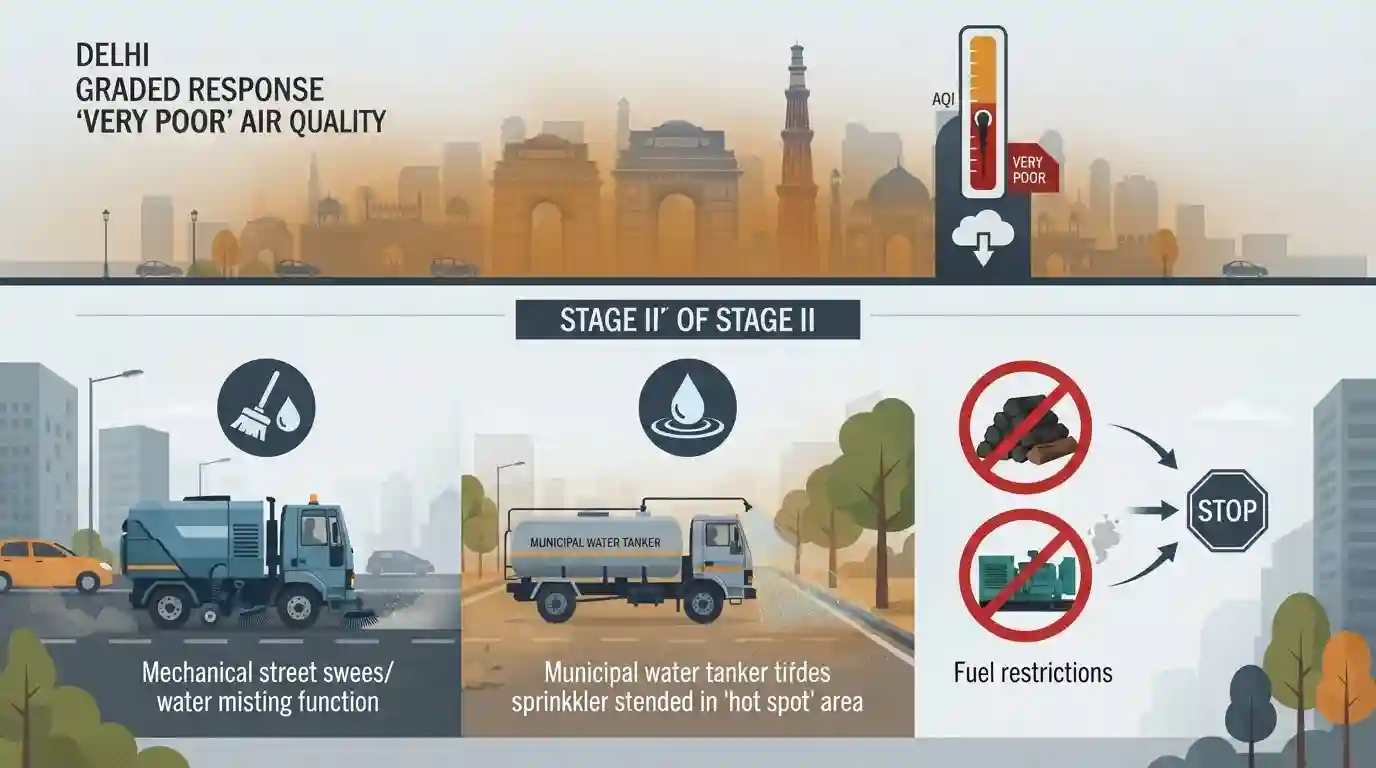
With Delhi's Air Quality Index (AQI) falling into the 'very poor' category, pollution control authorities invoked Stage II of the Graded Response Action Plan (GRAP). The measures entail intensive mechanized sweeping, water sprinkling on identified hot spots, and restrictions on polluting fuels and diesel generators to prevent further deterioration of air quality in the National Capital Region.
Key Points
- Delhi's Air Quality Index (AQI) dropped into the 'very poor' category, triggering the implementation of Graded Response Action Plan (GRAP) Stage II curbs.
- GRAP Stage II imposes stricter restrictions, including enhanced mechanized sweeping, water sprinkling on roads, bans on coal and firewood in eateries, and targeted actions to control diesel generator sets and dust.
- The Commission for Air Quality Management (CAQM) oversees the enforcement of GRAP measures across the National Capital Region to combat seasonal spikes in air pollution.
Important Terms
Graded Response Action Plan (GRAP)

A set of emergency measures implemented in stages based on air quality index levels to combat air pollution in the Delhi-National Capital Region.
UPSC context
GS Paper III (Environmental Pollution and Degradation). Tests understanding of institutional mechanisms and emergency response strategies for urban air quality management.
Commission for Air Quality Management (CAQM)
A statutory body established to coordinate, monitor, and plan for air quality management in the National Capital Region and adjoining areas.
UPSC context
GS Paper III (Environment/Pollution). Tests knowledge of statutory regulatory bodies, environmental governance frameworks, and inter-state coordination in India.
Prelims Trap
judicial body or Supreme Court-mandated committee
Aspirants often confuse CAQM as a judicial or court-appointed body, whereas it is a statutory body established under an Act of Parliament in 2021.
Static Concepts Connected
What is the Commission for Air Quality Management (CAQM) and its statutory backing?
- Statutory Status: Statutory Status: Established under the Commission for Air Quality Management in National Capital Region and Adjoining Areas Act, 2021.
- Jurisdiction: Jurisdiction: Supersedes previous bodies like the EPCA and exercises jurisdiction over NCR and adjoining areas in Punjab, Haryana, Rajasthan, and UP.
- Executive Powers: Powers: Empowered to issue directions, entertain complaints, set emission standards, and coordinate research on air quality.
Cross-Topic Patterns
CAQM Statutory Framework and Federalism
Air quality management in the NCR relies on the statutory Commission for Air Quality Management (CAQM), replacing older ad-hoc judicial committees, linking environmental federalism with executive accountability.
GRAP Enforcement versus Industrial Economics
Emergency pollution protocols like GRAP trigger economic trade-offs, such as restrictions on diesel generators and construction, directly impacting industrial productivity and MSMEs in the NCR.

CAQM statutory powers and GRAP stages (I-IV AQI thresholds) are prime candidates for a matching-list prelims question.
Linked PYQs · 3
Linked PYQs · 3
- 2022PrelimsGS1
In the context of WHO Air Quality Guidelines, consider the following statements: 1. The 24-hour mean of PM2.5 should not exceed 15 µg/m³ and annual mean of PM2.5 should not exceed 5 µg/m³. 2. In a year, the highest levels of ozone pollution occur during the periods of inclement weather. 3. PM10 can penetrate the lung barrier and enter the bloodstream. 4. Excessive ozone in the air can trigger asthma. Which of the statements given above are correct?
- 2025PrelimsGS1
Artificial way of causing rainfall to reduce air pollution makes use of
- 2020MainsGS3
What are the key features of the National Clean Air Programme (NCAP) initiated by the Government of India?
