Delhi High Court sets aside stay on race club eviction
Source:Indian Express ↗
Why It Matters
The case highlights the statutory mechanisms available to the government (via the Public Premises Act) for eviction of unauthorised occupants from public land, and the role of judicial review in assessing the legality of such administrative actions and jurisdictional claims.
Summary
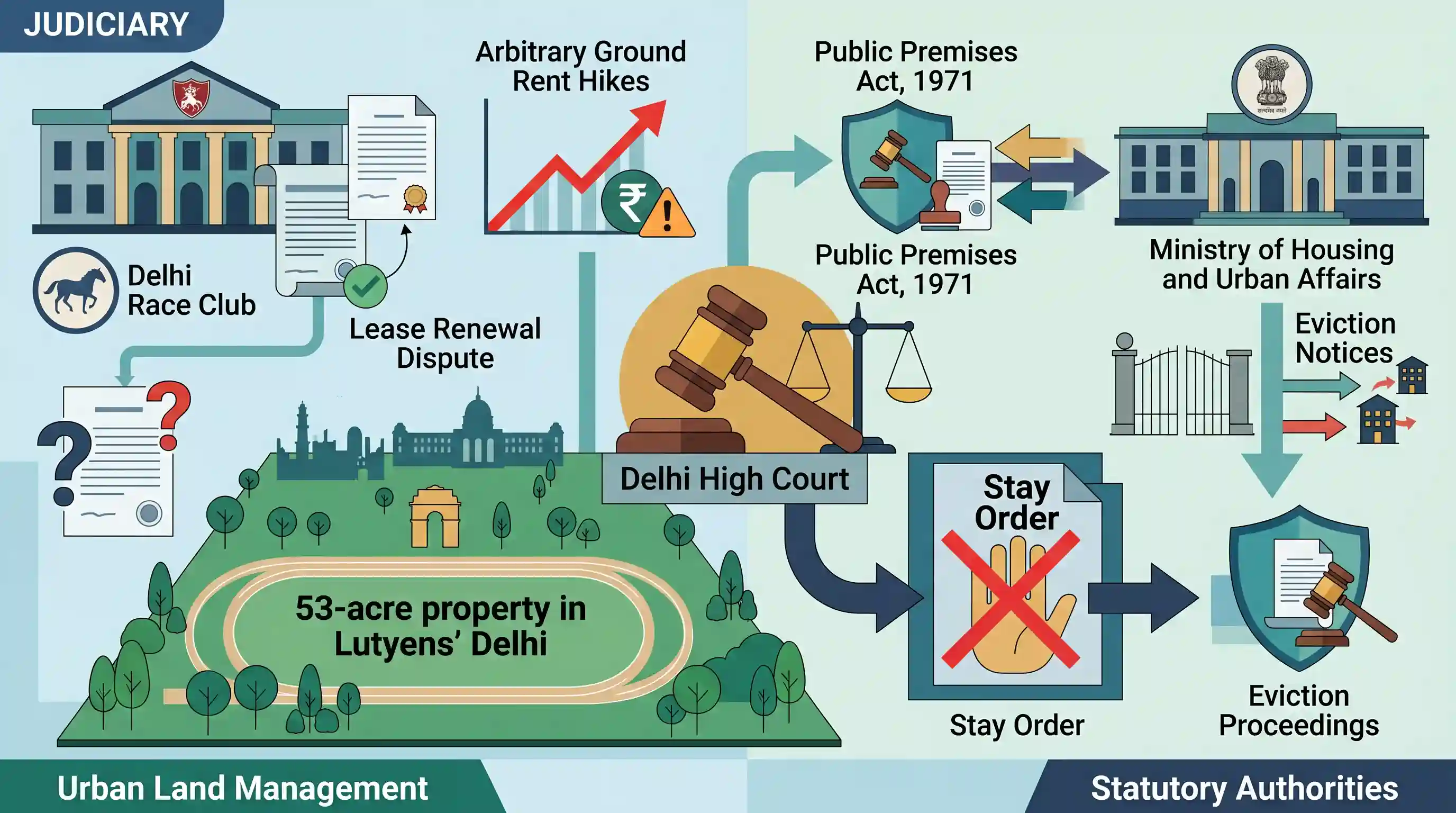
The Delhi High Court set aside a previous stay order on eviction proceedings initiated by the Ministry of Housing and Urban Affairs against the Delhi Race Club. The eviction notices were issued under the Public Premises Act, 1971, which the Club argues is inapplicable, contending its lease is valid. The dispute centers on lease renewal, arbitrary ground rent hikes, and definitions of 'public premises' regarding the 53-acre prime property in Lutyens' Delhi.
Key Points
- A division bench of the Delhi High Court overturned a single judge's stay on the eviction proceedings against the Delhi Race Club initiated by the MoHUA.
- The Centre issued a show-cause notice under Section 4 of the Public Premises (Eviction of Unauthorised Occupants) Act, 1971, declaring the Club in unauthorised occupation post lease expiry.
- The Club contends that the leased property does not meet the definition of 'public premises' under the Act, and that its lease is valid until 2038.
- The legal dispute underlines friction in urban land management, leasehold rights, and statutory powers of the Estate Officer in ordering eviction from government land.
Important Terms
Public Premises (Eviction of Unauthorised Occupants) Act, 1971

A special central legislation providing for the speedy eviction of unauthorized occupants from government-owned or controlled lands and buildings, overriding general rent control laws to ensure public welfare.
UPSC context
GS Paper 2 (Governance/Statutory Bodies) — tests understanding of administrative laws and the State's power to manage public assets.
Ministry of Housing and Urban Affairs (MoHUA)
A central government ministry responsible for urban policy, housing development, and the management of government estates and land in cities across India.
UPSC context
GS Paper 2 (Government Policies) — crucial for questions on urbanization, smart cities, and administrative interventions in urban land.
Estate Officer
A gazetted officer appointed under the Public Premises Act with quasi-judicial powers to conduct inquiries, issue show-cause notices, and order the eviction of unauthorized occupants.
UPSC context
GS Paper 2 (Administrative Law) — highlights the delegation of judicial powers to executive officials for administrative efficiency.
Lutyens' Bungalow Zone (LBZ)
A highly regulated, 2,800-acre heritage and administrative zone in New Delhi containing colonial-era bungalows, government offices, and VVIP residences, protected by strict architectural guidelines.
UPSC context
GS Paper 1 (Urbanization) / Paper 3 (Land Reform) — involves heritage conservation, high-value land management, and urban planning challenges.
Delhi Race Club
A century-old premier racing institution in Lutyens' Delhi, currently involved in a legal dispute with the Centre over lease renewal and occupation of 53 acres of prime land.
UPSC context
GS Paper 2 (Judiciary) — serves as a case study for leasehold disputes, "holding over" tenants, and judicial review of administrative actions.
Prelims Trap
Orders of the Estate Officer under the Public Premises Act are final and immune from judicial review.
While the Act bars the jurisdiction of ordinary civil courts, Estate Officers are quasi-judicial authorities whose orders are absolutely subject to the writ jurisdiction of Constitutional Courts.
Static Concepts Connected
What constitutes 'Public Premises' under the 1971 Act?
- Central Government Land: Any premises belonging to, taken on lease by, or requisitioned on behalf of the Central Government.
- Statutory Bodies & CPSEs: Includes properties belonging to Central Public Sector Enterprises (CPSEs), major Port Trusts, and central Universities.
- Union Territory Properties: Encompasses properties owned by the administration of Union Territories, including the National Capital Territory of Delhi.
What makes an Estate Officer a quasi-judicial authority?
- Statutory Powers: Derives authority from the Public Premises Act to issue show-cause notices and legally determine 'unauthorized occupation'.
- Natural Justice Mandate: Bound by principles of natural justice to hear the affected party and evaluate evidence before passing eviction or penalty orders.
- Alternate Dispute Resolution: Functions as a specialized alternative mechanism to bypass lengthy civil court trials for speedy state action.
Cross-Topic Patterns
Statutory Officers & Writ Jurisdiction
Eviction drives highlight the tension between statutory bodies expediting state action (bypassing civil courts) and the constitutional right to judicial review via High Court writs under Article 226.
Urban Land Management & MoHUA
Governance of prime urban land regularly intersects with the Land and Development Office (L&DO) under MoHUA, linking leasehold disputes to broader urban planning and municipal finance themes in Mains GS2/GS3.

Expect Prelims statements testing the expansive definition of 'Public Premises' and the quasi-judicial powers of Estate Officers in 2026.
Linked PYQs · 2
Linked PYQs · 2
- 2025MainsGS2
Comment on the need of administrative tribunals as compared to the court system. Assess the impact of the recent tribunal reforms through rationalization of tribunals made in 2021.
- 2019MainsGS2
“The Central Administrative Tribunal which was established for redressal of grievances and complaints by or against central government employees, nowadays is exercising its powers as an independent judicial authority.” Explain.
