Supreme Court Hearing on Delhi Protests and Detentions
Source:Indian Express ↗
Why It Matters
This case touches upon the core constitutional tensions between state police powers, public order management, and the protection of fundamental freedoms like the right to assemble and personal liberty.
Summary
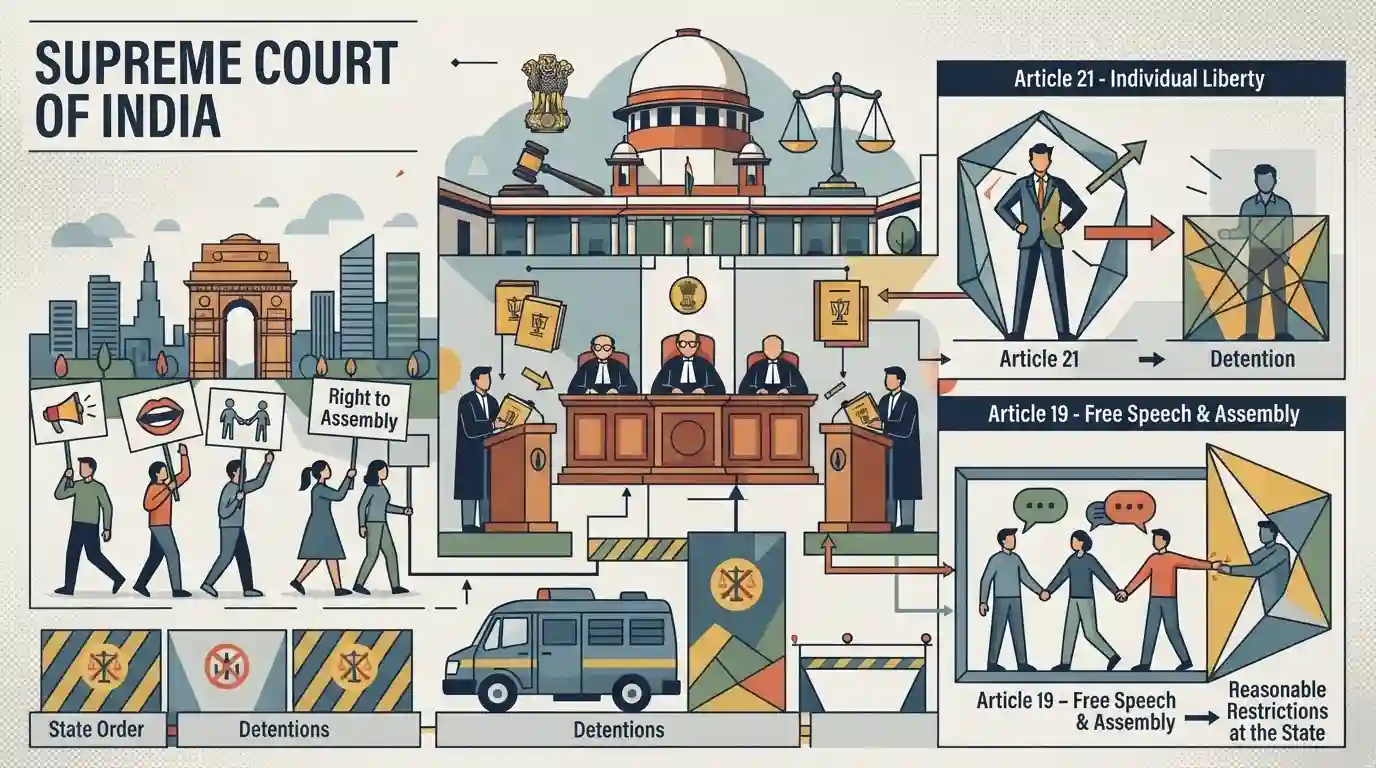
The Supreme Court of India is hearing legal proceedings and petitions concerning detentions related to civil protests in Delhi. The case highlights key constitutional questions surrounding the limits of the right to free speech and assembly, individual liberty under Article 21, and the extent of state executive powers in handling public order.
Key Points
- The Supreme Court of India hears petitions and legal challenges related to detentions and actions arising from protests in New Delhi.
- The balance between the fundamental right to protest (Article 19) and maintenance of public order and state security is a central legal theme.
- Judicial scrutiny of police detentions, preventive custody laws, and adherence to due process of law come into sharp focus during civil unrest cases.
Important Terms
Supreme Court of India

The apex judicial body of India, serving as the final interpreter of the Constitution, protector of fundamental rights, and highest court of appeal with original, appellate, and advisory jurisdictions.
UPSC context
UPSC GS Paper II: Indian Constitution — structure, powers, and functioning of organs, judicial review, and enforcement of fundamental rights under Article 32.
Prelims Trap
fundamental right to protest freely anywhere
Aspirants often assume Article 19 includes an absolute right to strike or block roads. The Constitution only guarantees peaceable assembly without arms, which is subject to strict reasonable restrictions.
Static Concepts Connected
What are the constitutional grounds for imposing reasonable restrictions on Article 19(1)(a) and (1)(b)?
- Constitutional Basis: Sovereignty and Integrity: Added by the 16th Constitutional Amendment Act, 1963, to protect India's territorial integrity.
- Public Order: Public Order: Included as a specific ground following the Supreme Court's ruling in Romesh Thappar v. State of Madras (1950).
- Proportionality Test: Proportionality: Restrictions must be the least restrictive measure necessary to achieve the legitimate state objective.
Cross-Topic Patterns
Protest Rights and Preventive Detention Jurisprudence
State detentions during civil unrest test the delicate balance between Article 19 freedoms and internal security, intersecting with the Unlawful Activities Prevention Act (UAPA) and preventive custody jurisprudence.
Judicial Activism vs Executive Public Order Powers
Judicial review of police actions during public protests directly impacts India's global democratic rankings and civil liberties evaluations under international human rights frameworks.

Expect a conceptual Statement-I and Statement-II question linking Article 19(2) reasonable restrictions directly to preventive custody standards.
Linked PYQs · 2
Linked PYQs · 2
- 2022MainsGS2
“Right of movement and residence throughout the territory of India are freely available to the Indian citizens, but these rights are not absolute.” Comment.
- 2024MainsGS2
Right to privacy is intrinsic to life and personal liberty and is inherently protected under Article 21 of the constitution. Explain. In this reference discuss the law relating to D.N.A. testing of child in the womb to establish its paternity.
