Preventive Detention Laws and Constitutional Safeguards in India
Source:The Hindu ↗
Why It Matters
Preventive detention is a critical intersection of state police powers, national security, and individual liberty under Article 21 and Article 22. Understanding its legal limits is vital for evaluating democratic governance and civil liberties in India.
Summary
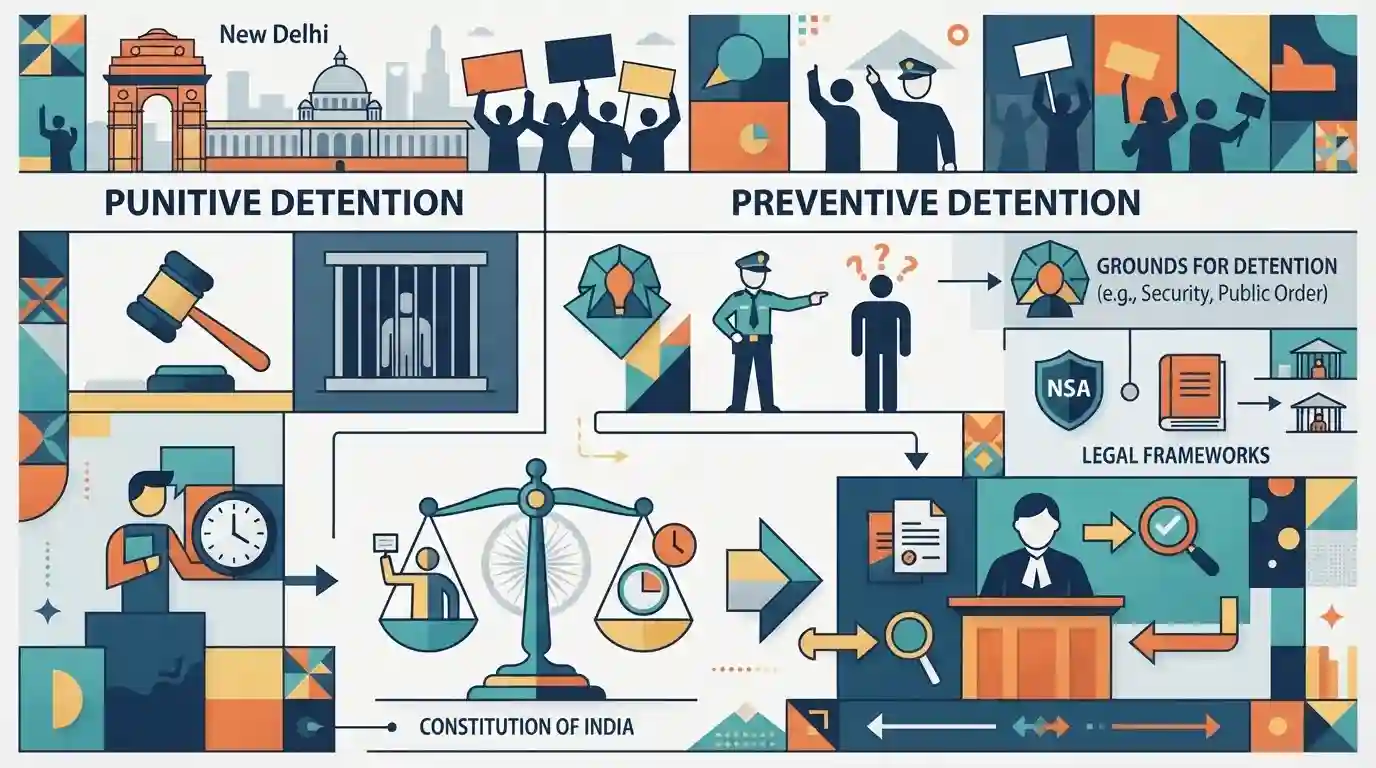
The article explains the legal provisions, constitutional safeguards, and judicial checks surrounding preventive detention in India, in the context of protests and detentions in New Delhi. It breaks down the distinction between punitive and preventive detention under Article 22 of the Constitution and statutory frameworks like the National Security Act.
Key Points
- Preventive detention involves detaining a person to prevent them from committing a future crime or acting in a manner prejudicial to state security, public order, or maintenance of supplies, rather than punishing a past crime.
- Article 22 of the Indian Constitution provides procedural safeguards for preventive detention, though these are much narrower than those for punitive detention.
- Supreme Court guidelines repeatedly emphasize that preventive detention is an exceptional power and must be exercised with extreme caution to protect personal liberty under Article 21.
- Protests and public demonstrations often test the balance between maintaining public order and safeguarding democratic rights to dissent.
Static Concepts Connected
What are the constitutional safeguards and limitations under Article 22 regarding preventive detention?
- Advisory Board: Max 3-month limit without review by an Advisory Board consisting of persons qualified to be High Court judges.
- Grounds Communication: The grounds of detention must be communicated to the detainee as soon as possible, though disclosure can be withheld if against public interest.
- Right to Represent: The detainee must be afforded the earliest opportunity of making a representation against the detention order.
Cross-Topic Patterns
Preventive Detention vs. Freedom of Speech
Preventive detention laws like the NSA are frequently invoked during civil unrest, creating tension between the state's police powers and Article 19 freedoms.
Colonial Legacies in Modern Criminal Jurisprudence
The colonial legacy of preventive detention statutes links modern executive powers directly to the Rowlatt Act and pre-independence security measures.

Article 22 safeguards and the 3-month Advisory Board limit under preventive detention will be tested in a multi-statement Prelims MCQs.
Linked PYQs · 1
Linked PYQs · 1
- 2023PrelimsGS1
Consider the following statements: 1. According to the Constitution of India, the Central Government has a duty to protect States from internal disturbances. 2. The Constitution of India exempts the States from providing legal counsel to a person being held for preventive detention. 3. According to the Prevention of Terrorism Act, 2002, confession of the accused before the police cannot be used as evidence. How many of the above statements are correct?
