Legal Framework and Constitutional Safeguards of Detention
Source:The Hindu ↗
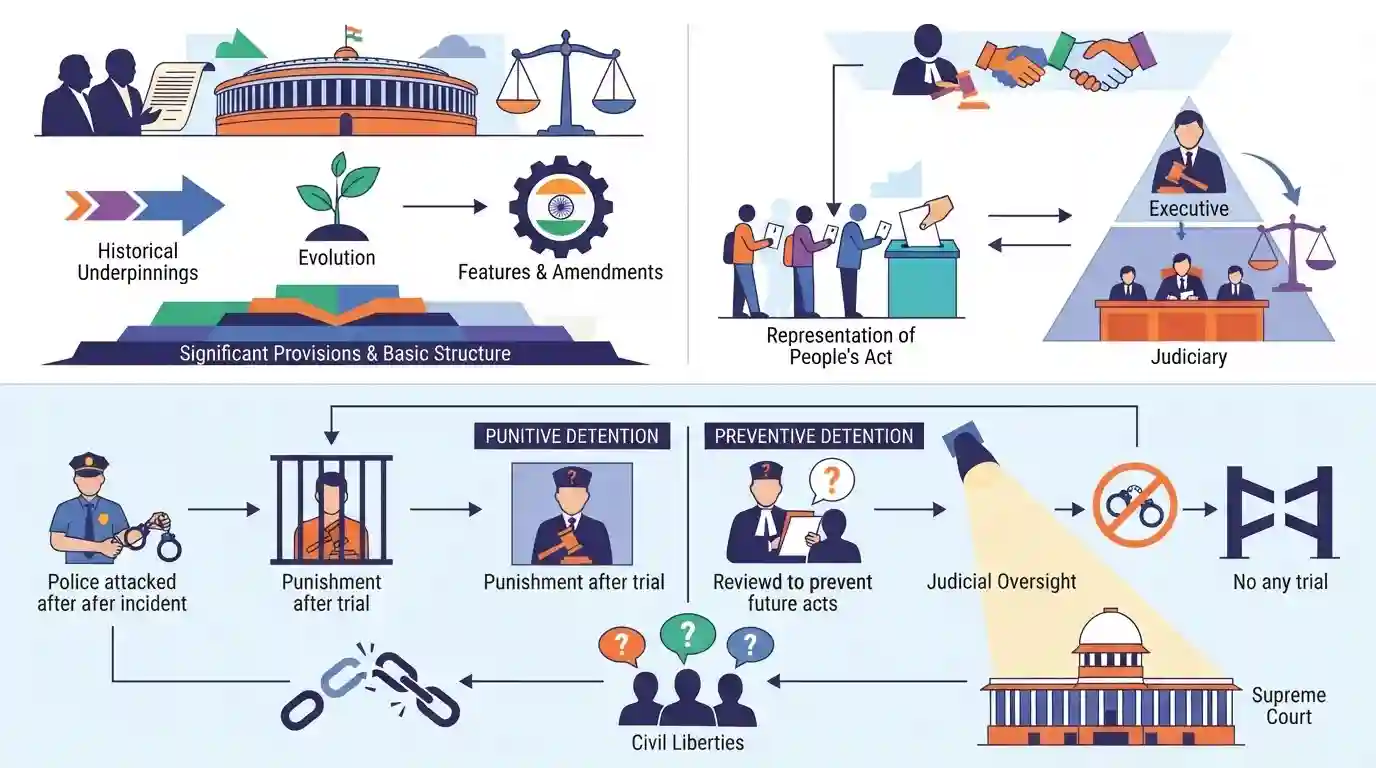
কেন এটি গুরুত্বপূর্ণ
Preventive detention is a recurring theme in Indian polity and governance, directly engaging questions on the balance between national security/public order and individual fundamental liberties under Articles 21 and 22.
সারসংক্ষেপ
An analysis of the legal provisions, constitutional framework, and judicial oversight surrounding preventive detention in India, triggered by protests in Delhi. The article outlines how preventive detention differs from punitive detention, detailing the checks, limitations, and civil liberty concerns under Indian law.
মূল বিষয়
- Preventive detention allows the state to detain individuals without trial to prevent them from committing future crimes or disrupting public order.
- Article 22 of the Indian Constitution provides constitutional safeguards regarding preventive detention, though critics argue these safeguards are weaker compared to punitive detention.
- Protests and political demonstrations often trigger administrative use of preventive detention under police laws to maintain law and order, leading to judicial scrutiny over civil liberties.
- The balance between maintaining state security, public order, and safeguarding fundamental rights of personal liberty (Article 21) remains a critical governance debate in India.
গুরুত্বপূর্ণ শব্দ
Article 22 of the Constitution

A constitutional provision that guarantees safeguards against arbitrary arrest and detention, while explicitly authorizing laws providing for preventive detention subject to specified procedural checks and Advisory Board reviews.
UPSC context
UPSC GS Paper II: Indian Constitution—Significant Provisions, Fundamental Rights, and checks against arbitrary executive actions.
Bharatiya Nagarik Suraksha Sanhita (BNSS)
The updated criminal procedure code replacing the CrPC, containing statutory provisions like Section 170 that empower police to execute preventive arrests without a warrant to stop cognizable offenses.
UPSC context
UPSC GS Paper II: Structure, Organization, and Functioning of the Executive and Judiciary; criminal justice reforms.
National Security Act (NSA)
A stringent statute empowering central and state governments to detain individuals without trial for up to 12 months (or more) to prevent actions prejudicial to national security or public order.
UPSC context
UPSC GS Paper II: Statutory provisions, executive powers, and balancing state security with fundamental rights.
প্রিলিমস ফাঁদ
Article 22 provides identical constitutional safeguards and procedural protections to individuals subjected to both preventive and punitive detention.
Aspirants often assume Article 22 provides equal procedural safeguards for both preventive and punitive detention, missing the fact that preventive detainees have fewer rights (e.g., no immediate right to be produced before a magistrate within 24 hours).
সংযুক্ত স্থির ধারণা
What are the constitutional safeguards and limitations under Article 22 of the Indian Constitution regarding preventive detention?
- Advisory Board Review: Maximum period: A person cannot be detained for more than three months unless an Advisory Board recommends extended detention.
- Communication of Grounds: Grounds of detention: The detaining authority must communicate the grounds of detention to the detainee as soon as possible, subject to public interest exceptions.
- Opportunity to Represent: Right to representation: The detained person must be afforded the earliest opportunity to make a representation against the detention order.
আন্তঃবিষয় প্যাটার্ন
Preventive Detention vs. Fundamental Freedoms
Preventive detention powers used during political protests intersect with police powers under CrPC/BNSS and fundamental rights under Articles 19 and 21.
Administrative Discretion and Judicial Review
The judicial review threshold for executive subjective satisfaction in detentions bridges administrative law principles with constitutional writ jurisdiction.

Preventive detention safeguards under Article 22 vs Article 21 will likely feature as a statement-based polity question.
সংযুক্ত PYQ · 2
সংযুক্ত PYQ · 2
- 2023PrelimsGS1
Consider the following statements: 1. According to the Constitution of India, the Central Government has a duty to protect States from internal disturbances. 2. The Constitution of India exempts the States from providing legal counsel to a person being held for preventive detention. 3. According to the Prevention of Terrorism Act, 2002, confession of the accused before the police cannot be used as evidence. How many of the above statements are correct?
- 2021PrelimsGS1
'Right to Privacy' is protected under which Article of the Constitution of India?
