Supreme Court Directives on Toll Suspension to Curb Delhi Smog
Source:Indian Express ↗
Why It Matters
The article provides an excellent case study of the complex, multi-stakeholder challenges involved in managing urban air pollution. It highlights the tension between judicial intervention and executive policymaking (e.g., school closures vs. mid-day meals), inter-agency coordination (MCD vs. NHAI), and the economic impacts of environmental regulations (toll revenue loss, impounding EOL vehicles). These themes are directly relevant to GS-2 (Governance) and GS-3 (Environment) mains answers.
Summary
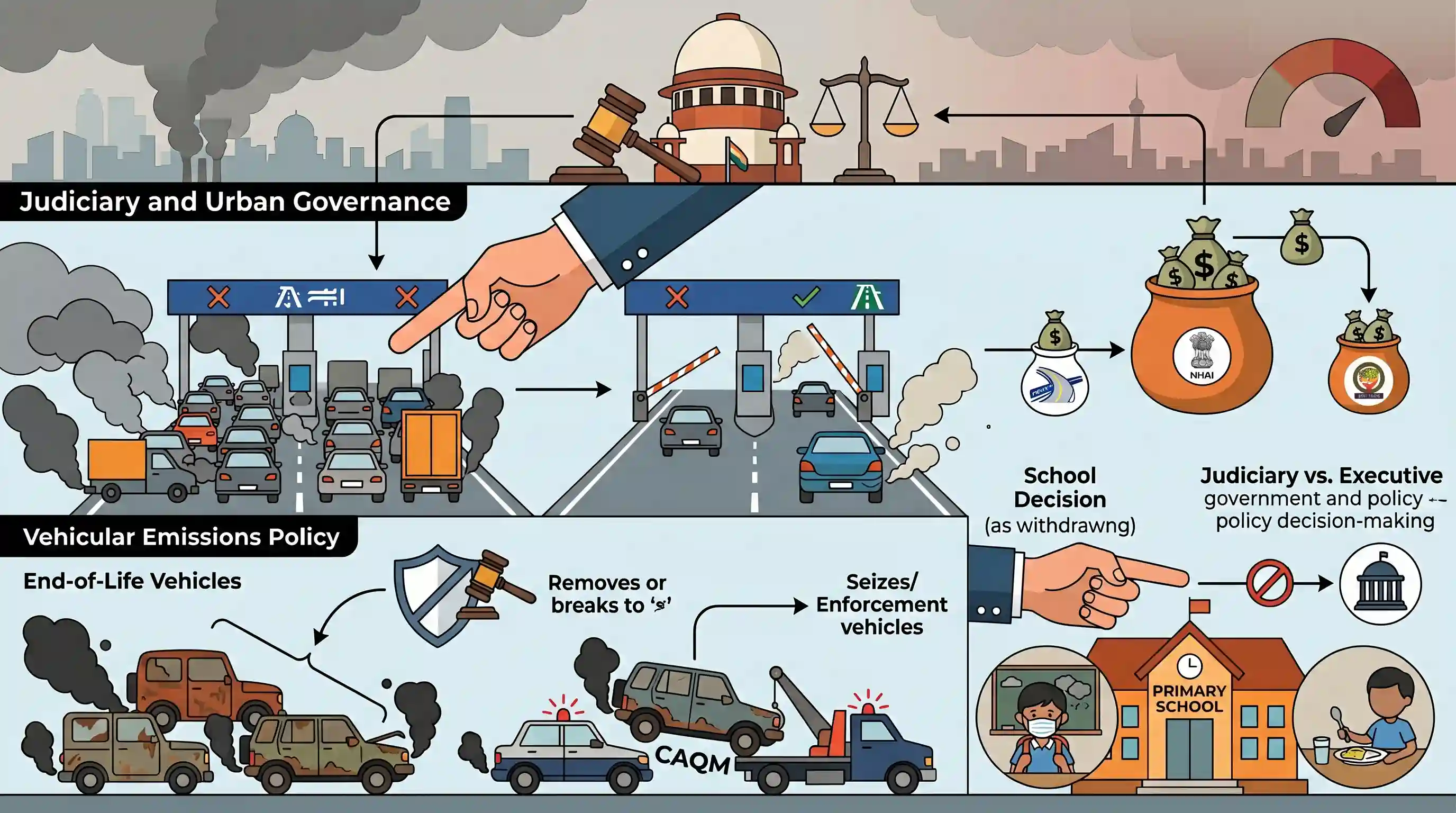
The Supreme Court has intervened to mitigate Delhi's severe air pollution by asking the Municipal Corporation of Delhi (MCD) to explore the temporary suspension of toll booths, aiming to reduce traffic congestion and vehicular emissions. Acknowledging the financial impact, the Court proposed a revenue-sharing arrangement with the NHAI to compensate the MCD. In a strict move against vehicular pollution, the Court ended the protection previously granted to end-of-life (EOL) vehicles, allowing enforcement agencies to take coercive action against older, polluting vehicles in the Delhi-NCR area based on CAQM recommendations. Conversely, the bench declined to interfere with the Delhi government's decision regarding the closure of primary schools, emphasizing that balancing the health risks of pollution with the nutritional benefits of mid-day meals is a domain of executive policy.
Key Points
- The Supreme Court directed the MCD to consider temporarily suspending toll plazas to minimize traffic bottlenecks and lower vehicular emissions in Delhi.
- To address potential revenue shortfalls for the MCD, the Court suggested that the NHAI divert a portion of its toll collections to the civic body.
- The Court revoked its earlier protection against coercive action for end-of-life (EOL) vehicles, clearing the way for authorities to act against polluting BS-III petrol and BS-IV diesel vehicles in the NCR.
- Refusing to dictate school closures, the Court deemed the Delhi government's suspension of physical classes for primary students a policy matter, noting the trade-off between pollution exposure and access to mid-day meals.
Important Terms
Commission for Air Quality Management (CAQM)

Statutory body established under the CAQM in NCR and Adjoining Areas Act, 2021, to coordinate and implement measures for controlling air pollution in Delhi-NCR and neighboring states.
UPSC context
GS Paper II & III; tests institutional frameworks for pollution control and federal coordination in the National Capital Region.
Bharat Stage (BS) emission standards
Legally enforced vehicular pollution norms instituted by the CPCB to regulate air pollutants from internal combustion engines, currently at BS-VI (Euro-equivalent) standards nationwide since 2020.
UPSC context
GS Paper III (Environment); tests understanding of environmental regulations, the BS-IV to BS-VI transition, and vehicular emission control policies.
National Highways Authority of India (NHAI)
Autonomous statutory agency under the NHAI Act, 1988, responsible for the development, maintenance, and management of India’s national highways and expressways network.
UPSC context
GS Paper III (Infrastructure); relevant for questions on statutory bodies and infrastructure financing models.
Municipal Corporation of Delhi (MCD)
Statutory urban local body established by Parliament (1958) and reunified in 2022 to provide civic services and manage municipal infrastructure in the national capital.
UPSC context
GS Paper II (Local Governance); tests knowledge of the 74th Amendment and the unique administrative challenges of urban governance in Delhi.
Supreme Court of India
Apex judicial body of India which proactively interprets Article 21 (Right to Life) to include the right to a clean environment, often using PILs to direct executive action.
UPSC context
GS Paper II (Judiciary); tests knowledge of judicial activism, separation of powers, and environmental jurisprudence.
Delhi Government
The executive administration of the National Capital Territory, operating under Article 239AA, which manages state subjects while frequently navigating jurisdictional overlaps with central authorities.
UPSC context
GS Paper II (Federalism); concerns the special constitutional status of NCT Delhi and power-sharing between the Center and the UT.
Prelims Trap
"CAQM is a statutory body constituted under the Environment (Protection) Act, 1986."
CAQM is not under the EPA 1986. It is a distinct statutory body established under the CAQM in National Capital Region and Adjoining Areas Act, 2021.
Static Concepts Connected
What are the key powers and jurisdiction of the CAQM?
- Jurisdiction: Covers Delhi, Haryana, Punjab, Rajasthan, and Uttar Pradesh specifically for air quality management and coordinating interventions.
- Overriding Powers: Its directions prevail over those of the Central Pollution Control Board (CPCB) and respective State Pollution Control Boards in cases of conflict.
- Enforcement: Empowered to impose environmental compensation, restrict industries, and order the closure of polluting units or suspension of utility services.
What are the primary sources of revenue for Municipal Corporations (ULBs)?
- Tax Revenue: Direct collections like property tax, professional tax, tolls, and advertisement tax form the core autonomous revenue base.
- Non-Tax Revenue: User charges for sanitation/water, building permission fees, and rents from municipal properties.
- Devolution & Grants: Transfers recommended by the State Finance Commission, along with tied/untied grants from the Central Finance Commission.
Cross-Topic Patterns
Pollution Control vs. Nutritional Security
Closing schools to limit smog exposure inadvertently disrupts the Mid-Day Meal Scheme (PM POSHAN). This highlights a complex policy trade-off between securing immediate respiratory health and maintaining vulnerable children's nutritional security.
Judicial Restraint in Executive Policy
The SC's refusal to dictate school closures demonstrates judicial restraint. It underscores the principle of separation of powers, acknowledging that weighing multifaceted socio-economic impacts is strictly an executive domain.

Expect a 2026 Prelims question testing CAQM's overriding powers over State boards combined with criteria for the Vehicle Scrappage Policy.
Linked PYQs · 4
Linked PYQs · 4
- 2021MainsGS3
Describe the key points of the revised Global Air Quality Guidelines (AQGs) recently released by the World Health Organisation (WHO). How are these different from its last update in 2005? What changes in India's National Clean Air Programme are required to achieve these revised standards?
- 2018PrelimsGS1
How is the National Green Tribunal (NGT) different from the Central Pollution Control Board (CPCB)? 1. The NGT has been established by an Act whereas the CPCB has been created by an executive order of the Government. 2. The NGT provides environmental justice and helps reduce the burden of litigation in the higher courts whereas the CPCB promotes cleanliness of streams and wells, and aims to improve the quality of air in the country. Which of the statements given above is/are correct?
- 2018MainsGS2
“Policy contradictions among various competing sectors and stakeholders have resulted in inadequate 'protection and prevention of degradation' to environment.” Comment with relevant illustrations.
- 2024MainsGS2
Explain the reasons for the growth of public interest litigation in India. As a result of it, has the Indian Supreme Court emerged as the world's most powerful judiciary ?
