Road Dust Emerges as Major Urban Air Pollution Threat in Delhi
Source:Indian Express ↗
Why It Matters
Urban air pollution is a persistent UPSC theme. Understanding the specific contribution of road dust versus other sources (like agriculture or industry) helps in writing nuanced GS3 answers on environmental policies (like NCAP) and evaluating the practical challenges of urban governance.
Summary
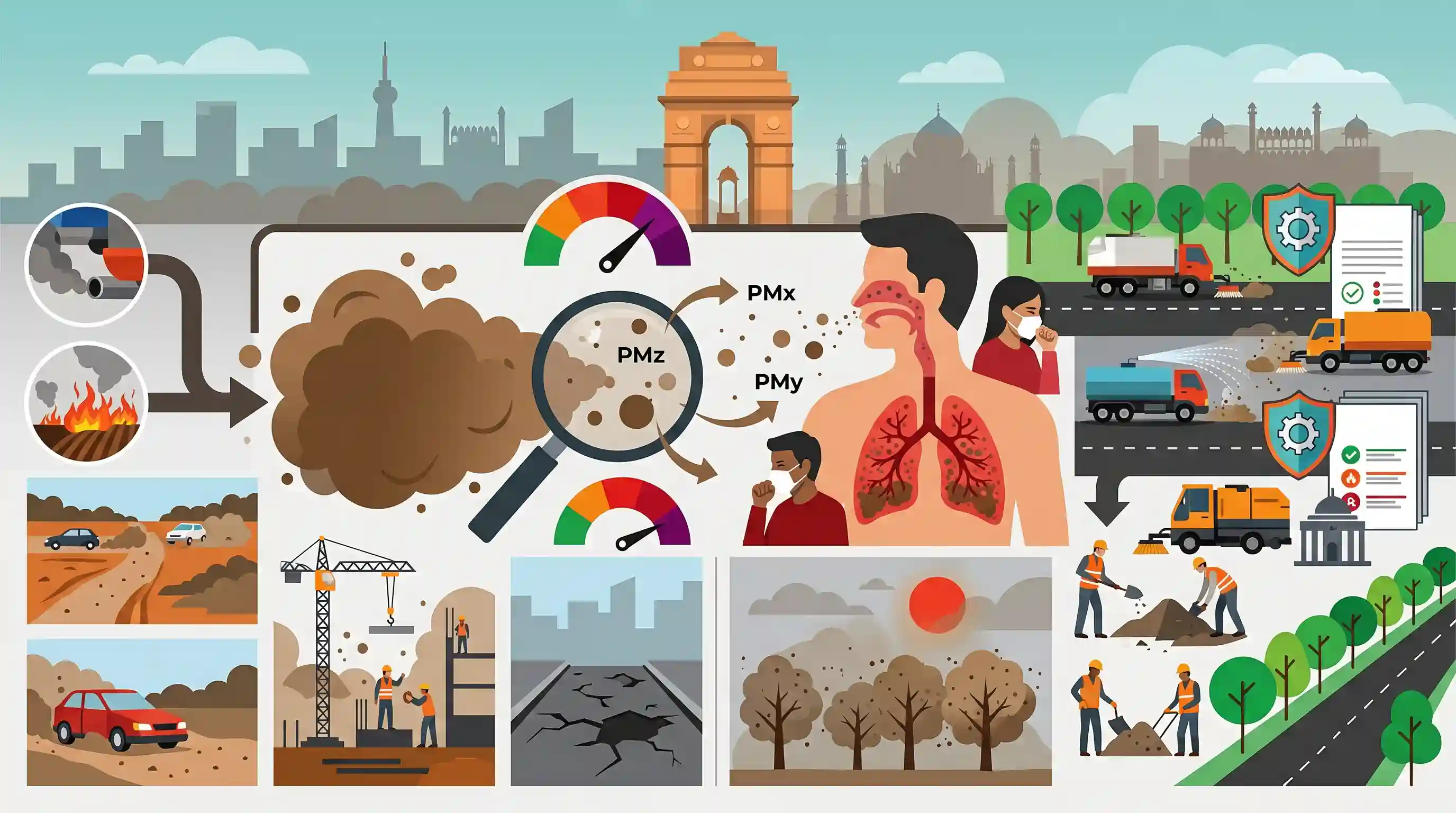
The article highlights the growing menace of road dust as a primary source of air pollution in Delhi. Shifting the focus from traditional culprits like stubble burning and vehicular emissions, it identifies unpaved roads, construction activities, and poor infrastructure maintenance as key drivers of suspended particulate matter (PM10 and PM2.5). This structural urban challenge worsens the Air Quality Index (AQI) and poses severe health risks, demanding targeted interventions under frameworks like the National Clean Air Programme (NCAP) and Graded Response Action Plan (GRAP).
Key Points
- Road dust is emerging as one of the most significant contributors to Delhi's air pollution, notably driving up PM10 and PM2.5 particulate matter levels.
- While winter pollution discussions often focus on stubble burning and vehicular emissions, road dust from unpaved surfaces, poor road conditions, and construction is a persistent year-round threat.
- Particulate matter from road dust can penetrate respiratory systems, causing severe health hazards, often resulting in violations of the WHO Air Quality Guidelines.
- Mitigation requires stringent urban planning measures, including mechanical sweeping, water sprinkling, paving unpaved roads, and enforcing strict dust control at construction sites as mandated under GRAP and NCAP.
Important Terms
National Clean Air Programme (NCAP)

Launched by MoEFCC in 2019, it is India's first national framework for time-bound air pollution reduction. It targets a 40% reduction in particulate matter concentrations by 2026 across 131 "non-attainment" cities.
UPSC context
GS III: Environment & Pollution. Tests knowledge of national pollution mitigation strategies, urban health policies, and time-bound environmental targets in India.
Graded Response Action Plan (GRAP)
An emergency response framework for Delhi-NCR that activates specific restrictions (like construction bans or vehicle curbs) based on Air Quality Index (AQI) thresholds. It is currently implemented by the Commission for Air Quality Management (CAQM).
UPSC context
GS III: Environment. Evaluates understanding of emergency urban management, regulatory frameworks (CAQM), and specific measures used to handle seasonal air crises.
Central Pollution Control Board (CPCB)
A statutory body under the Ministry of Environment, established in 1974, responsible for coordinating pollution control activities, setting environmental standards, and monitoring air and water quality nationwide.
UPSC context
GS II: Statutory Bodies. Tests understanding of the powers, functions, and legislative basis of India's apex environmental regulator and center-state coordination.
World Health Organization (WHO)
The UN specialized agency for public health that sets Global Air Quality Guidelines. These non-binding recommendations serve as benchmarks for protecting human health from particulate matter and gaseous pollutants.
UPSC context
GS II/III: International Organizations & Environment. Tests awareness of global health benchmarks versus national standards and the public health impact of pollutants.
Prelims Trap
Road dust is the single largest contributor to PM2.5 pollution in Delhi-NCR during the dry seasons.
Source apportionment studies show road dust dominates the coarser PM10 fraction, whereas combustion sources like vehicular emissions and stubble burning dominate the finer PM2.5 fraction.
Static Concepts Connected
What are the key parameters of the National Clean Air Programme (NCAP)?
- Revised Target: Aims for a 40% reduction in PM2.5 and PM10 concentrations by 2025-26, using 2017 as the base year.
- Scope: Focuses on 131 'non-attainment cities' that consistently failed to meet National Ambient Air Quality Standards (NAAQS) for 5 years.
- Monitoring via PRANA: City-specific implementation, progress, and fund disbursement are tracked via the PRANA portal.
How does PM10 differ from PM2.5 in its primary emission sources?
- PM10 Sources: Largely mechanical and crustal in origin, predominantly driven by road dust, construction activities, and windblown soil.
- PM2.5 Sources: Primarily originates from combustion processes, including vehicular exhaust, biomass/stubble burning, and industrial emissions.
Cross-Topic Patterns
Municipal Governance vs. Pollution
Identifying road dust as the primary PM10 source shifts accountability from rural farmers (stubble burning) to urban local bodies for basic infrastructure maintenance and GRAP enforcement.
Artificial Rain and PM mitigation
Using cloud seeding (silver iodide) as an emergency measure to wash down suspended road dust links urban environmental crisis management directly with applied atmospheric physics in GS3.

PM10 vs PM2.5 source apportionment (dust vs combustion) and NCAP's revised 2026 targets are prime candidates for a 2026 Prelims MCQ.
Linked PYQs · 3
Linked PYQs · 3
- 2022PrelimsGS1
In the context of WHO Air Quality Guidelines, consider the following statements: 1. The 24-hour mean of PM2.5 should not exceed 15 µg/m³ and annual mean of PM2.5 should not exceed 5 µg/m³. 2. In a year, the highest levels of ozone pollution occur during the periods of inclement weather. 3. PM10 can penetrate the lung barrier and enter the bloodstream. 4. Excessive ozone in the air can trigger asthma. Which of the statements given above are correct?
- 2025PrelimsGS1
Artificial way of causing rainfall to reduce air pollution makes use of
- 2020MainsGS3
What are the key features of the National Clean Air Programme (NCAP) initiated by the Government of India?
