Internal Security Priorities and Organised Crime Countermeasures
Source:The Hindu ↗
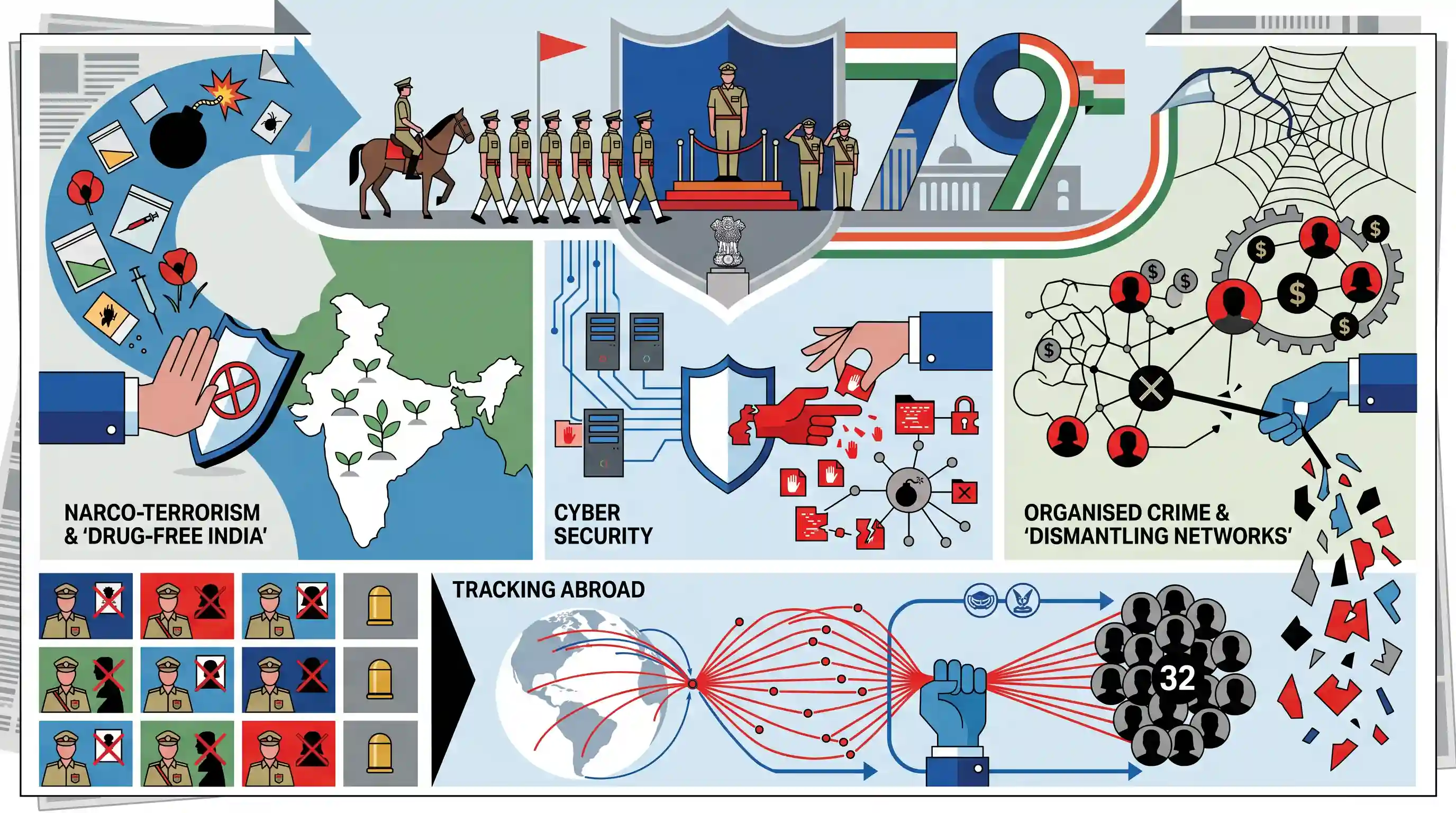
Why It Matters
The priorities outlined by the Delhi Police align perfectly with GS3 Internal Security topics—specifically the interlinkages between cyberterrorism, transnational organised crime, and narco-trafficking. The monitoring of gangsters abroad highlights the growing transnational nature of organised crime networks and the importance of inter-agency coordination.
Summary
The Delhi Police celebrated its 79th Raising Day with a ceremonial parade reviewed by Union Home Minister Amit Shah. Police Commissioner Satish Golchha stated the force's main priorities are ensuring a 'drug-free India', combating cyberterrorism, and dismantling organised crime networks. Highlighting recent achievements, he noted that nine gangsters were killed in encounters in 2025, and the Special Cell is currently coordinating with central agencies to track 32 gangsters operating from abroad.
Key Points
- Delhi Police celebrated its 79th Raising Day on February 16, 2026, with Union Home Minister Amit Shah as the chief guest.
- The primary focus areas of the force include building a 'drug-free India', eliminating cyberterrorism, and dismantling organised crime networks.
- Nine gangsters were killed in encounters in 2025, highlighting a strict law and order approach.
- The Special Cell is monitoring 32 gangsters abroad with the help of central agencies, showing a transnational focus on organised crime.
Important Terms
Delhi Police

The primary law enforcement agency for the National Capital Territory, unique for functioning directly under the Union Ministry of Home Affairs rather than the state government.
UPSC context
GS Paper 2 (Governance) and 3 (Internal Security). Tests understanding of federalism and the role of police in union territories.
Special Cell
The specialized counter-terrorism wing of the Delhi Police, mandated to investigate terror modules, organized crime, and high-stakes criminal conspiracies in the national capital.
UPSC context
GS Paper 3 (Security). Tests knowledge of specialized units tackling non-traditional security threats like terror-crime nexuses.
SWAT (Special Weapons and Tactics)
An elite tactical unit within the Special Cell, trained for high-risk operations including anti-terror strikes, hostage rescues, and urban combat.
UPSC context
GS Paper 3 (Security). Focuses on modernization of police and specialized combat capabilities.
Narco-terrorism
The symbiotic relationship between drug traffickers and terrorist organizations, where drug profits are used to finance insurgency and terror activities against the state.
UPSC context
GS Paper 3 (Security). Core topic: Linkages of organized crime with terrorism.
Organized Crime
Continuing criminal enterprises that operate transnationally or locally to profit from illicit activities like smuggling and extortion, often challenging state authority.
UPSC context
GS Paper 3 (Security). Analyzes threats to internal security and the role of state vs. central agencies.
Bharatiya Nyaya Sanhita (BNS)
The new criminal code replacing the colonial-era Indian Penal Code (IPC), aimed at modernizing justice delivery and increasing conviction rates.
UPSC context
GS Paper 2 (Governance/Judiciary). Tests awareness of legislative reforms in the criminal justice system.
Prelims Trap
"The Delhi Police is governed by the elected State Government."
Under Article 239AA, the subjects of 'Public Order', 'Police', and 'Land' are explicitly excluded from the Delhi legislative assembly's purview; they fall under the Union MHA.
Static Concepts Connected
How does Article 239AA limit the powers of the Delhi legislature?
- 69th Amendment: Introduced via the 69th Constitutional Amendment (1991), it conferred special status to the National Capital Territory of Delhi and created its legislative assembly.
- Exempted Entries: The legislative assembly cannot make laws regarding State List entries 1 (Public Order), 2 (Police), and 18 (Land), keeping Delhi Police strictly under Union control.
What are the SC guidelines on investigating police encounters?
- PUCL Case (2014): The Supreme Court laid down a 16-point standard operating procedure to investigate police encounter deaths, emphasizing human rights and transparency.
- Mandatory FIR: Requires prompt FIR registration and an independent investigation by the CID or a police team from another station.
- Magisterial Inquiry: A compulsory magisterial inquiry is required under Section 176 of the CrPC for all encounter deaths.
Cross-Topic Patterns
Transnational Crime and Extradition
Targeting gangsters abroad links local policing to international diplomacy, requiring coordination with central agencies (like CBI as the Interpol nodal agency) and using Mutual Legal Assistance Treaties (MLATs).
Narco-Terrorism and Internal Security
The 'drug-free India' priority ties into GS3 Internal Security, highlighting the symbiotic nexus between illicit drug trafficking (from the Golden Crescent/Triangle) and terror financing.

Expect a Mains GS3 question linking transnational organized crime networks to local law-and-order challenges and cyber-terrorism.
Linked PYQs · 4
Linked PYQs · 4
- 2022MainsGS3
Discuss the types of organised crimes. Describe the linkages between terrorists and organised crime that exist at the national and transnational levels.
- 2020MainsGS3
Discuss different types of cyber crimes and measures required to be taken to fight the menace.
- 2024MainsGS3
Explain how narco-terrorism has emerged as a serious threat across the country. Suggest suitable measures to counter narco-terrorism.
- 2023MainsGS3
What are the internal security challenges being faced by India? Give out the role of Central Intelligence and Investigative Agencies tasked to counter such threats.
