Delhi Terror Module Bust and Online Radicalisation Dynamics
Source:The Hindu ↗
Why It Matters
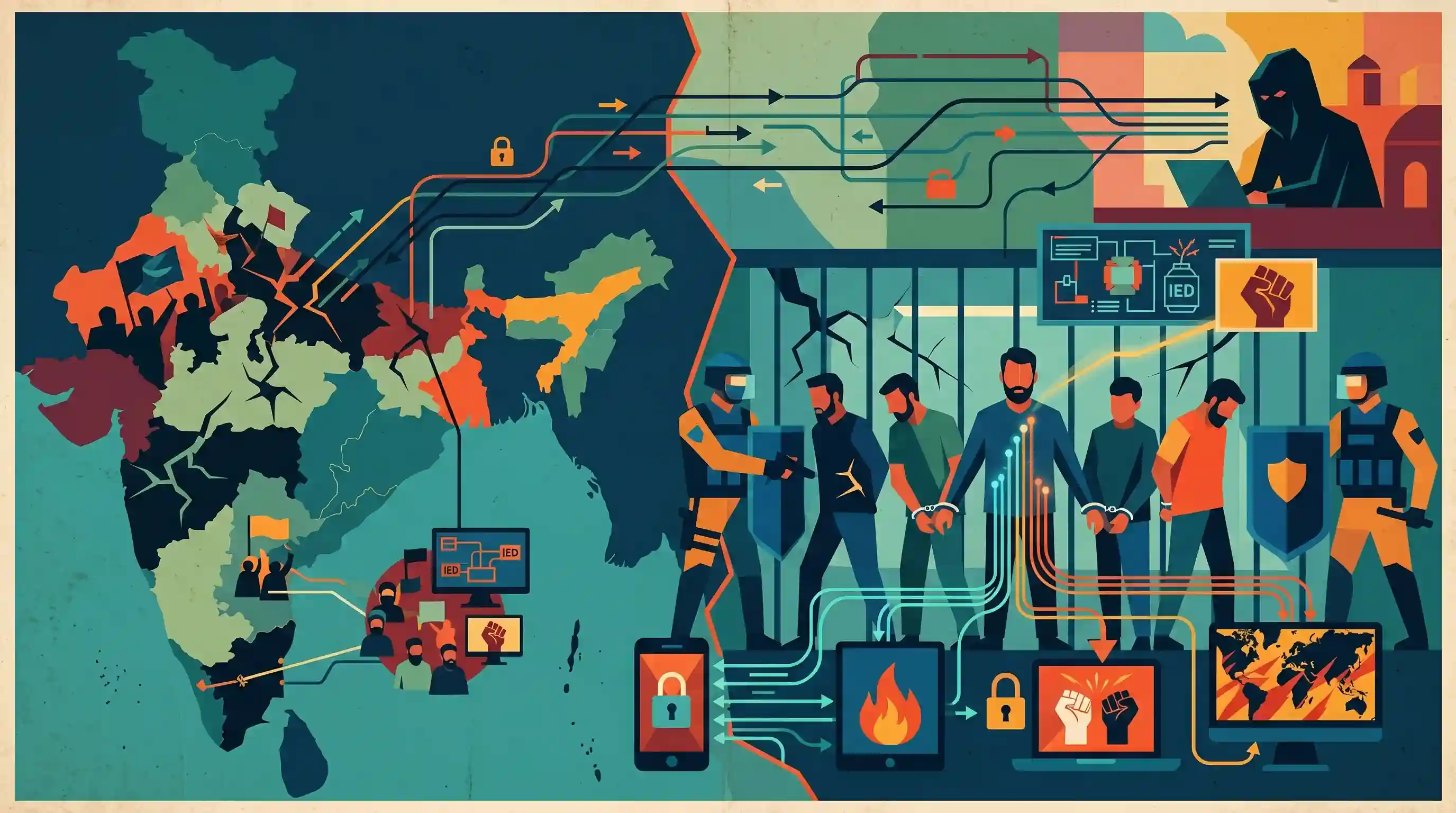
This case exemplifies the evolving modus operandi of cross-border terrorism. It demonstrates the dangerous intersection of encrypted social media and online radicalization, allowing external state and non-state actors to establish 'faceless', decentralized terror modules within India without physical infiltration.
Summary
The Delhi Police busted a Pakistan-linked inter-state terror module, arresting five operatives who were radicalized and trained online. The module, led by Ashar Danish, communicated exclusively via encrypted social media channels with a Pakistan-based handler. They received ideological indoctrination and instructions for fabricating Improvised Explosive Devices (IEDs) to wage jihad and establish a "Khilafat zone" in India. The arrests highlight the growing threat of decentralized, digitally-radicalized terror networks.
Key Points
- Delhi Police dismantled an inter-state, Pakistan-linked terror module, arresting five suspected operatives from states including Jharkhand, Maharashtra, and Telangana.
- The module was highly decentralized and radicalized entirely online by a Pakistan-based handler operating under pseudonyms such as 'CEO', 'Gazba', and 'Professor'.
- The handlers used encrypted social media platforms to disseminate ideological training, weapon designs, and instructions for fabricating Improvised Explosive Devices (IEDs).
- The module, led by Ashar Danish, aimed to acquire land to establish a "Khilafat zone" and wage jihad within India.
- Law enforcement recovered materials indicative of bomb-making, including sulphur powder, sodium bicarbonate, ball bearings, gas masks, and electrical fuse points.
Important Terms
Delhi Police Special Cell

The specialized counter-terrorism unit of the Delhi Police tasked with investigating terror modules, organized crime, and transnational threats in the national capital.
UPSC context
GS Paper III: Security Forces and Their Mandate; focuses on specialized agencies countering asymmetric threats.
External State and Non-State Actors
External state actors are sovereign entities (e.g., foreign intelligence), while non-state actors are independent groups (e.g., terror modules) that influence security without formal state backing.
UPSC context
GS Paper III: Role of external state and non-state actors in creating challenges to internal security.
Digital Radicalization
The use of internet-based platforms, including social media and encrypted messaging apps, to disseminate extremist ideologies and recruit or train operatives.
UPSC context
GS Paper III: Security challenges through communication networks and the role of social media in radicalization.
Improvised Explosive Device (IED)
A non-conventional "homemade" bomb constructed from readily available materials like fertilizers or chemicals, frequently used in asymmetric warfare and terrorist attacks.
UPSC context
GS Paper III: Internal Security; tactical understanding of tools used by extremist and insurgent groups.
Internal Security
The preservation of peace, law, and sovereignty within a country's borders by addressing threats such as terrorism, insurgency, and organized crime.
UPSC context
GS Paper III: Core syllabus pillar; tests understanding of multifaceted domestic security challenges.
Khilafat (Caliphate)
The ideological goal of establishing a sovereign Islamic state under the leadership of a supreme religious and political head (Khalifa).
UPSC context
GS Paper III: Terrorism and Extremism; pertains to the ideological motivations of transnational terror networks.
Prelims Trap
Only the National Investigation Agency (NIA) has jurisdiction to investigate inter-state terror modules and online radicalization in India.
State police agencies (e.g., Delhi Police) retain concurrent jurisdiction to investigate and bust inter-state terror networks. The MHA may optionally transfer cases to the NIA later.
Static Concepts Connected
What distinguishes Lone Wolf attacks from Decentralized Terror Modules?
- Lone Wolf: An individual who prepares and commits violent acts entirely alone, outside of any formal command structure, typically through self-radicalization.
- Decentralized Module: A multi-person cell directed remotely by external handlers via encrypted channels. It features a distributed but active command structure, unlike independent lone wolves.
How does India regulate dual-use chemicals used in IED fabrication?
- Explosives Act 1884: Regulates the manufacture, possession, and transport of explosive substances. It is administered by the Petroleum and Explosives Safety Organisation (PESO).
- Dual-Use Challenge: Readily available commercial chemicals (like sulphur powder or sodium bicarbonate) bypass strict PESO explosives monitoring, creating severe regulatory blindspots for urban IED prevention.
Cross-Topic Patterns
E2E Encryption vs. Traceability Mandates
The reliance on encrypted apps by handlers highlights the friction between the fundamental right to privacy (Puttaswamy judgment) and internal security mandates, specifically the traceability clauses in the IT Rules 2021.
Historical vs. Jihadist 'Khilafat'
The modern jihadist aim of creating territorial "Khilafat zones" subverts the GS1 historical context of the 1919 Khilafat Movement, which was anti-imperialist and integrated into India's composite freedom struggle.

Expect a 2026 GS3 Mains question on 'faceless terrorism,' emphasizing the triad of encrypted comms, dual-use chemicals, and online grooming.
Linked PYQs · 4
Linked PYQs · 4
- 2021MainsGS3
Analyse the multidimensional challenges posed by external state and non-state actors, to the internal security of India. Also discuss measures required to be taken to combat these threats.
- 2020MainsGS3
Analyze internal security threats and transborder crimes along Myanmar, Bangladesh and Pakistan borders including Line of Control (LoC). Also discuss the role played by various security forces in this regard.
- 2024MainsGS3
Social media and encrypting messaging services pose a serious security challenge. What measures have been adopted at various levels to address the security implications of social media? Also suggest any other remedies to address the problem.
- 2016MainsGS3
Use of Internet and social media by non-state actors for subversive activities is a major security concern. How have these been misused in the recent past? Suggest effective guidelines to curb the above threat.
