Noida Cyber Fraud Syndicate and Financial Crime Investigation
Source:Indian Express ↗
Why It Matters
Highlights the evolving nature of cybercrimes (social engineering via malicious APKs) and the importance of technical investigations (IPDR, IMEI tracking) in addressing sophisticated financial frauds. Essential for understanding internal security challenges related to cyber threats.
Summary
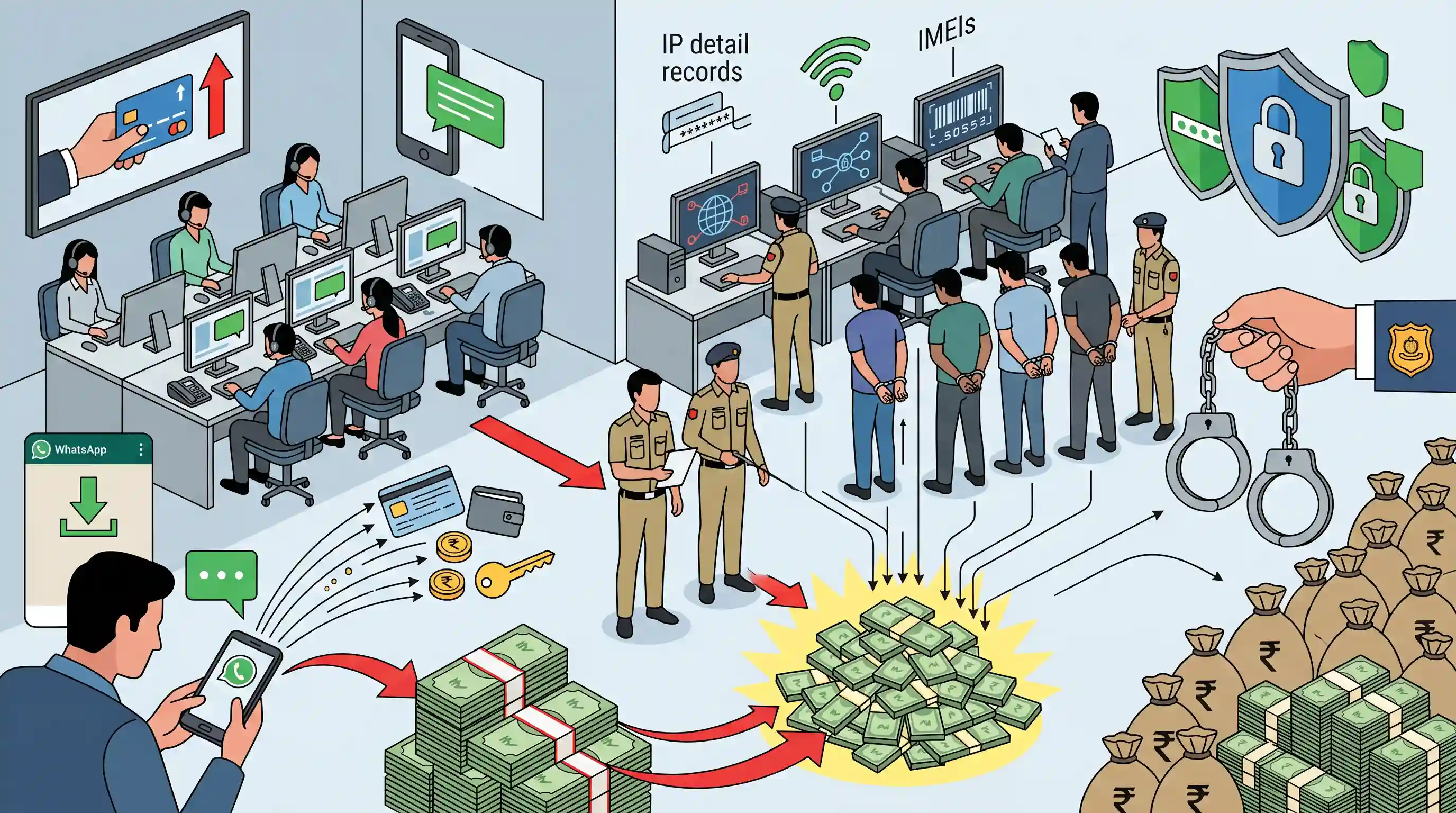
Delhi Police busted a fraudulent call centre in Noida that cheated people by offering to increase their credit card limits. The scammers sent malicious APK links via WhatsApp; upon installation, they harvested sensitive banking details and OTPs to siphon money. Eight individuals were arrested, and transactions worth Rs 6.5 crore linked to the fraud were tracked using IP detail records and IMEIs.
Key Points
- Delhi Police exposed a fake call centre operating from Noida, arresting eight suspects involved in a widespread credit card fraud syndicate.
- Modus Operandi: Fraudsters posed as bank officials, promising credit card limit increases, and sent victims malicious APK files on WhatsApp to secretly access OTPs and banking data.
- The investigation was triggered when a complainant lost Rs 1.15 lakh from two separate credit cards.
- Law enforcement used technical surveillance, including Internet Protocol Detail Records (IPDR) and IMEI tracking, to trace the transactions and locate the scammers.
- Total fraudulent transactions amounting to over Rs 6.5 crore were discovered linked to the arrested individuals' accounts.
Important Terms
APK Scam

A fraud where malicious Android Package Kit (APK) files are sent via messaging apps to install malware, steal banking data, and intercept OTPs.
UPSC context
GS Paper 3 (Internal Security); tests awareness of emerging cyber threats and challenges of digital literacy.
IP Detail Record (IPDR)
A metadata log maintained by ISPs capturing session details like source/destination IP addresses and timestamps to track digital activities.
UPSC context
GS Paper 3 (Cyber Security); tests knowledge of technical tools used by investigative agencies to attribute digital crimes.
IMEI (International Mobile Equipment Identity)
A unique 15-digit identifier for mobile devices used by security agencies to track, block, or blacklist stolen or fraudulent handsets.
UPSC context
GS Paper 3 (S&T/Security); relevant for discussions on the Central Equipment Identity Register (CEIR) and curbing mobile crimes.
Cyber Police Station
Specialized district-level police units with the mandate to register FIRs and investigate complex cybercrimes using digital forensics.
UPSC context
GS Paper 3 (Security Forces); focuses on the institutional decentralization of police to handle tech-enabled crimes.
Intelligence Fusion and Strategic Operations (IFSO)
A specialized unit of the Delhi Police that handles sensitive cybercrime cases using advanced cyber labs and forensic tools.
UPSC context
GS Paper 3 (Internal Security); tests understanding of specialized wings within law enforcement for strategic cyber-defense.
Prelims Trap
IMEI tracking identifies the specific SIM card and subscriber identity used in cybercrimes.
IMEI uniquely identifies the physical mobile device hardware, regardless of the SIM. IMSI (International Mobile Subscriber Identity) is what identifies the SIM card and subscriber.
Static Concepts Connected
What are the common variants of Phishing attacks?
- Vishing: Using voice calls to impersonate trusted entities (like bank officials) to extract confidential data or OTPs.
- Smishing: Using SMS messages containing malicious links to steal information or deploy malware.
- Pharming: Redirecting legitimate website traffic to a spoofed, fraudulent website to capture credentials.
What is the mandate of the Indian Cyber Crime Coordination Centre (I4C)?
- Nodal Agency: It operates under the Ministry of Home Affairs to coordinate all comprehensive responses to cybercrime across India.
- Central Portal: It manages both the National Cyber Crime Reporting Portal and the dedicated '1930' financial fraud helpline.
- Multi-State Coordination: It formulates Joint Cybercrime Coordination Teams (JCCTs) to tackle multi-jurisdictional cybercrime syndicates effectively.
Cross-Topic Patterns
Cyber fraud undermining Financial Inclusion
As digital banking expands via the JAM Trinity, poor digital literacy makes vulnerable demographics prime targets for vishing, threatening trust in India's digital financial infrastructure.
IPDR metadata vs Right to Privacy
The routine use of Internet Protocol Detail Records (IPDR) for metadata tracking frequently surfaces in GS2/GS3 debates balancing law enforcement capabilities against the Puttaswamy Right to Privacy framework.

Expect a Prelims match-the-pair question on cybercrime terms (Vishing, Smishing, Pharming) or I4C's nodal ministry (MHA) in 2026.
Linked PYQs · 4
Linked PYQs · 4
- 2020MainsGS3
Discuss different types of cyber crimes and measures required to be taken to fight the menace.
- 2017MainsGS3
Discuss the potential threats of Cyber attack and the security framework to prevent it.
- 2019MainsGS3
What is CyberDome Project? Explain how it can be useful in controlling internet crimes in India.
- 2018PrelimsGS1
The terms 'WannaCry, Petya and EternalBlue' sometimes mentioned in the news recently are related to
