Internal security threats from transnational criminal terror nexus
Source:The Hindu ↗
Why It Matters
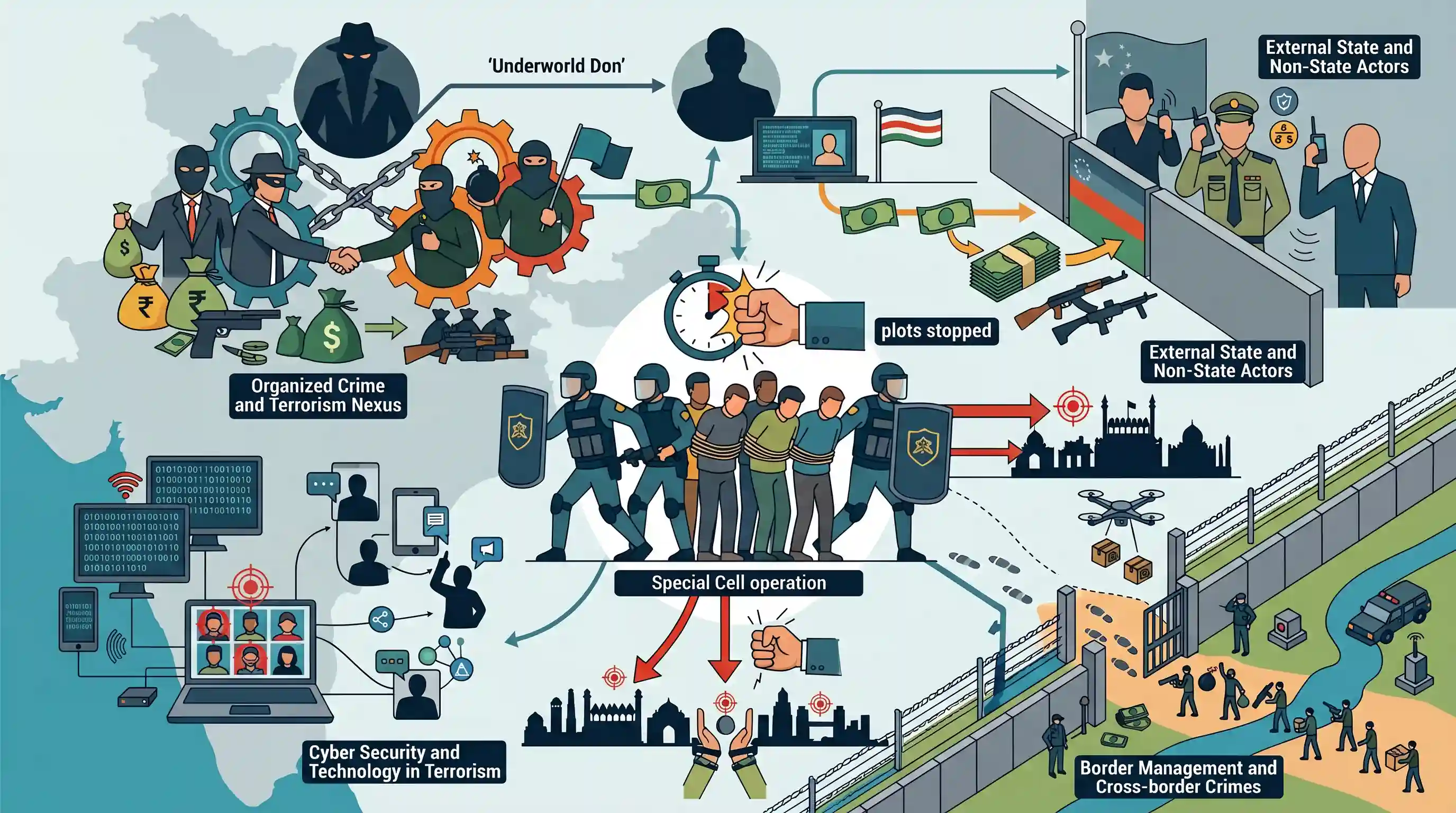
This article serves as a contemporary case study of internal security challenges, illustrating the practical manifestations of organized crime linking with cross-border terrorism, and the adaptation of terror modules using drones and social media. These themes map directly to the UPSC GS3 syllabus on security.
Summary
The Delhi Police Special Cell thwarted major terror plots by arresting eight individuals connected to a module run by Pakistan's ISI and the Mumbai underworld. The group, involving associates of Dawood Ibrahim like Munna Jhingada and transnational criminals, planned attacks in Delhi, Mumbai, and Punjab. The operation highlights the evolving internal security threats characterized by the nexus of organized crime and terrorism, the role of external state and non-state actors, and the increasing use of social media and drones for cross-border arms smuggling and recruitment.
Key Points
- The Delhi Police Special Cell arrested eight individuals associated with a terror module linked to Pakistan's ISI and the Mumbai underworld.
- The module planned to carry out major attacks on government and non-government buildings in Delhi, Mumbai, Punjab, and Chandigarh.
- Key operatives included Munna Jhingada, an associate of Dawood Ibrahim, and a Nepali citizen, Ang Kami Lama, who managed logistics and finances.
- The terror network utilized modern technology, communicating via Instagram and WhatsApp and allegedly using drones for cross-border weapon drops.
- The arrests underscore the complex challenges to internal security posed by the nexus between organized crime, drug smuggling, and terrorism aided by external actors.
Important Terms
Organized Crime-Terrorism Nexus

A symbiotic relationship where terrorist groups utilize criminal networks for funding and logistics, while criminal syndicates exploit terror-induced instability to expand illicit activities for profit and protection.
UPSC context
GS III Internal Security; essential for analyzing interconnected threats and comprehensive policy responses to disrupt illicit networks.
Non-State Actors
Individuals or groups—such as terrorist outfits, insurgent groups, or criminal cartels—that operate independently of sovereign governments but significantly impact national security, stability, and territorial integrity.
UPSC context
GS III Internal Security; a core syllabus topic testing the understanding of diverse security threats beyond conventional warfare.
Inter-Services Intelligence (ISI)
Pakistan's premier intelligence agency, frequently implicated by Indian security forces for sponsoring cross-border terrorism, radicalization, and proxy warfare through various militant proxies to destabilize India.
UPSC context
GS III Internal Security; relevant for examining the role of external state actors in fueling internal disturbances and proxy wars.
Delhi Police Special Cell
The specialized counter-terrorism unit of the Delhi Police, mandated to detect and neutralize terror plots, organized crime syndicates, and transnational smuggling operations affecting the National Capital Region.
UPSC context
GS III Internal Security; illustrates the role of specialized state-level investigative agencies in urban counter-terrorism and internal safety.
Unmanned Aerial Vehicles (UAVs) in Terrorism
The use of remote-controlled drones by adversaries for surveillance, weapon delivery, or smuggling narcotics and arms across borders, bypassing traditional radar and physical security infrastructure.
UPSC context
GS III Internal Security; focuses on technology-driven threats and the need for modernizing border management and counter-UAS strategies.
Prelims Trap
"The Indo-Nepal border is a fenced, closed boundary exclusively guarded by the Border Security Force (BSF)."
The Indo-Nepal border is an open, porous border under the 1950 Treaty of Peace and Friendship. It is guarded by the Sashastra Seema Bal (SSB), not the BSF.
Static Concepts Connected
How do organized crime and terrorism mutually reinforce each other?
- Financial synergy: Crime syndicates provide illicit funds through smuggling, hawala, and extortion; in return, terrorists offer intimidation and protection.
- Logistical networks: Criminals supply established smuggling routes, safe houses, forged documents, and cross-border access for weapons and narcotics.
- Operational convergence: Terrorist groups outsource the execution of attacks to criminal syndicates to maintain deniability, as seen historically in the 1993 Mumbai blasts.
Which Central Armed Police Forces (CAPFs) guard India's respective international borders?
- BSF: Guards the borders with Pakistan and Bangladesh.
- ITBP: Secures the Indo-China border (Line of Actual Control).
- SSB: Deployed along the open and porous borders of Nepal and Bhutan.
- Assam Rifles: Manages the highly rugged Indo-Myanmar border.
Cross-Topic Patterns
Rogue Drones + Anti-Drone Tech
The shift from manual or tunnel-based smuggling to drone-based weapon and drug drops across borders necessitates the rapid deployment of indigenous anti-drone systems (like DRDO's D4) by border guarding forces.
Narco-Terrorism + FATF and PMLA
Proceeds from organized crime and drug smuggling directly fund terror modules, triggering international watchdogs like the FATF and domestic tools like the PMLA to trace and freeze illicit assets.
Encrypted Comms + Intermediary Rules
The reliance on Instagram and WhatsApp by terror modules highlights the ongoing friction between end-to-end encryption platforms and law enforcement's demand for traceability under India's IT Rules.

The structural convergence of organized crime, narco-terrorism, and rogue drone technology along porous borders is a prime candidate for a GS3 Mains 15-marker in 2026.
Linked PYQs · 4
Linked PYQs · 4
- 2022MainsGS3
Discuss the types of organised crimes. Describe the linkages between terrorists and organised crime that exist at the national and transnational levels.
- 2021MainsGS3
Analyse the complexity and intensity of terrorism, its causes, linkages and obnoxious nexus. Also suggest measures required to be taken to eradicate the menace of terrorism.
- 2021MainsGS3
Analyse the multidimensional challenges posed by external state and non-state actors, to the internal security of India. Also discuss measures required to be taken to combat these threats.
- 2023MainsGS3
The use of unmanned aerial vehicles (UAVs) by our adversaries across the borders to ferry arms/ammunitions, drugs, etc., is a serious threat to the internal security. Comment on the measures being taken to tackle this threat.
