Delhi Police Busts Spurious Medicine Unit and Seizes Tramadol
Source:Indian Express ↗
Why It Matters
The dual threat of counterfeit medicine manufacturing and the diversion of prescription opioids (like Tramadol) into the illicit market underscores severe vulnerabilities in India's pharmaceutical supply chain. It highlights the evolving nature of organized crime and drug trafficking, making it a critical case study for internal security and regulatory governance in UPSC exams.
Summary
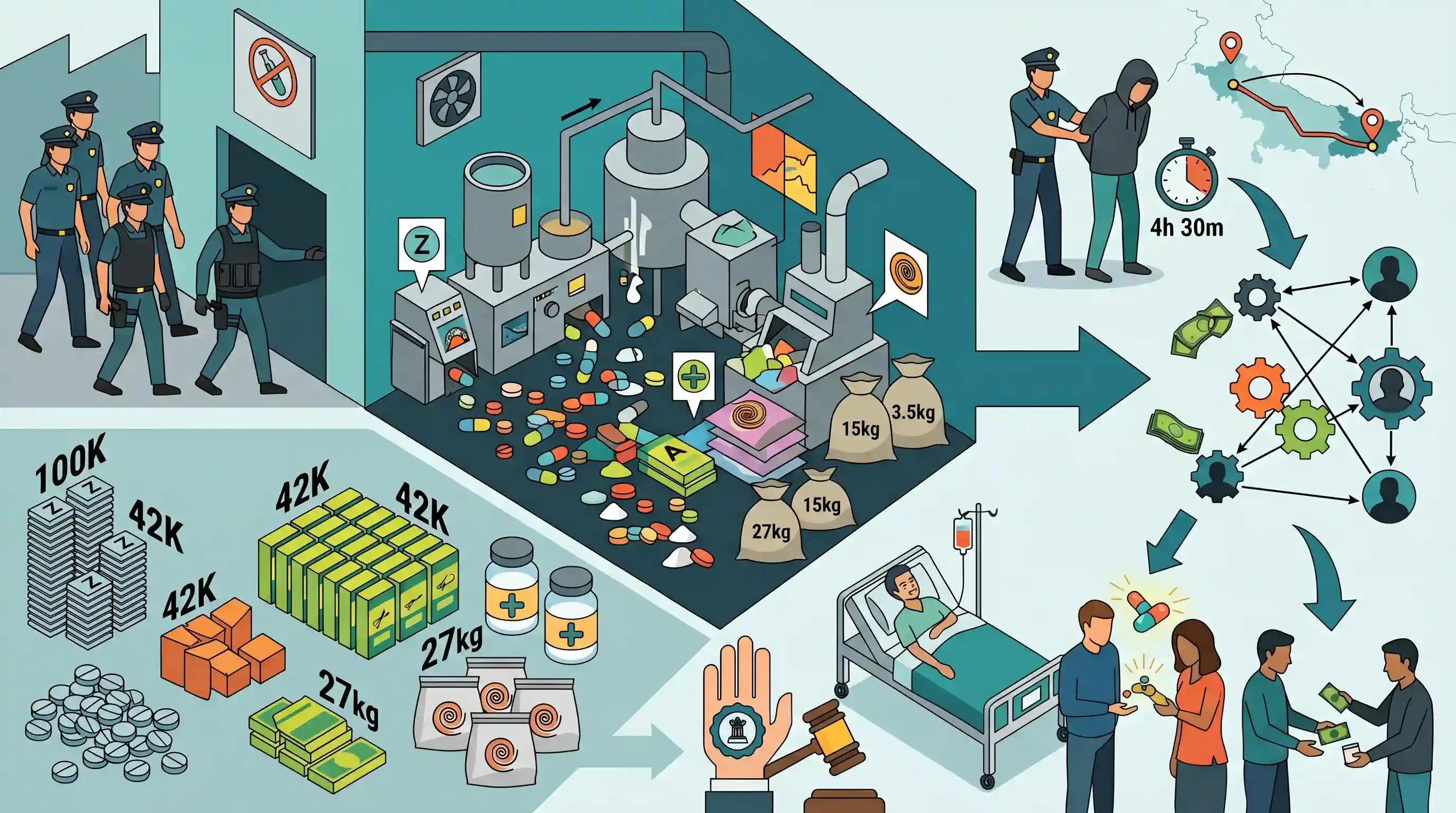
The Delhi Police Anti-Narcotics Task Force (ANTF) successfully dismantled a fake pharmaceutical manufacturing unit in Gaya, Bihar. The operation led to the seizure of over one lakh spurious zinc tablets, 42,000 fake antibiotic tablets, 27 kg of paracetamol, and significant quantities of smuggled tramadol powder. The illegal enterprise utilized bogus medical fronts to divert these counterfeit medicines and opioids into the market, often selling them at inflated prices or as substitutes for heroin. The arrest of a key operative highlights the deep inter-state linkages and the severe threat posed by organized crime networks that exploit pharmaceutical supply chains, thereby compromising public health and fueling drug trafficking.
Key Points
- The Delhi Police Anti-Narcotics Task Force (ANTF) busted an illegal manufacturing unit in Gaya, Bihar, producing spurious pharmaceuticals.
- Authorities seized massive quantities of counterfeit zinc and antibiotic tablets, along with 5 kg of smuggled tramadol powder.
- Tramadol, a regulated opioid, was being illegally processed into tablets, diverted through bogus medical fronts, and sold as a heroin substitute.
- The operation highlights the growing trend of organized crime networks exploiting pharmaceutical supply chains for drug trafficking.
- Raises serious concerns regarding drug regulation enforcement, public health safety, and the inter-state coordination required to dismantle narcotics syndicates.
Important Terms
Anti-Narcotics Task Force (ANTF)

Specialized state-level units, including within Delhi Police, mandated to combat drug trafficking and coordinate inter-agency enforcement of the NDPS Act for a drug-free India.
UPSC context
GS Paper 3: Internal Security; tests knowledge of specialized enforcement agencies and institutional responses to organized crime.
Spurious Drugs
Under Section 17B of the Drugs and Cosmetics Act (1940), drugs sold under another product's name, imitations, or those with false manufacturer labels intended to deceive.
UPSC context
GS Paper 2: Regulatory Bodies; GS Paper 3: Public Health; tests understanding of pharmaceutical regulatory challenges and safety.
Tramadol
A synthetic opioid painkiller classified as a "psychotropic substance" under India's NDPS Act since 2018; noted for its abuse potential and links to international smuggling.
UPSC context
GS Paper 3: Internal Security; tests awareness of specific substances linked to narco-terrorism and drug law enforcement.
NDPS Act, 1985
The primary Indian law (1985) regulating narcotic drugs and psychotropic substances, providing for stringent penalties, asset forfeiture, and the foundation for agencies like the NCB.
UPSC context
GS Paper 2 & 3: Law and Internal Security; essential for analyzing the legal framework against drug trafficking.
Drugs and Cosmetics Act, 1940
The central legislation (1940) governing the import, manufacture, and sale of drugs and cosmetics in India to ensure safety, efficacy, and standard quality.
UPSC context
GS Paper 2: Governance; vital for understanding the regulatory environment of India’s pharmaceutical industry.
Organized Crime
Coordinated criminal activities, such as inter-state drug smuggling, characterized by structured networks and profit-driven motives, often posing significant threats to national internal security.
UPSC context
GS Paper 3: Internal Security; tests the ability to analyze linkages between illegal trade and security threats.
Prelims Trap
"The CDSCO has exclusive jurisdiction over licensing and inspecting all drug manufacturing units in India."
Manufacturing licenses, facility inspections, and enforcement against spurious drug units are primarily handled by State Licensing Authorities (SLAs), not the CDSCO.
Static Concepts Connected
How is the regulatory jurisdiction over drugs divided in India?
- Central level: The Central Drugs Standard Control Organisation (CDSCO) handles approval of new drugs, clinical trials, import controls, and lays down drug standards.
- State level: State Licensing Authorities (SLAs) are responsible for issuing manufacturing and sales licenses, inspecting facilities, and acting against spurious or counterfeit drugs.
What is the Narco-Coordination Centre (NCORD) mechanism?
- MHA framework: An MHA initiative established to ensure effective coordination among various central and state law enforcement agencies combating drug trafficking.
- 4-Tier structure: Operates as a 4-tier structure (Apex, Executive, State, and District levels) to dismantle inter-state drug syndicates and synchronize enforcement.
- NDPS enforcement: Tramadol, a synthetic opioid often used as a heroin substitute, was brought under the NDPS Act in 2018 to allow NCORD agencies to crack down on its diversion.
Cross-Topic Patterns
Shift to synthetic opioids
Syndicates are exploiting generic pharma supply chains to divert Tramadol, shifting the internal security threat from traditional Golden Crescent heroin smuggling to domestic synthetic opioid production.
Mashelkar Committee & Spurious Drugs
Inter-state fake pharma operations validate the Mashelkar Committee's findings on weak state-level enforcement infrastructure, highlighting the ongoing debate over creating a centralized national drug authority.

Expect a 2026 GS3 question on the nexus between India's pharmaceutical boom, organized crime, and the rise of synthetic opioid smuggling.
Linked PYQs · 4
Linked PYQs · 4
- 2018MainsGS3
India's proximity to two of the world's biggest illicit opium-growing states has enhanced her internal security concerns. Explain the linkages between drug trafficking and other illicit activities such as gunrunning, money laundering and human trafficking. What counter-measures should be taken to prevent the same?
- 2022MainsGS3
Discuss the types of organised crimes. Describe the linkages between terrorists and organised crime that exist at the national and transnational levels.
- 2024MainsGS3
Explain how narco-terrorism has emerged as a serious threat across the country. Suggest suitable measures to counter narco-terrorism.
- 2015MainsGS2
For achieving the desired objectives, it is necessary to ensure that the regulatory institutions remain independent and autonomous. Discuss in the light of the experiences in recent past.
