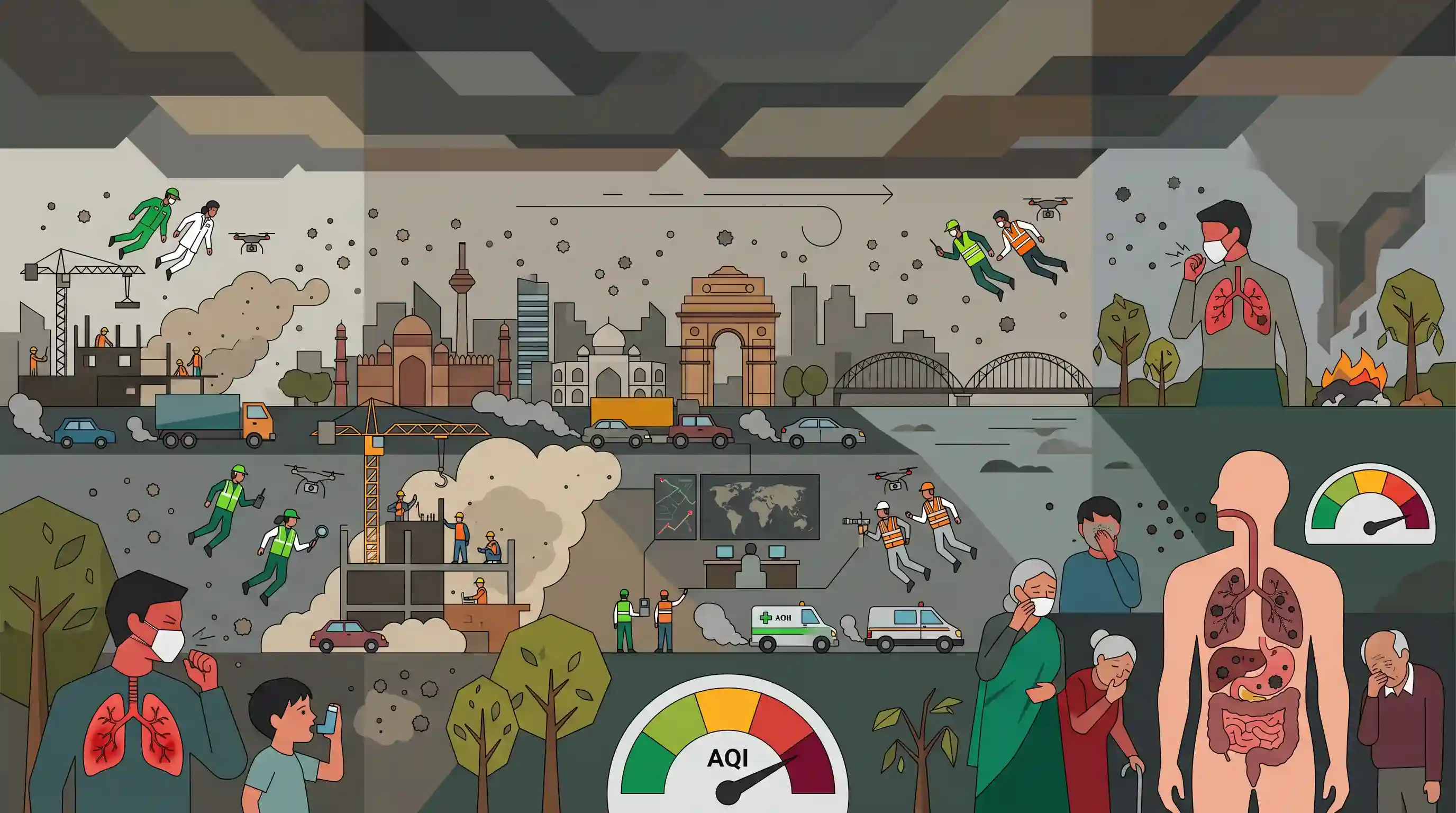
Delhi NCR air quality index and particulate matter monitoring
Source:Indian Express ↗
Why It Matters
Delhi's winter air pollution is a recurring public health crisis. It is frequently tested in UPSC (Prelims and Mains) concerning the components of the Air Quality Index (AQI), health impacts of particulate matter (PM2.5 and PM10), and the effectiveness of institutional bodies like the CAQM and CPCB in implementing mitigation measures.
Summary
Delhi's air quality remained in the 'severe' zone on December 1, 2025, with an average Air Quality Index (AQI) of 373 and PM10 levels reaching 283 µg/m³. The Commission for Air Quality Management (CAQM) has deployed flying squads to monitor dust emissions and local violations, though unfavorable meteorological conditions are expected to keep the air quality in the 'Very Poor' category.
Key Points
- Delhi-NCR's Air Quality Index (AQI) averaged 373, remaining in the 'severe' category due to stagnant meteorological conditions.
- PM10 levels were recorded at 283 µg/m³.
- The Commission for Air Quality Management (CAQM) deployed 11 flying squads to monitor dust at construction sites and roads.
- According to the Air Quality Early Warning System, air quality is expected to remain in the 'Very Poor' category in the coming days.
- The CPCB standards classify AQI from 0-50 as 'good' to 401-500 as 'severe'.
Important Terms
Graded Response Action Plan (GRAP)

An emergency framework of stage-wise measures (Poor to Severe+) triggered based on air quality levels in Delhi-NCR to prevent further atmospheric deterioration.
UPSC context
GS Paper III (Environment); vital for understanding emergency pollution mitigation and urban governance in the National Capital Region.
Commission for Air Quality Management (CAQM)
A statutory body established under a 2021 Act to coordinate, monitor, and manage air quality in Delhi-NCR and adjoining states like Punjab and Haryana.
UPSC context
GS Paper II (Statutory Bodies) and Paper III (Environment); tests knowledge of inter-state coordination and environmental executive powers.
Central Pollution Control Board (CPCB)
India's apex statutory organization under the MoEFCC, responsible for implementing environmental laws, setting pollution standards, and providing technical support to the government.
UPSC context
GS Paper II & III; key for topics related to institutional frameworks for pollution control and environmental governance.
Air Quality Early Warning System (AQEWS)
A high-resolution forecasting system developed by IITM Pune that provides 72-hour air quality predictions to help authorities take preemptive measures against pollution events.
UPSC context
GS Paper III (Science & Technology/Environment); relevant for technological interventions in environmental management.
National Air Quality Index (AQI)
A standardized tool using six color-coded categories to communicate air quality status, based on the concentration of eight major pollutants like PM2.5 and Ozone.
UPSC context
GS Paper III (Environment); essential for understanding public health monitoring and environmental quality standards in India.
PM10 (Particulate Matter 10)
Inhalable particulate matter with a diameter of 10 micrometers or less, originating from dust and construction, which poses significant respiratory health risks.
UPSC context
GS Paper III (Pollution and Public Health); relevant for scientific understanding of specific pollutants and their urban impact.
Prelims Trap
"NAQI measures greenhouse gases like Carbon Dioxide (CO2) to determine the Air Quality Index."
The National Air Quality Index tracks 8 specific pollutants (including PM10, PM2.5, CO, and Ozone). It does NOT measure CO2 or other greenhouse gases.
Static Concepts Connected
What is the statutory status and jurisdiction of the CAQM?
- Statutory origin: Established under the CAQM in NCR and Adjoining Areas Act, 2021, replacing the Supreme Court-mandated EPCA.
- Jurisdiction: Covers Delhi, NCR, and adjoining areas in Punjab, Haryana, Rajasthan, and UP where emissions impact Delhi's air.
- Overriding powers: Has overriding powers over state pollution control boards regarding air quality management and enforcement in the region.
What are the parameters of the National Air Quality Index (NAQI)?
- Pollutants measured: Tracks eight pollutants: PM10, PM2.5, NO2, SO2, CO, O3, NH3, and Lead (Pb).
- Six categories: Divided into six color-coded categories ranging from Good (0-50) to Severe (401-500).
- Exclusions: Focuses on criteria air pollutants affecting local health; does not measure greenhouse gases like CO2 or Methane.
Cross-Topic Patterns
Meteorological inversion + AQI severity
Delhi's winter pollution is heavily driven by temperature inversions and low wind speeds, trapping local emissions. UPSC often tests this geographical phenomenon alongside anthropogenic pollution sources.
Urban governance + GRAP enforcement
The execution of the Graded Response Action Plan (GRAP) highlights challenges in urban governance, requiring coordination across multiple state governments, municipal bodies, and the statutory CAQM.

Expect a 2026 multi-statement question linking CAQM's statutory powers, NAQI pollutants, and winter temperature inversions.
Linked PYQs · 5
Linked PYQs · 5
- 2024MainsGS3
Industrial pollution of river water is a significant environmental issue in India. Discuss the various mitigation measures to deal with this problem and also the government's initiatives in this regard.
- 2021MainsGS3
Describe the key points of the revised Global Air Quality Guidelines (AQGs) recently released by the World Health Organisation (WHO). How are these different from its last update in 2005? What changes in India's National Clean Air Programme are required to achieve these revised standards?
- 2022PrelimsGS1
In the context of WHO Air Quality Guidelines, consider the following statements: 1. The 24-hour mean of PM2.5 should not exceed 15 µg/m³ and annual mean of PM2.5 should not exceed 5 µg/m³. 2. In a year, the highest levels of ozone pollution occur during the periods of inclement weather. 3. PM10 can penetrate the lung barrier and enter the bloodstream. 4. Excessive ozone in the air can trigger asthma. Which of the statements given above are correct?
- 2016PrelimsGS1
In the cities of our country, which among the following atmospheric gases are normally considered in calculating the value of Air Quality Index? 1. Carbon dioxide 2. Carbon monoxide 3. Nitrogen dioxide 4. Sulfur dioxide 5. Methane Select the correct answer using the code given below.
- 2025PrelimsGS1
Artificial way of causing rainfall to reduce air pollution makes use of
