Delhi and Mumbai severe air quality index and urban controls
Source:Indian Express ↗
Why It Matters
Urban air pollution is a persistent crisis in India's megacities. Understanding institutional mechanisms (like AQI monitoring), regulatory responses (such as BMC's stop-work notices for construction dust), and the public health implications is directly relevant to GS-3 Environment and GS-2 Governance.
Summary
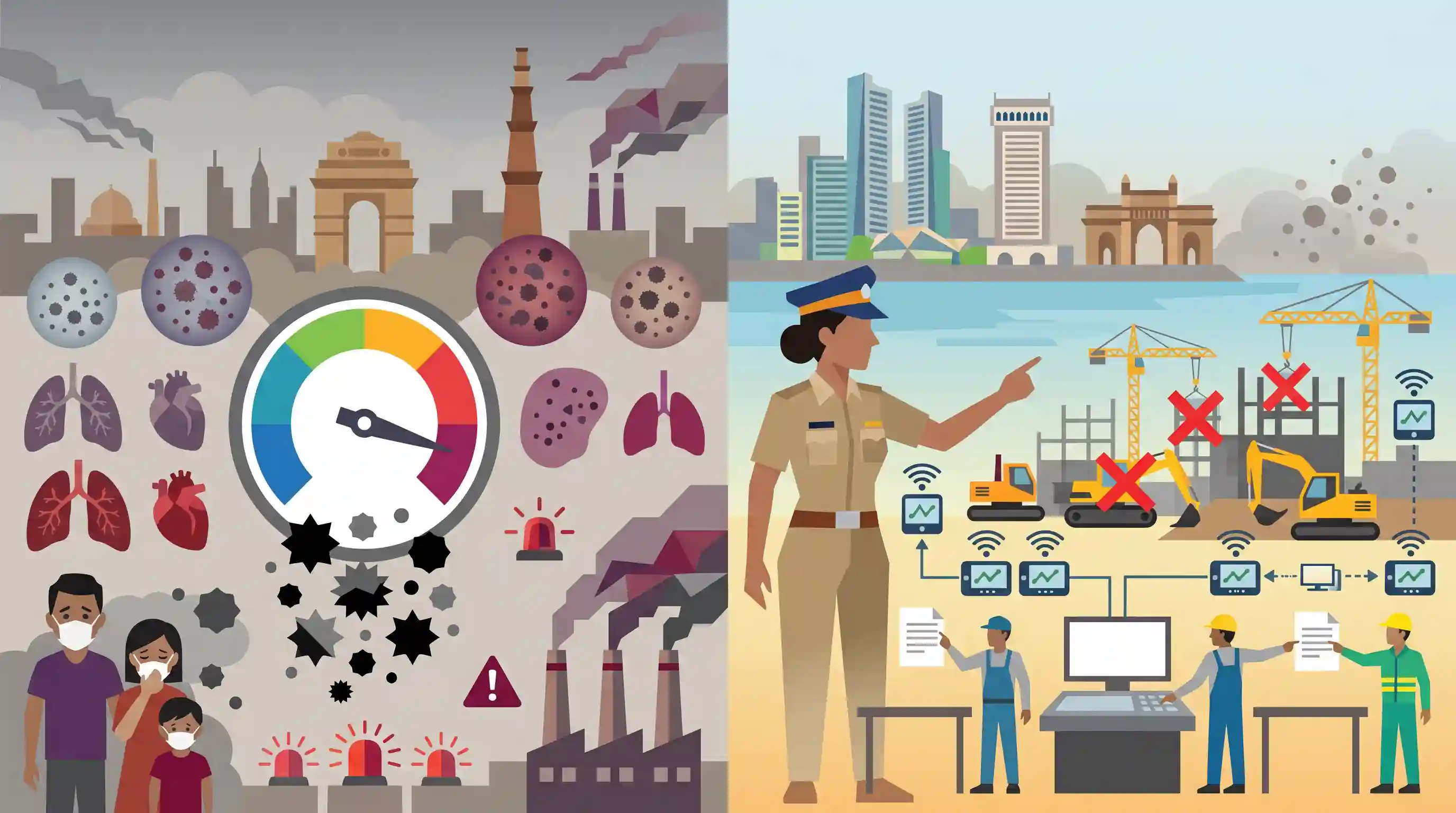
On November 29, 2025, the Air Quality Index (AQI) in Delhi-NCR plunged into the 'Very Poor' category (338), sparking serious public health concerns as PM2.5 concentrations reached highly toxic levels. Authorities have recorded similarly poor AQI levels across multiple adjoining NCR cities. Concurrently, air quality in Mumbai is also deteriorating, prompting the Brihanmumbai Municipal Corporation (BMC) to enforce strict regulatory actions. The BMC issued stop-work notices to dozens of construction sites for violating dust pollution guidelines and mandated the installation of continuous, 24x7 operational AQI monitoring sensors at construction sites.
Key Points
- Delhi's Air Quality Index (AQI) plummeted to 338, categorizing it as 'Very Poor' under the Central Pollution Control Board (CPCB) standards.
- The extreme concentration of fine particulate matter (PM2.5) in Delhi carries health risks equivalent to smoking approximately 8.5 cigarettes a day, severely impacting pulmonary and cardiovascular health.
- AQI variations across different platforms and agencies occur due to differences in station locations and specific calibration parameters.
- Air quality is simultaneously worsening in Mumbai, where the AQI recently touched 197.
- In response to the deteriorating air, the Brihanmumbai Municipal Corporation (BMC) enforced strict environmental regulations, issuing stop-work notices to 53 construction sites and mandating 24x7 AQI monitoring sensors.
Important Terms
Air Quality Index (AQI)

A standardized numerical scale used by government agencies to communicate the level of air pollution and its associated health risks to the public.
UPSC context
Critical for GS Paper 3 (Environment); tests understanding of pollution monitoring frameworks and public health communication strategies.
PM2.5
Fine inhalable particles with diameters 2.5 micrometers or smaller, capable of entering the bloodstream and causing severe respiratory and cardiovascular issues.
UPSC context
Key topic in GS Paper 3 (Environment); involves science-based pollution causes and environmental impact assessment.
Central Pollution Control Board (CPCB)
A statutory body under the Ministry of Environment, Forest and Climate Change, responsible for preventing and controlling air and water pollution nationwide.
UPSC context
Relevant for GS Paper 2 (Governance) and GS Paper 3 (Environment); tests knowledge of statutory bodies and environmental regulation.
Brihanmumbai Municipal Corporation (BMC)
The local governing body for Greater Mumbai, responsible for urban governance, including the enforcement of dust mitigation and air pollution control guidelines.
UPSC context
Important for GS Paper 2 (Urban Governance); tests the role of local bodies in implementing environmental policies.
Graded Response Action Plan (GRAP)
An emergency framework for Delhi-NCR that invokes specific pollution-control measures (Stage I to IV) based on deteriorating air quality levels.
UPSC context
Frequently tested in GS Paper 3 (Environment) and Current Affairs; focuses on proactive urban crisis management.
Commission for Air Quality Management (CAQM)
A statutory body established in 2021 to oversee air quality and coordinate pollution-control efforts across Delhi, Punjab, Haryana, Rajasthan, and Uttar Pradesh.
UPSC context
Vital for GS Paper 3 (Environment); represents recent legislative shifts in inter-state environmental governance.
Prelims Trap
"The National Air Quality Index measures major greenhouse gases including Carbon Dioxide (CO2) to determine pollution severity."
The AQI strictly measures 8 specific pollutants for direct human health impacts. It does NOT track greenhouse gases like Carbon Dioxide or Methane.
Static Concepts Connected
What are the 8 pollutants measured under the National Air Quality Index (AQI)?
- Particulate Matter: PM10 and PM2.5 are continuously tracked due to their ability to penetrate deep into pulmonary alveoli.
- Toxic Gases: Tracks Nitrogen Dioxide (NO2), Sulphur Dioxide (SO2), Carbon Monoxide (CO), and ground-level Ozone (O3).
- Other Pollutants: Tracks Ammonia (NH3) and Lead (Pb), rounding out the eight designated parameters.
What is the Graded Response Action Plan (GRAP) for Delhi-NCR?
- Statutory Enforcement: Implemented by the Commission for Air Quality Management (CAQM), which holds statutory backing to enforce air quality regulations in the NCR.
- Threshold-Based Action: Triggers progressively stricter emergency measures across four stages based on AQI levels, including bans on construction activities and diesel vehicles.
Cross-Topic Patterns
74th Amendment & Pollution Enforcement
BMC's stop-work notices highlight the growing role of ULBs under the 12th Schedule in managing urban ecology and enforcing the Construction and Demolition Waste Management Rules, 2016.
Geography's Role in Urban Air Quality
Mumbai's coastal breezes traditionally disperse emissions, unlike Delhi where landlocked geography, winter temperature inversions, and regional stubble burning create severe PM2.5 trapping.

Expect a 2026 question linking urban local bodies' (74th CAA) legal mandates with the enforcement of Construction & Demolition Waste Rules.
Linked PYQs · 4
Linked PYQs · 4
- 2022PrelimsGS1
In the context of WHO Air Quality Guidelines, consider the following statements: 1. The 24-hour mean of PM2.5 should not exceed 15 µg/m³ and annual mean of PM2.5 should not exceed 5 µg/m³. 2. In a year, the highest levels of ozone pollution occur during the periods of inclement weather. 3. PM10 can penetrate the lung barrier and enter the bloodstream. 4. Excessive ozone in the air can trigger asthma. Which of the statements given above are correct?
- 2016PrelimsGS1
In the cities of our country, which among the following atmospheric gases are normally considered in calculating the value of Air Quality Index? 1. Carbon dioxide 2. Carbon monoxide 3. Nitrogen dioxide 4. Sulfur dioxide 5. Methane Select the correct answer using the code given below.
- 2025PrelimsGS1
Artificial way of causing rainfall to reduce air pollution makes use of
- 2021MainsGS3
Describe the key points of the revised Global Air Quality Guidelines (AQGs) recently released by the World Health Organisation (WHO). How are these different from its last update in 2005? What changes in India's National Clean Air Programme are required to achieve these revised standards?
