Delhi NCR Air Quality Plunges Into Severe Winter Smog Category
Source:Indian Express ↗
Why It Matters
The recurring winter smog in Northern India represents a major environmental and public health crisis. It highlights the complexities of environmental governance, requiring interstate coordination to tackle agricultural practices (stubble burning) alongside urban emission control. It is highly relevant for GS3 (Environment) and questions on the effectiveness of statutory bodies like the CPCB.
Summary
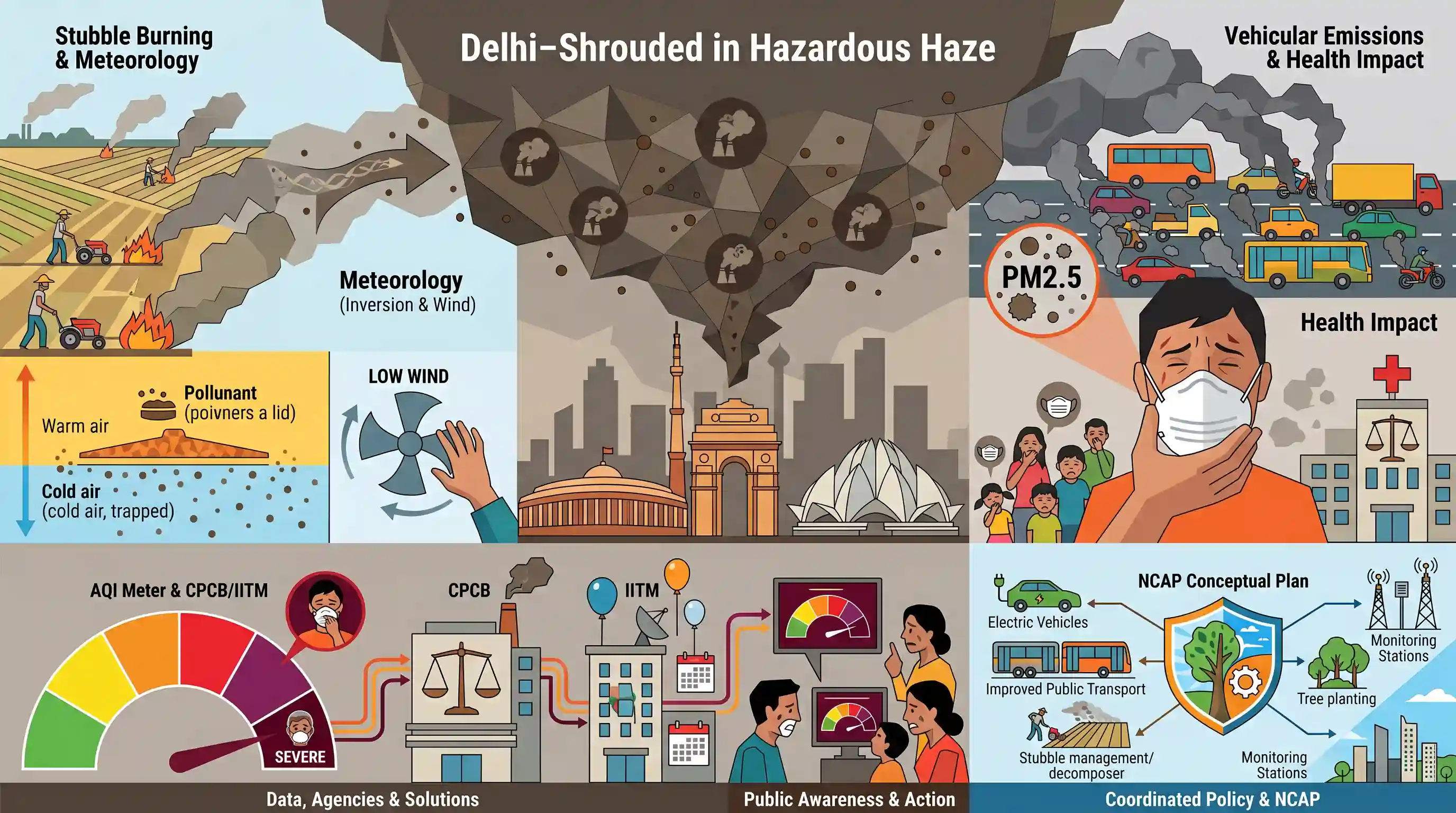
The article reports on the hazardous air quality levels in Delhi-NCR during early November, with the Air Quality Index (AQI) regularly breaching the 'severe' category. Key contributing factors include a significant spike in PM2.5 levels driven by stubble burning in neighboring states, vehicular emissions, and unfavorable meteorological conditions like low wind speeds and temperature inversions. Data from the Central Pollution Control Board (CPCB) and forecasts by the Indian Institute of Tropical Meteorology (IITM) highlight the persistent and severe nature of the pollution, which poses severe public health risks and necessitates urgent, coordinated policy interventions.
Key Points
- Delhi-NCR consistently experiences 'severe' Air Quality Index (AQI) levels during early winter, particularly in November.
- Stubble burning in neighboring states (Punjab and Haryana) acts as a major source, contributing significantly to PM2.5 concentrations in Delhi's air.
- The Central Pollution Control Board (CPCB) operates as the apex statutory body monitoring and categorizing air quality levels across the country.
- Meteorological factors, including temperature inversion and low wind speeds, trap pollutants near the surface, leading to dense winter smog.
- Tools like the Decision Support System (DSS) by IITM are crucial for forecasting air quality and identifying the proportionate contribution of different pollution sources.
Important Terms
National Clean Air Programme (NCAP)

Launched in 2019, it is a national strategy aiming for a 40% reduction in particulate matter concentration by 2026 across 131 "non-attainment cities" that fail to meet national air quality standards.
UPSC context
GS Paper III (Environment). Tests knowledge of national pollution mitigation frameworks, targets, and federal environmental governance.
Graded Response Action Plan (GRAP)
An emergency framework for Delhi-NCR that mandates stage-wise restrictions based on Air Quality Index (AQI) levels. It is implemented by the Commission for Air Quality Management (CAQM) to prevent further atmospheric deterioration.
UPSC context
GS Paper III (Environment). Tests understanding of emergency response mechanisms and specialized bodies like the CAQM.
Central Pollution Control Board (CPCB)
A statutory body established in 1974 under the Water Act. It serves as India's apex technical authority for monitoring pollution, setting environmental standards, and coordinating between State Pollution Control Boards.
UPSC context
GS Paper II (Governance) & III (Environment). Key for understanding statutory regulators and center-state environmental coordination.
Indian Institute of Tropical Meteorology (IITM)
An autonomous research institute under the Ministry of Earth Sciences, Pune. It conducts specialized research in tropical meteorology, monsoon dynamics, and climate modeling, providing technical data for air quality forecasting.
UPSC context
GS Paper III (Science & Tech/Environment). Relevant for institutional frameworks in climate research and technical pollution inputs.
Decision Support System (DSS)
A numerical model-based framework developed by IITM Pune. it quantifies daily contributions from various local and regional sources—like transport, industries, and stubble burning—to help policymakers manage Delhi's air quality.
UPSC context
GS Paper III (Environment/S&T). Tests knowledge of technological interventions and data-driven policy-making in urban environmental management.
Prelims Trap
The CPCB is a statutory body constituted under the Air (Prevention and Control of Pollution) Act, 1981.
CPCB was actually constituted under the Water (Prevention and Control of Pollution) Act, 1974. It was only later entrusted with powers under the Air Act, 1981.
Static Concepts Connected
What meteorological phenomena exacerbate Delhi’s winter pollution?
- Temperature Inversion: A layer of warm air acts as a lid, trapping colder air and suspended pollutants (like PM2.5) near the ground, preventing upward dispersion.
- Topographical Basin: The Himalayas block northern escape routes, while the landlocked NCR basin restricts horizontal dispersion of transboundary emissions.
- Low Wind Speed: Post-monsoon and early winter months experience severely reduced wind speeds, preventing vertical and horizontal mixing of atmospheric pollutants.
Which 8 pollutants constitute the National Air Quality Index (AQI)?
- Particulate Matter: PM10 and PM2.5 are the primary drivers of severe AQI scores during winter.
- Reactive Gases: Nitrogen Dioxide (NO2), Sulphur Dioxide (SO2), and Carbon Monoxide (CO). Note: Carbon Dioxide (CO2) is NOT included.
- Other Pollutants: Ozone (O3), Ammonia (NH3), and Lead (Pb) complete the eight criteria pollutants.
Cross-Topic Patterns
Inter-state pollution vs. Federalism
Transboundary stubble burning highlights friction in federal environmental governance, leading to the statutory CAQM (replacing EPCA) to enforce unified mandates across conflicting NCR states.
Predictive tech in urban governance
Tools like IITM's DSS shift pollution management from reactive (GRAP) to predictive, aligning with National Clean Air Programme (NCAP) goals for data-driven, city-specific emission mitigation.

Expect a multi-statement question combining CPCB's statutory origins (Water Act vs Air Act) with the exact 8 pollutants in the AQI.
Linked PYQs · 2
Linked PYQs · 2
- 2021MainsGS3
Describe the key points of the revised Global Air Quality Guidelines (AQGs) recently released by the World Health Organisation (WHO). How are these different from its last update in 2005? What changes in India's National Clean Air Programme are required to achieve these revised standards?
- 2018PrelimsGS1
How is the National Green Tribunal (NGT) different from the Central Pollution Control Board (CPCB)? 1. The NGT has been established by an Act whereas the CPCB has been created by an executive order of the Government. 2. The NGT provides environmental justice and helps reduce the burden of litigation in the higher courts whereas the CPCB promotes cleanliness of streams and wells, and aims to improve the quality of air in the country. Which of the statements given above is/are correct?
