Delhi Air Pollution and Limitations of GRAP Strategy
Source:Indian Express ↗
Why It Matters
Understanding the efficacy and limits of institutional responses like GRAP to severe urban pollution is essential for GS3 environment questions on pollution control frameworks and policy evaluation.
Summary
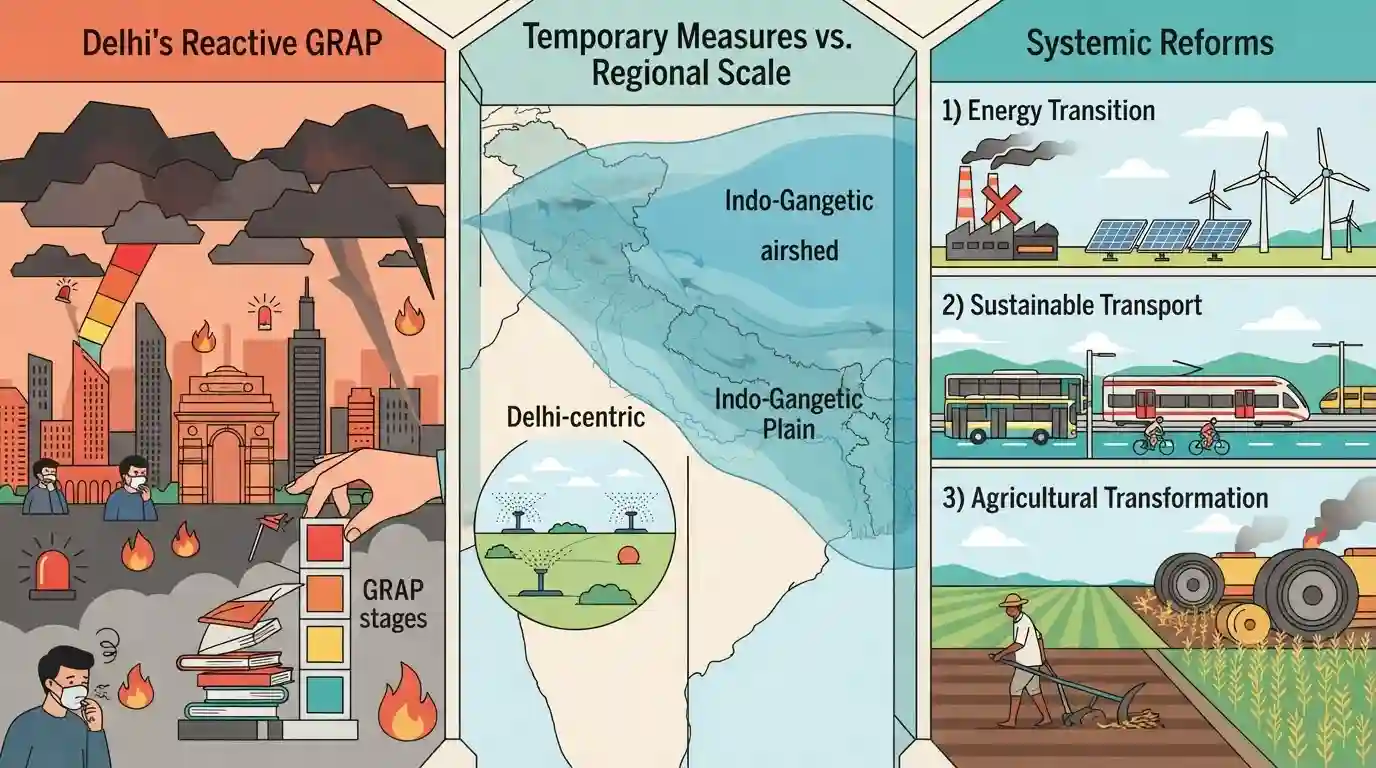
The article highlights the structural limitations of Delhi's Graded Response Action Plan (GRAP), noting that it serves as a temporary, reactive firefighting measure rather than a long-term solution. To effectively tackle winter air pollution, policy interventions must shift toward a comprehensive regional airshed approach across the Indo-Gangetic Plain and implement systemic structural reforms in energy, transport, and agriculture.
Key Points
- The Graded Response Action Plan (GRAP) acts primarily as a reactive crisis-management tool rather than a structural fix for Delhi's chronic air pollution.
- Air pollution in northern India operates on a regional airshed scale, requiring coordinated interstate airshed management rather than city-centric firefighting.
- Permanent structural reforms are necessary, including shifting to clean energy in manufacturing, massive electrification of public transit, and scientific stubble management.
Important Terms
Graded Response Action Plan

A multi-staged emergency response mechanism activated incrementally in Delhi-NCR based on air quality index thresholds to restrict dust, vehicular emissions, and industrial operations during severe winter pollution episodes.
UPSC context
UPSC Prelims & Mains (GS Paper III - Environment): Tests understanding of regulatory mechanisms and emergency air pollution management.
Commission for Air Quality Management
A statutory body established to monitor, coordinate, and regulate air quality management across the National Capital Region and adjoining industrial and agricultural air basins.
UPSC context
UPSC Prelims & Mains (GS Paper III - Environment): Evaluates institutional frameworks and statutory bodies for pollution governance.
National Clean Air Programme
India's flagship national strategy aiming to reduce particulate matter pollution concentrations in designated non-attainment cities through localized action plans and expanded monitoring networks.
UPSC context
UPSC Prelims & Mains (GS Paper III - Environment): Assesses national policy targets, timelines, and mitigation strategies for urban air quality.
Static Concepts Connected
What is the institutional framework governing air quality management in the National Capital Region?
- Creation: Statutory Body: Established under the Commission for Air Quality Management in National Capital Region and Adjoining Areas Act, 2021.
- Jurisdiction: Superseding Powers: It supersedes all existing bodies like the CPCB and state pollution control boards in NCR on air pollution matters.
- Enforcement: Binding Directions: The Commission has the power to issue binding directions and penalize violators with fines up to ₹1 crore or imprisonment up to 5 years.
Cross-Topic Patterns
Airshed Management vs Federal Governance Limits
Delhi's winter smog underscores how federal governance structures struggle with transboundary environmental externalities, linking cooperative federalism under Article 263 with inter-state river water disputes.
Clean Energy Transition and Agricultural Subsidies
Air quality management in the Indo-Gangetic Plain directly intersects with fiscal federalism, as subsidies for power and agriculture complicate green transition mandates.

Expect a multi-statement prelims question on CAQM powers versus state enforcement, or Mains on airshed governance vs emergency GRAP measures.
Linked PYQs · 3
Linked PYQs · 3
- 2020MainsGS3
What are the key features of the National Clean Air Programme (NCAP) initiated by the Government of India?
- 2021MainsGS3
Describe the key points of the revised Global Air Quality Guidelines (AQGs) recently released by the World Health Organisation (WHO). How are these different from its last update in 2005? What changes in India's National Clean Air Programme are required to achieve these revised standards?
- 2022MainsGS3
Discuss in detail the photochemical smog emphasizing its formation, effects and mitigation. Explain the 1999 Gothenburg Protocol.
