Delhi-Mumbai Expressway tunnel in Mukundra Hills and wildlife impact
Source:Indian Express ↗
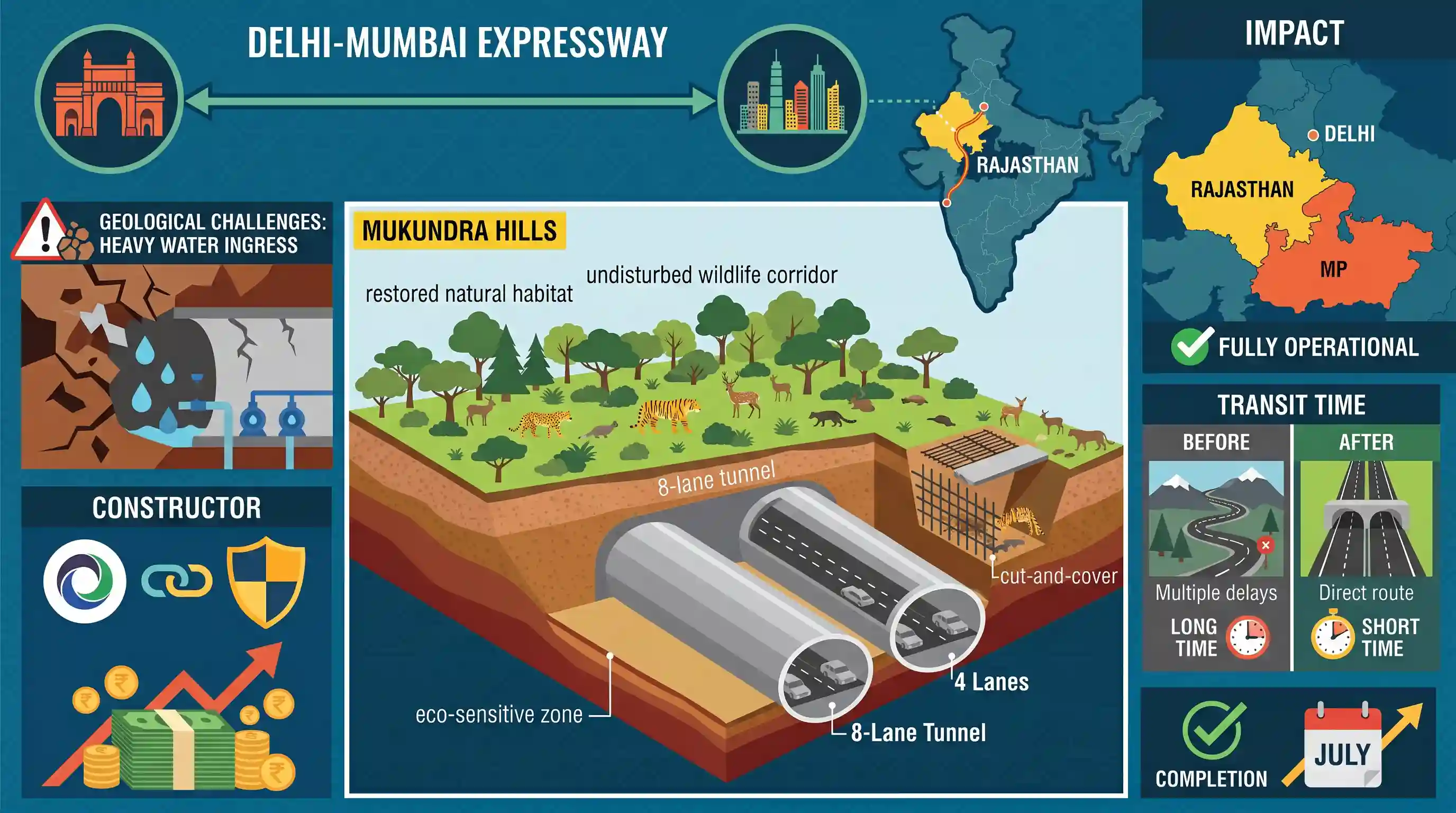
Why It Matters
The article serves as a critical case study for UPSC Mains GS3 on how to balance mega infrastructure projects (like the Delhi-Mumbai Expressway) with environmental conservation. The use of cut-and-cover tunnels to preserve wildlife corridors in a Tiger Reserve directly addresses the complexities of Environmental Impact Assessments (EIA) and sustainable development.
Summary
The Delhi-Mumbai Expressway's 4.89-km eight-lane tunnel, passing through the eco-sensitive Mukundra Hills tiger habitat in Rajasthan, is slated for completion in late July. Built at a revised cost of Rs 1,250 crore by a joint venture of Dilip Buildcon and Altis-Holding Corp, the project faced significant geological challenges, including heavy water ingress. To balance infrastructure growth with biodiversity conservation, the design integrates cut-and-cover sections that ensure an undisturbed wildlife corridor for tigers and other fauna. The opening will fully operationalize the Delhi-Rajasthan-MP stretch of the expressway, significantly reducing transit time between Delhi and Mumbai.
Key Points
- An eight-lane, 4.89-km twin-tube tunnel traversing the Mukundra Hills tiger habitat in Rajasthan is scheduled to open by late July.
- The tunnel features 'cut-and-cover' sections specifically designed to maintain the continuity of the wildlife corridor and prevent disturbances to tigers and other animals.
- The project cost escalated from Rs 1,000 crore to Rs 1,250 crore due to engineering challenges such as heavy water ingress and rainfall.
- Once operational, it will complete the Delhi-Rajasthan-Madhya Pradesh stretch of the Delhi-Mumbai Expressway, cutting total travel time between the two metropolises to just 12 hours.
Important Terms
Delhi-Mumbai Expressway

India’s longest 8-lane access-controlled greenfield expressway (1,386 km) connecting Delhi and Mumbai. It integrates "forgiving highway" designs and Asia’s first dedicated wildlife overpasses to reduce travel time and environmental impact.
UPSC context
GS Paper III (Infrastructure). Tests knowledge of flagship infrastructure projects and the balance between development and conservation.
Mukundra Hills Tiger Reserve
Rajasthan’s third tiger reserve (notified 2013), located in the Vindhyan range near Kota. It consists of three sanctuaries—Darrah, Jawahar Sagar, and Chambal—and serves as a critical movement corridor for tigers.
UPSC context
GS Paper III (Environment). Important for protected area locations, tiger conservation, and geography (Vindhyan range/Chambal river).
Eco-Sensitive Zones (ESZ)
Fragile areas within 10 km of Protected Areas notified under the Environment Protection Act, 1986. They serve as transition "shock absorbers" to regulate industrial activity and minimize human-animal conflict.
UPSC context
GS Paper III (Conservation). Tests understanding of environmental legislation and recent Supreme Court mandates on protected area buffers.
Bharatmala Pariyojana
A flagship umbrella program for the highway sector focused on optimizing freight movement. It utilizes a corridor-based approach to bridge infrastructure gaps via economic corridors and greenfield expressways.
UPSC context
GS Paper III (Infrastructure). Central to questions on logistics efficiency, multimodal integration, and national connectivity initiatives.
Wildlife Corridors
Ecological strips connecting isolated habitat patches to facilitate animal migration and gene flow. They are vital for preventing species isolation and mitigating the impact of linear infrastructure like roads.
UPSC context
GS Paper III (Biodiversity). Relevant for habitat fragmentation issues and sustainable infrastructure design (mitigation measures like underpasses).
Prelims Trap
Mukundra Hills Tiger Reserve is in the Aravalli range, and the Delhi-Mumbai Expressway completely bypasses all protected areas.
Mukundra Hills is in the Vindhyan range, not the Aravallis. The expressway actively intersects the reserve, mitigating impact via dedicated animal overpasses rather than bypassing it completely.
Static Concepts Connected
What are the key geographical features of Mukundra Hills Tiger Reserve?
- Hill Range: Located in a valley formed by two parallel mountains (Mukundra and Gargola) within the Vindhyan range in southeastern Rajasthan.
- Sanctuary Composition: It was established in 2013 by amalgamating three distinct zones: the Darrah, Jawahar Sagar, and Chambal Wildlife Sanctuaries.
- River Basin: The reserve is primarily drained by the Chambal River and its tributaries, forming a vital riparian ecosystem for diverse fauna.
How do Cut-and-Cover tunnels mitigate the ecological impact of highways?
- Habitat Connectivity: They act as eco-ducts or animal overpasses, preventing severe habitat fragmentation and maintaining genetic flow across divided ecosystems.
- Construction Method: A trench is excavated, roofed over, and covered with soil and native flora to seamlessly mimic the natural forest floor.
- Conflict Reduction: By segregating vehicular traffic from wildlife movement, they drastically reduce roadkill mortality and human-animal conflicts on high-speed corridors.
Cross-Topic Patterns
Linear Infrastructure vs. Wildlife Habitats
Reflects the ongoing UPSC focus on Environmental Impact Assessments (EIA) and National Board for Wildlife (NBWL) clearances, similar to the Ken-Betwa link or Great Nicobar projects.
Green Highways & Sustainable Engineering
Connects Bharatmala Pariyojana transit goals with ecological mandates, testing aspirants on the integration of rainwater harvesting and eco-ducts in large-scale road projects.

Mapping Tiger Reserves to their specific hill ranges (Mukundra/Vindhyas) and river basins (Chambal) is a highly probable 2026 Prelims question.
Linked PYQs · 5
Linked PYQs · 5
- 2021MainsGS3
“Investment in infrastructure is essential for more rapid and inclusive economic growth.” Discuss in the light of India's experience.
- 2024MainsGS3
What role do environmental NGOs and activists play in influencing Environmental Impact Assessment (EIA) outcomes for major projects in India? Cite four examples with all important details.
- 2023PrelimsGS1
With reference to India's projects on connectivity, consider the following statements: 1. East-West Corridor under Golden Quadrilateral Project connects Dibrugarh and Surat. 2. Trilateral Highway connects Moreh in Manipur and Chiang Mai in Thailand via Myanmar. 3. Bangladesh-China-India-Myanmar Economic Corridor connects Varanasi in Uttar Pradesh with Kunming in China. How many of the above statements are correct?
- 2026PrelimsGS1
With reference to Madhav National Park, which of the following statements is/are correct ? 1. It was declared a Tiger Reserve in India in 2025. 2. Sakhya Sagar, which is designated as a Ramsar Site, is situated within this National Park. 3. Its area is shared between Madhya Pradesh and Rajasthan. Select the answer using the code given below :
- 2020PrelimsGS1
Among the following Tiger Reserves, which one has the largest area under "Critical Tiger Habitat"?
