Press Council of India Constitutional Mandate and Vacancy Delay
Source:The Hindu ↗
Why It Matters
The Press Council of India (PCI) is a prominent example of a statutory, quasi-judicial body relevant to the UPSC GS-2 syllabus. Understanding its composition, mandate, and the implications of its non-functioning is essential for questions related to press freedom, accountability, and the role of institutional frameworks in democracy.
Summary
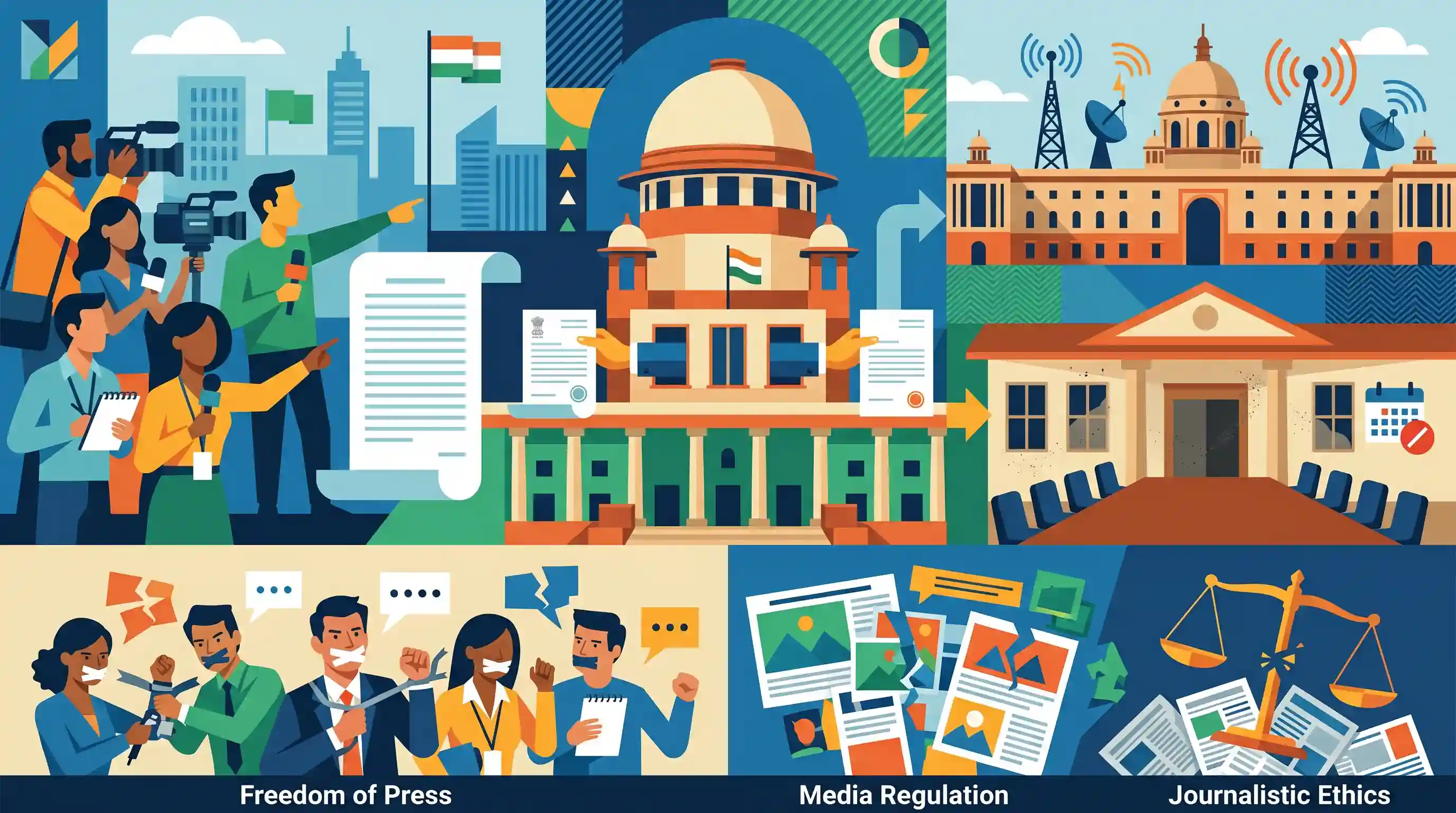
The Delhi High Court has issued notices to the Press Council of India (PCI) and the Union Ministry of Information and Broadcasting following a petition by the Mumbai Press Club over the failure to constitute the 15th Press Council. With the 14th Council's term having expired on October 8, 2024, the petitioners argue that the prolonged vacancy in this crucial quasi-judicial body undermines press freedom and the regulation of journalistic ethics in India. The PCI plays a key role in overseeing the smooth and ethical functioning of the press.
Key Points
- The Delhi High Court has sought responses from the Press Council of India and the I&B Ministry regarding the delay in constituting the 15th Press Council.
- The term of the 14th Press Council ended on October 8, 2024, leaving the quasi-judicial body without its designated members.
- The Mumbai Press Club filed a petition highlighting that the delay hinders the oversight of press ethics and journalistic standards.
- The Press Council of India typically comprises a chairperson and 28 members, representing journalists, media owners, MPs, and other experts, serving a three-year term.
Important Terms
Press Council of India (PCI)

A statutory, quasi-judicial body established under the Press Council Act, 1978, acting as a watchdog to preserve press freedom and maintain journalistic standards in India's print media.
UPSC context
GS-2: Statutory and regulatory bodies; tests understanding of media regulation and institutional autonomy.
Press Council Act, 1978
The legislation that re-established the Press Council of India in 1979, defining its composition (29 members), three-year term limit, and powers to censure unethical journalistic conduct.
UPSC context
GS-2: Important Acts and policies; tests knowledge of the legal framework governing the Fourth Estate.
Quasi-Judicial Body
A non-judicial entity, such as the PCI or a tribunal, empowered with court-like functions to adjudicate specialized disputes, summon witnesses, and examine evidence under specific statutes.
UPSC context
GS-2: Governance and Polity; essential for distinguishing between purely administrative and adjudicatory functions.
Freedom of Press
A fundamental right derived from Article 19(1)(a) of the Indian Constitution, encompassing the right to publish and circulate information without arbitrary government interference.
UPSC context
GS-2: Fundamental Rights; tested through the lens of 'reasonable restrictions' and the media's role in democracy.
Union Ministry of Information and Broadcasting
The nodal Union ministry responsible for formulating and administering rules, regulations, and laws related to information, broadcasting, the press, and films in India.
UPSC context
GS-2: Government policies and interventions; tests knowledge of the executive's role in media oversight.
Delhi High Court
A constitutional court with original and appellate jurisdiction; in this case, exercising writ jurisdiction under Article 226 to seek accountability regarding the delayed constitution of a statutory body.
UPSC context
GS-2: Judiciary; tests understanding of writ jurisdiction and judicial oversight over executive delays.
Prelims Trap
"PCI regulates electronic media, digital portals, and can impose monetary penalties on erring journalists."
PCI's jurisdiction is exclusively restricted to print media and news agencies. It lacks punitive powers (cannot impose fines) and its decisions cannot be appealed in court.
Static Concepts Connected
What is the composition and appointment mechanism of the Press Council of India?
- Composition: It consists of a Chairman and 28 members, which includes 5 Members of Parliament (3 from Lok Sabha, 2 from Rajya Sabha).
- Appointment Committee: The Chairman (typically a retired SC judge) is chosen by the Lok Sabha Speaker, Rajya Sabha Chairman, and one PCI member. The CJI is not involved.
- Term of Office: Members serve a designated three-year term under the Press Council Act, 1978.
What are the specific jurisdictional limits and powers of the PCI?
- Print Only: It only regulates print media (newspapers, magazines) and news agencies. It has no statutory authority over television, radio, or digital news platforms.
- Quasi-Judicial Powers: While it has civil court powers to summon witnesses, it lacks punitive authority. It can warn or censure, but cannot fine or penalize.
- Finality of Decisions: Decisions made regarding complaints of journalistic misconduct are final and cannot be contested or appealed in a court of law.
Cross-Topic Patterns
PCI vs. NBSA vs. Digital Rules
UPSC often contrasts statutory regulation of print media (PCI) with self-regulation of broadcast (NBSA) and executive oversight of digital media via the IT Rules 2021.
Toothless Tigers in Governance
The PCI's lack of punitive power parallels the National Human Rights Commission (NHRC), often cited in Mains questions analyzing the efficacy of India's statutory watchdogs.

Expect a multi-statement Prelims question contrasting PCI's print-only jurisdiction with IT Rules 2021 for digital media.
Linked PYQs · 3
Linked PYQs · 3
- 2016MainsGS2
What is a quasi-judicial body? Explain with the help of concrete examples.
- 2014MainsGS2
What do you understand by the concept "freedom of speech and expression"? Does it cover hate speech also ? Why do the films in India stand on a slightly different plane from other forms of expression ? Discuss.
- 2023PrelimsGS1
Consider the following organizations/bodies in India: 1. The National Commission for Backward Classes 2. The National Human Rights Commission 3. The National Law Commission 4. The National Consumer Disputes Redressal Commission How many of the above are constitutional bodies?
