High Court Orders Community Service in Quashing FIR
Source:Indian Express ↗
Why It Matters
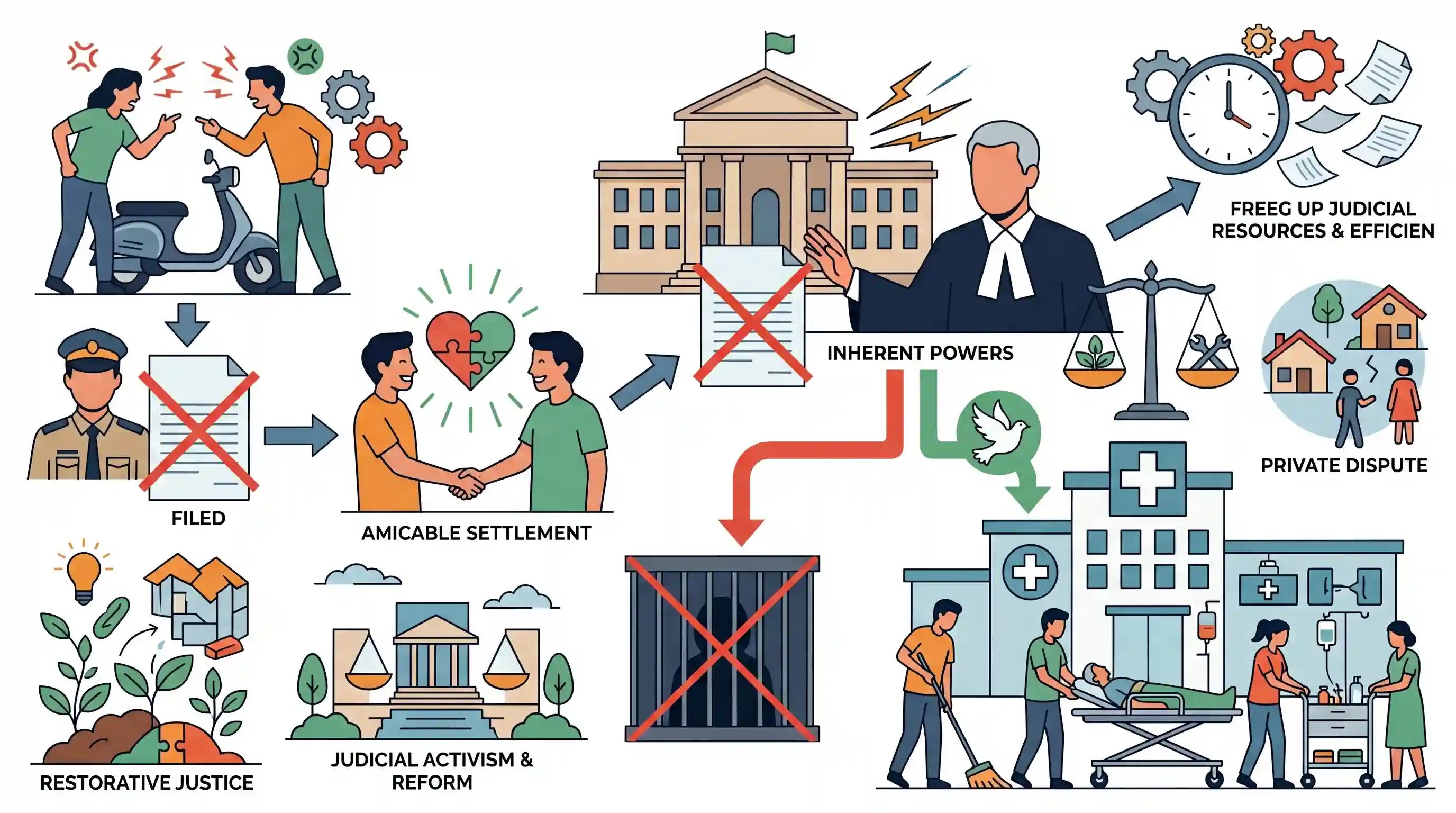
It provides a practical example of the Indian judiciary's growing adoption of restorative justice and alternative punishments (like community service) to address the pendency of cases, demonstrating the application of inherent powers under the newly enacted BNSS.
Summary
The Delhi High Court quashed a 2018 FIR regarding a scuffle over a parked scooter after the parties reached an amicable settlement. In lieu of conventional prosecution, the court ordered the accused to perform community service at Safdarjung Hospital, underscoring a restorative justice approach. Justice Prateek Jalan invoked the High Court's inherent powers under Section 528 of the Bharatiya Nagarik Suraksha Sanhita (BNSS) and Article 226 of the Constitution, noting that the dispute was overwhelmingly private in nature and quashing it would free up judicial resources.
Key Points
- The Delhi High Court quashed a 2018 assault FIR following a settlement, directing the accused to perform a month of community service at Safdarjung Hospital.
- The decision reflects a shift towards a restorative justice approach, aiming to rehabilitate offenders and resolve personal disputes without clogging the penal system.
- The Court exercised its inherent powers under Section 528 of the BNSS (formerly Section 482 of the CrPC) and Article 226 of the Constitution.
- Relying on Supreme Court precedents (e.g., Gian Singh v State of Punjab), the Court emphasized that FIRs in overwhelmingly private disputes can be quashed upon settlement, unlike grave societal offenses.
- Mandating community service in public institutions is increasingly utilized as an alternative judicial measure to ensure accountability while serving the public good.
Important Terms
Bharatiya Nagarik Suraksha Sanhita (BNSS)

The 2023 legislation replacing the Code of Criminal Procedure (CrPC). It governs the procedural aspects of criminal justice in India, including investigation, arrest, and trial processes.
UPSC context
GS Paper II (Governance/Law); critical for questions on criminal justice reforms and the transition from colonial-era laws.
Section 528 of the BNSS
The specific provision in the BNSS (successor to Section 482 CrPC) that preserves the High Court's inherent power to quash proceedings to prevent the abuse of any legal process.
UPSC context
GS Paper II (Judiciary); tests understanding of judicial discretion and the inherent powers of the High Court to ensure justice.
Article 226 of the Constitution
A constitutional provision empowering High Courts to issue writs (like Habeas Corpus or Mandamus) for the enforcement of fundamental rights and for "any other purpose."
UPSC context
GS Paper II (Polity); a core topic regarding judicial review and the comparative powers of the High Court vs. the Supreme Court.
Restorative Justice
A system of criminal justice which focuses on the rehabilitation of offenders through reconciliation with victims and the community at large, prioritizing healing over retribution.
UPSC context
GS Paper II & IV (Ethics/Governance); relevant for essays and questions on judicial reform, victimology, and ethical punishment.
Community Service
Unpaid work performed by an offender for the community's benefit; formally introduced as a distinct form of punishment under Section 4(f) of the Bharatiya Nyaya Sanhita (BNS).
UPSC context
GS Paper II (Social Justice/Law); highlights modern shifts in penology and reformative measures for petty offenses.
Prelims Trap
Only the Supreme Court possesses inherent powers to quash criminal proceedings to secure the ends of justice.
While Article 142 gives the SC "complete justice" powers, High Courts possess statutory inherent powers under Section 528 BNSS (formerly Section 482 CrPC) to quash proceedings and secure justice.
Static Concepts Connected
How do the High Court's inherent powers differ from the Supreme Court's?
- High Court statutory: Derives inherent powers to prevent abuse of the court process from statutory law, specifically Section 528 of the BNSS (formerly Section 482 of the CrPC).
- Supreme Court constitutional: Utilizes Article 142 of the Constitution to pass any decree or make any order necessary for doing "complete justice" in any pending matter.
What distinguishes Restorative Justice from Retributive Justice?
- Restorative Justice: Focuses on repairing harm, rehabilitating the offender, and reconciling with victims, often utilizing alternative measures like community service.
- Retributive Justice: Views crimes primarily as offenses against the State, emphasizing proportional punishment of the wrongdoer to serve as a societal deterrent.
Cross-Topic Patterns
Community Service in Bhartiya Nyaya Sanhita
The new Bhartiya Nyaya Sanhita (BNS) formally introduces 'community service' as a statutory punishment for petty offenses, codifying restorative practices that were previously driven purely by judicial activism.
Writ Jurisdiction: Article 226 vs 32
Invoking Article 226 to quash private disputes highlights its wider scope ("for any other purpose") compared to the Supreme Court's Article 32, which is strictly restricted to Fundamental Rights enforcement.

Expect a comparative question distinguishing High Court's inherent statutory powers (BNSS Sec 528) from Supreme Court's Article 142 in 2026.
Linked PYQs · 3
Linked PYQs · 3
- 2024MainsGS4
“The concept of Just and Unjust is contextual. What was just a year back, may turn out to be unjust in today's context. Changing context should be constantly under scrutiny to prevent miscarriage of justice.” Examine the above statement with suitable examples.
- 2023MainsGS2
“Constitutionally guaranteed judicial independence is a prerequisite of democracy.” Comment.
- 2021MainsGS2
‘Constitutional Morality’ is rooted in the Constitution itself and is founded on its essential facets. Explain the doctrine of ‘Constitutional Morality’ with the help of relevant judicial decisions.
