Delhi High Court Examines Telegram Intermediary Liability Dispute
Source:The Hindu ↗
Why It Matters
This case highlights the constitutional and administrative friction between the state's mandate to maintain public order (e.g., preventing exam leaks) and the fundamental rights to free speech and trade on digital platforms. It is highly relevant for understanding the scope of Section 69A of the IT Act and the security challenges posed by encrypted messaging intermediaries.
Summary
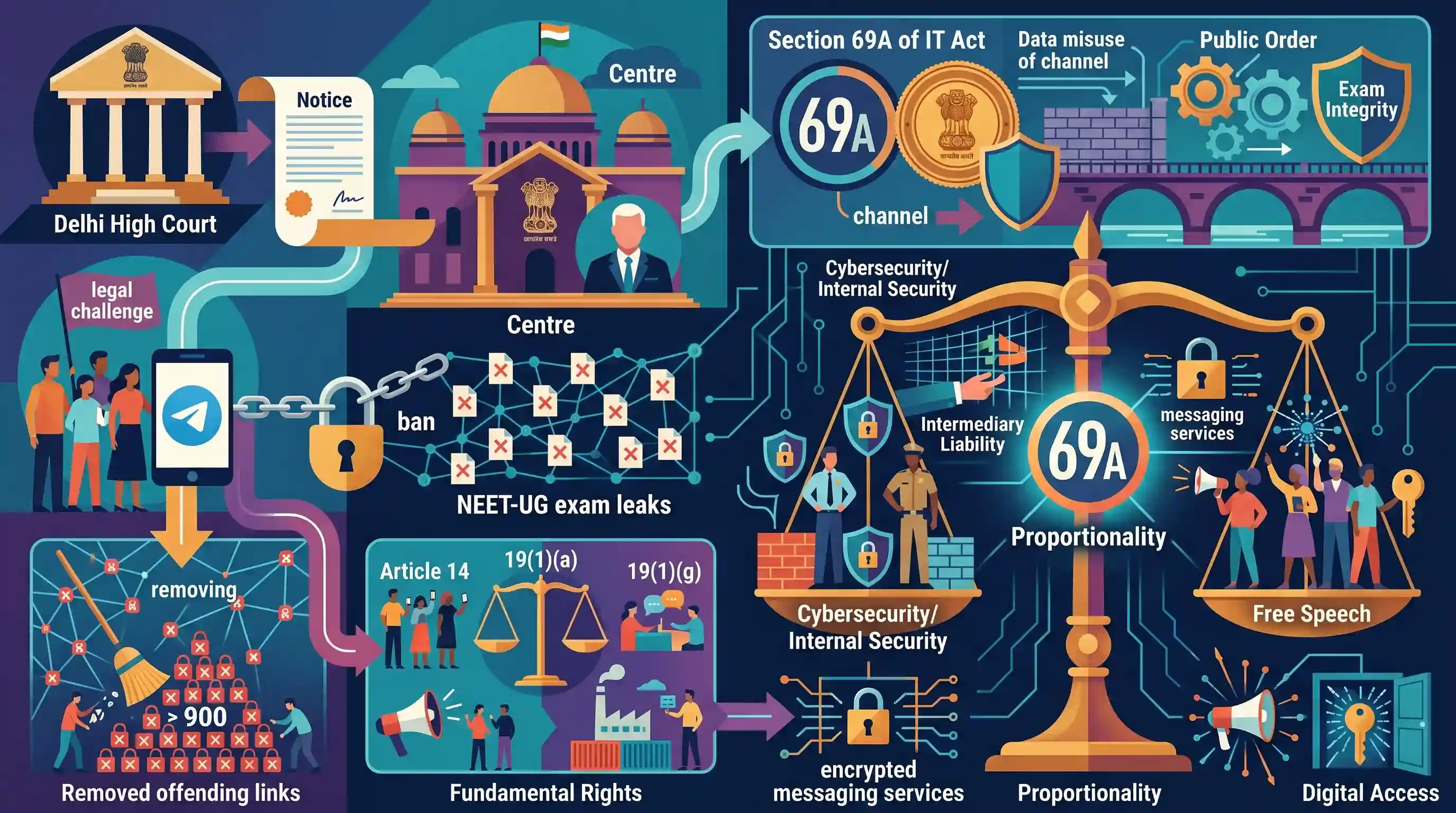
The Delhi High Court has issued a notice to the Centre following Telegram's legal challenge against a temporary ban imposed under Section 69A of the Information Technology Act. The Ministry of Electronics and Information Technology implemented the ban, citing the misuse of Telegram channels to sell leaked NEET-UG examination questions and emphasizing the threat to public order and exam integrity. Telegram countered that a blanket ban violates fundamental rights, including Articles 14, 19(1)(a), and 19(1)(g), arguing it penalizes the entire platform for isolated incidents despite their cooperation in removing over 900 offending links. The case brings to the forefront critical issues regarding intermediary liability, the regulation of encrypted messaging services, and the principle of proportionality in balancing state security measures with free speech and digital access.
Key Points
- The Delhi High Court issued a notice to the Centre over a petition by Telegram challenging a temporary ban imposed by the government until June 22.
- The ban was enacted under Section 69A of the Information Technology Act by the Ministry of Electronics and Information Technology, citing public order concerns related to alleged leaks of NEET-UG question papers on the platform.
- Telegram argued that the blanket ban is arbitrary, unconstitutional, and violates the right to free speech, access to information, and the right to carry on a profession, noting that it had already removed over 900 offending links.
- The government defended the ban, stating that Telegram channels were actively used to sell leaked examination materials, thereby compromising the integrity of the NEET-UG exam.
- The court questioned the proportionality of banning an entire platform for the actions of a subset of users, noting that any digital platform could be misused, and asked for clarification on the scale of the illegal activity.
Important Terms
Section 69A of the IT Act

A provision empowering the Central Government to block public access to online content in the interest of sovereignty, integrity, defense, security, friendly foreign relations, or public order.
UPSC context
GS Paper 2 & 3: Tests knowledge of state powers versus digital rights and internal security measures.
Intermediary Liability
The legal accountability of digital platforms (intermediaries) for content posted by users, often mitigated by 'safe harbor' protections if they comply with government takedown orders.
UPSC context
GS Paper 3: Critical for understanding social media regulation, IT Rules 2021, and cybersecurity frameworks.
Article 19(1)(a)
Guarantees all citizens the right to freedom of speech and expression, which the Supreme Court (Anuradha Bhasin case) ruled includes the right to express oneself over the internet.
UPSC context
GS Paper 2: Fundamental Rights. Tests the balance between individual liberty and "reasonable restrictions" under Article 19(2).
Article 19(1)(g)
Ensures the right to practice any profession or carry on any occupation, trade, or business, protected even when conducted through digital or internet-based platforms.
UPSC context
GS Paper 2 & 3: Relevant for cases where internet bans impact livelihoods and digital commerce.
Principle of Proportionality
A judicial standard requiring that any state restriction on fundamental rights must be legal, serve a legitimate goal, and be the least intrusive means to achieve it.
UPSC context
GS Paper 2: Ethics & Governance. Key test for judging the constitutionality of executive actions and bans.
Article 14
Guarantees equality before the law and prohibits discrimination, often invoked to challenge "arbitrary" government actions that treat similar platforms or individuals unequally.
UPSC context
GS Paper 2: Fundamental Rights. Essential for analyzing the fairness and non-arbitrariness of executive orders.
Ministry of Electronics and Information Technology (MeitY)
The nodal agency responsible for India's digital policies, including the implementation of the IT Act and issuing content-blocking orders under Section 69A.
UPSC context
GS Paper 2: Statutory and Executive Bodies. Relevant for questions on digital governance and administrative law.
Prelims Trap
"Under Section 69A of the IT Act, the government can block content to prevent defamation or contempt of court."
Section 69A permits blocking only for sovereignty, defence, security, friendly relations, or public order. Defamation and contempt, while in Art 19(2), are NOT explicit grounds for 69A.
Static Concepts Connected
What is the 'Doctrine of Proportionality' in the context of internet restrictions?
- Judicial Origin: Applied to internet access in the Anuradha Bhasin vs UoI (2020) case, following the principles laid out in the KS Puttaswamy privacy judgment.
- Core Test: A restriction must be backed by law, serve a legitimate state aim, be the least restrictive measure available, and balance competing rights.
- Application: Indefinite internet bans are unconstitutional. Banning an entire platform for the actions of a few users is often challenged as a disproportionate response.
How do Section 69A and Section 79 of the IT Act intersect?
- Section 69A (Blocking): Empowers the Central Government to block public access to digital information under specific grounds like security or public order.
- Section 79 (Safe Harbour): Grants 'safe harbour' immunity to intermediaries (like Telegram) from legal liability for third-party user-generated content hosted on their platforms.
- The Intersection: Safe harbour is conditional. An intermediary loses its Section 79 immunity if it fails to expeditiously comply with a valid Section 69A blocking order.
Cross-Topic Patterns
Cyber-crime & exam integrity
The use of encrypted platforms like Telegram to leak competitive exam papers links internal security (cyber-policing) directly to governance issues and educational equity.
Balancing IT Act powers & Article 19
Platform bans highlight the friction between state regulatory tools (Section 69A) and citizens' fundamental rights to information and digital profession under Articles 19(1)(a) and 19(1)(g).

Expect a 2026 GS-2 question evaluating the 'doctrine of proportionality' in balancing intermediary safe harbour with national security.
Linked PYQs · 2
Linked PYQs · 2
- 2024MainsGS3
Social media and encrypting messaging services pose a serious security challenge. What measures have been adopted at various levels to address the security implications of social media? Also suggest any other remedies to address the problem.
- 2013MainsGS3
What are social networking sites and what security implications do these sites present ?
