Delhi High Court Notice on Plea to Rescue Trafficked Minors
Source:The Hindu ↗
આ શા માટે મહત્વનું છે
This issue brings attention to the ongoing challenges of human trafficking and child labour in India, emphasizing the critical role of statutory bodies like the NCPCR and the judiciary in protecting vulnerable sections of society.
સારાંશ
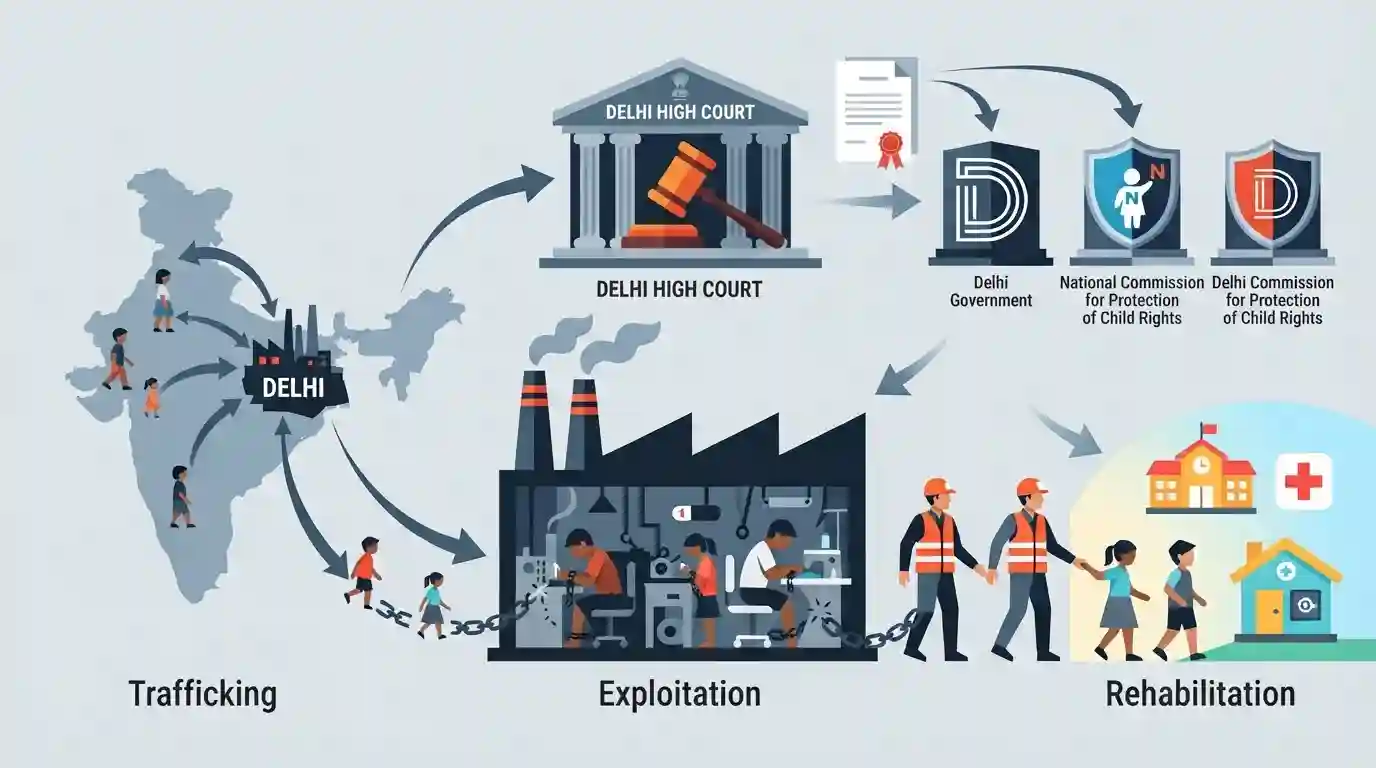
The Delhi High Court has issued notices to the Delhi government, the Delhi Commission for Protection of Child Rights (DCPCR), and the National Commission for Protection of Child Rights (NCPCR) based on a plea seeking the rescue of over 1,000 minors. These children, trafficked from various parts of the country, are reportedly forced to work as bonded labourers in hazardous factories in Delhi. The plea underscores the urgent need for their rescue, rehabilitation, and stricter enforcement of child protection laws against traffickers.
મુખ્ય મુદ્દા
- The Delhi High Court has sought responses from the Delhi government, DCPCR, and NCPCR regarding a plea to rescue over 1,000 trafficked minors.
- The minors, trafficked from various states across India, are allegedly forced to work as bonded labourers in unsafe and hazardous conditions in Delhi.
- The plea calls for the immediate rescue and rehabilitation of the children, along with strict legal action against the traffickers and factory owners.
- The case highlights systemic enforcement gaps in existing anti-trafficking and child labour laws.
મહત્વપૂર્ણ શબ્દો
National Commission for Protection of Child Rights (NCPCR)

A statutory body established under the Commissions for Protection of Child Rights Act, 2005. It functions under the Ministry of Women and Child Development to monitor and safeguard children's rights, including enforcing laws like POCSO and RTE.
UPSC context
Highly relevant for GS-2 (Statutory Bodies, Vulnerable Sections). Questions often test its mandate, powers, and role in child welfare.
Delhi Commission for Protection of Child Rights (DCPCR)
A state-level statutory body constituted under the CPCR Act, 2005. It monitors child rights implementation, investigates violations like child trafficking and bonded labor, and advises the government on child protection policies in the national capital.
UPSC context
Relevant for GS-2 (Statutory Bodies). Highlights decentralized frameworks for child protection and state-level institutional responses to exploitation.
Delhi High Court
The apex judicial body for the National Capital Territory of Delhi. In child protection cases, it exercises its writ jurisdiction (Article 226) to issue directives to state authorities, compelling action against trafficking and bonded labor.
UPSC context
Connects to GS-2 (Judiciary). Demonstrates judicial activism, public interest litigation (PIL), and the enforcement of fundamental rights (Articles 21 and 23).
Delhi Government
The administrative authority of the National Capital Territory of Delhi, functioning under Article 239AA. It holds primary executive responsibility for implementing labor laws, rescuing bonded laborers, and maintaining child welfare institutions within its jurisdiction.
UPSC context
Relevant to GS-2 (Federalism). Tests knowledge of Delhi's special constitutional status and the state's executive responsibilities regarding vulnerable sections.
પ્રિલિમ્સ ટ્રેપ
Article 24 of the Constitution completely prohibits the employment of children below 14 years in all types of occupations.
Article 24 only bans child labour in factories, mines, and hazardous jobs. The blanket ban across all sectors (with minor family enterprise exceptions) is statutory, enforced by the Child Labour Act, 2016.
સંલગ્ન સ્થિર ખ્યાલો
What are the key Constitutional shields against forced and child labour?
- Article 23: Prohibits traffic in human beings, begar, and other forms of forced labour.
- Article 24: Explicitly forbids employing children below 14 years in factories, mines, or hazardous occupations.
- Judicial expansion: The Supreme Court ruled in Bandhua Mukti Morcha that bonded labour violates Article 21's right to live with human dignity.
How does India's legal framework align with ILO child labour conventions?
- ILO Convention 138: Requires a minimum employment age. India's 2016 Act meets this by largely banning work for children under 14.
- ILO Convention 182: Targets the worst forms of child labour. India aligns by explicitly prohibiting adolescents (14-18) from hazardous occupations.
- Family enterprise exemption: The 2016 Act allows children under 14 to help in non-hazardous family businesses post-school hours, a carve-out often debated by child rights advocates.
આંતર-વિષય પેટર્ન
Distress migration + Bonded labour
Interstate child trafficking typically targets distressed migrants fleeing climate shocks or agrarian crises, directly linking core economic geography concepts to social justice vulnerabilities.
NCPCR vs NHRC mandate overlaps
The rescue of bonded child labourers triggers the mandates of both the NHRC (bonded labour) and NCPCR (child rights), highlighting structural governance overlaps among statutory bodies.

Expect a 2026 Prelims question distinguishing Article 24's hazardous-work focus from the 2016 statutory blanket ban on child labour.
સંલગ્ન PYQ · 3
સંલગ્ન PYQ · 3
- 2025MainsGS2
The National Commission for Protection of Child Rights has to address the challenges faced by children in the digital era. Examine the existing policies and suggest measures the Commission can initiate to tackle the issue.
- 2016MainsGS2
Examine the main provisions of the National Child Policy and throw light on the status of its implementation.
- 2018MainsGS3
India's proximity to two of the world's biggest illicit opium-growing states has enhanced her internal security concerns. Explain the linkages between drug trafficking and other illicit activities such as gunrunning, money laundering and human trafficking. What counter-measures should be taken to prevent the same?
