Delhi High Court Study on Judicial Background and Bail Discretion
Source:Indian Express ↗
কেন এটি গুরুত্বপূর্ণ
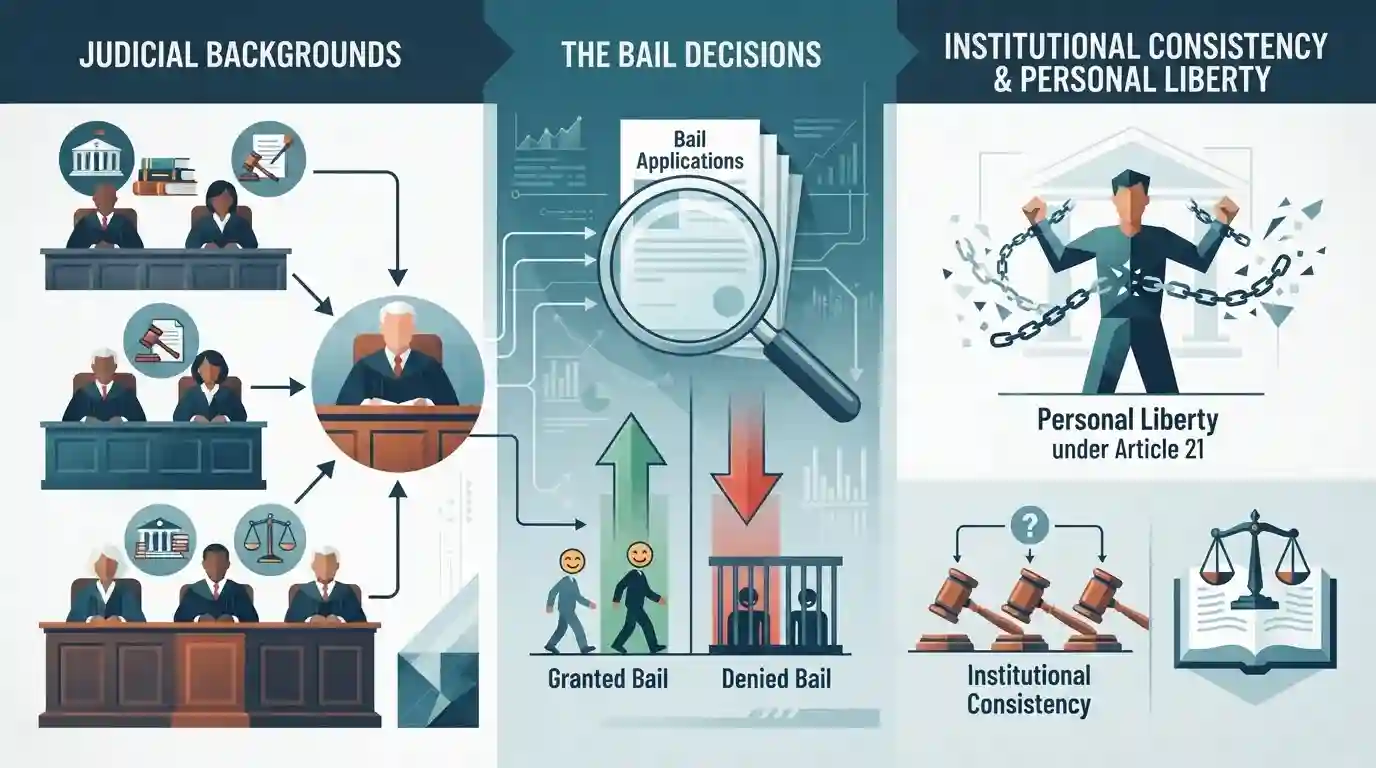
The study provides empirical insights into how judicial background affects discretion in bail decisions, directly impacting fundamental rights under Article 21 and highlighting the need for objective standards and diversity in the higher judiciary.
সারসংক্ষেপ
An analysis of a Delhi High Court study examining the correlation between judges' personal and professional backgrounds and their decisions on bail applications, raising questions about judicial discretion, institutional consistency, and the protection of personal liberty under Article 21.
মূল বিষয়
- A recent study on the Delhi High Court analyzed how judges' socio-economic, educational, and professional backgrounds influence their bail adjudication decisions.
- The research highlights potential judicial biases or patterns in granting or denying bail, intersecting with Article 21 (Right to Life and Personal Liberty).
- It underscores the importance of institutional consistency and objective criteria in criminal jurisprudence, minimizing subjective elements in personal liberty matters.
- The findings open a critical conversation about judicial diversity, background representation, and training within the higher judiciary.
গুরুত্বপূর্ণ শব্দ
Bail Jurisprudence

A legal mechanism determining whether an accused person awaiting trial remains in custody or is released, governed by principles balancing societal safety against personal liberty, notably the doctrine that 'bail is the rule, jail is the exception'.
UPSC context
Mains GS Paper II (Indian Judiciary, Rights, and Constitutionalism). Tests understanding of pre-trial detention, judicial discretion, and human rights.
Judicial Discretion
The authority of judges to decide cases based on their subjective interpretation of law and facts, raising concerns about institutional consistency when personal or professional backgrounds influence outcomes.
UPSC context
Mains GS Paper II (Structure, Organization, and Functioning of the Judiciary). Crucial for examining accountability, judicial independence, and consistency in adjudication.
Article 21
The fundamental right under Part III of the Constitution guaranteeing that no person shall be deprived of life or personal liberty except according to procedure established by law.
UPSC context
Prelims and Mains GS Paper II (Indian Constitution, Fundamental Rights). Core provision underpinning bail jurisprudence and anti-arbitrariness standards.
প্রিলিমস ফাঁদ
Judges promoted from the district judiciary grant bail at identical rates to those directly appointed from the practicing Bar.
Aspirants often assume all High Court judges have identical adjudication patterns regardless of whether they were elevated from the Bar or the subordinate judiciary.
সংযুক্ত স্থির ধারণা
What are the constitutional and statutory frameworks governing bail in India?
- Constitutional Anchor: Article 21 guarantees life and personal liberty, forming the bedrock of India's bail jurisprudence where 'bail is the rule, jail is the exception'.
- Statutory Basis: CrPC (now BNSS) categorizes offenses into bailable and non-bailable, giving courts judicial discretion in non-bailable matters under Section 437/439 (now BNSS equivalents).
- Judicial Precedents: Landmark rulings like State of Rajasthan v. Balchand (1977) and Nikesh Tarachand Shah (2017) established liberty as the default standard.
আন্তঃবিষয় প্যাটার্ন
Judicial Backgrounds and AIJS Reforms
Studies on higher judiciary background disparities intersect directly with discussions on All India Judicial Service (AIJS) reforms and collegium transparency.
Bail Jurisprudence vs. Article 21 Consistency
Inconsistent bail rates across judicial pathways challenge the foundational Article 21 guarantee of uniform due process of law.

Expect statement-based questions connecting judicial career pathways (Bar vs. Service) to Article 21 bail jurisprudence and institutional consistency.
সংযুক্ত PYQ · 2
সংযুক্ত PYQ · 2
- 2023MainsGS2
“Constitutionally guaranteed judicial independence is a prerequisite of democracy.” Comment.
- 2023MainsGS2
“The Constitution of India is a living instrument with capabilities of enormous dynamism. It is a constitution made for a progressive society.” Illustrate with special reference to the expanding horizons of the right to life and personal liberty.
