Judicial Intervention on Protester Health and Legal Safeguards
Source:The Hindu ↗
Why It Matters
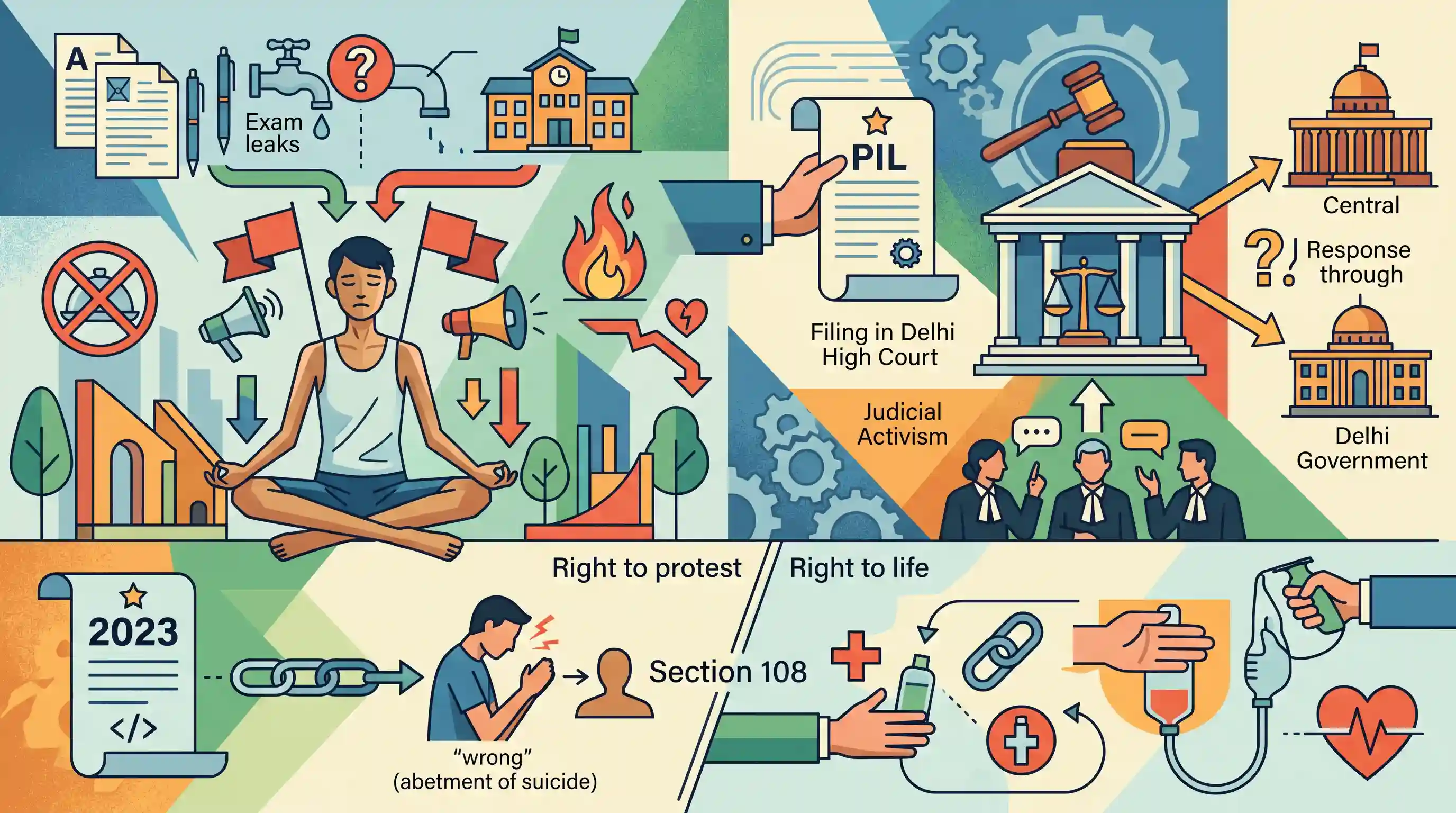
This case highlights the complex intersection of the fundamental Right to Protest (Article 19), the Right to Life (Article 21), and the state's legal/ethical duty to intervene in a fast-unto-death scenario. It also highlights the implementation of the new Bharatiya Nyaya Sanhita (BNS), 2023, specifically looking at the legally complex boundary between political hunger strikes and the crime of attempt/abetment of suicide.
Summary
The Delhi High Court has demanded urgent responses from both the Central and Delhi governments regarding a Public Interest Litigation (PIL) seeking immediate medical intervention and potential force-feeding for climate activist Sonam Wangchuk. Wangchuk has been on an indefinite hunger strike at Jantar Mantar since late June 2026, protesting exam leaks (NEET) and demanding education ministry reforms. The petitioner argues that under Section 108 of the Bharatiya Nyaya Sanhita (BNS), 2023, allowing Wangchuk's health to collapse without intervention would legally constitute abetment of suicide.
Key Points
- Climate activist Sonam Wangchuk initiated an indefinite hunger strike at Delhi's Jantar Mantar on June 28, 2026, demanding education reforms and the resignation of Union Education Minister Dharmendra Pradhan over exam irregularities and NEET paper leaks.
- A Public Interest Litigation (PIL) was filed in the Delhi High Court by advocate Rakesh Kumar Saini to safeguard Wangchuk's deteriorating health, requesting court-ordered medical intervention or force-feeding if necessary.
- The petitioner legally invoked Section 108 of the newly implemented Bharatiya Nyaya Sanhita (BNS), 2023, claiming that state inaction could lead to an offense of 'Abetment of Suicide'.
- A Delhi High Court division bench led by Chief Justice Devendra Kumar Upadhyaya and Justice Tejas Karia recognized the 'urgent' nature of the plea and directed the Centre and Delhi Government to submit responses on their medical intervention plans.
Important Terms
Bharatiya Nyaya Sanhita, 2023 (BNS)

The official substantive criminal code of India that replaced the colonial-era Indian Penal Code (IPC) on July 1, 2024, modernizing provisions on offences, punishments, and justice administration.
UPSC context
GS Paper II (Polity & Governance); tests understanding of criminal justice reforms, citizen-centric legislation, and comparative legal analysis.
Government of National Capital Territory of Delhi
The unique governance structure for Delhi under Article 239AA of the Constitution, featuring an elected legislative assembly and council of ministers, but excluding police, land, and public order powers.
UPSC context
GS Paper II (Polity & Federalism); tests comprehension of asymmetric federalism, Centre-State relations, and executive-legislative dynamics in Delhi.
Delhi High Court
The premier judicial body for the National Capital Territory of Delhi, established in 1966, holding original civil, criminal, and constitutional writ jurisdiction under Article 226 of the Indian Constitution.
UPSC context
GS Paper II (Polity & Judiciary); tests the roles, writ powers, and exclusive jurisdiction of High Courts in Union Territories.
Constitution of India
The supreme lex or fundamental governing law of India that establishes the political framework, rights of citizens, and duties of the central and state governments.
UPSC context
GS Paper II (Polity); foundational to all civil services papers, testing constitutional morality, federalism, and fundamental rights.
Central Government
The federal executive authority of the Republic of India, established under the Constitution, with executive powers extending to subjects under the Union List.
UPSC context
GS Paper II (Polity and Governance); tests understanding of the executive organ, federal separation of powers, and administrative control over Union Territories.
Prelims Trap
The Bharatiya Nyaya Sanhita (BNS), 2023, has completely decriminalized any attempt to commit suicide under Indian law.
While IPC Section 309 is gone, BNS Section 226 retains criminalization for attempts made with the intent to compel or restrain a public servant from doing their duty.
Static Concepts Connected
How has the Supreme Court interpreted the Right to Die under Article 21?
- Gian Kaur (1996): Ruled that Article 21's Right to Life is a right to live with dignity and does not encompass the Right to Die.
- Common Cause (2018): Held that the Right to Die with Dignity is intrinsic to Article 21, legalizing passive euthanasia and living wills.
- Active Euthanasia: Remains strictly illegal in India, distinguishing it from passive withdrawal of life support.
What is the statutory framework governing suicide attempts under Indian laws?
- Mental Healthcare Act: Section 115 presumes a person attempting suicide is under severe stress, effectively barring prosecution under general circumstances.
- BNS Section 226: Retains criminalization selectively for suicide attempts intended to compel or restrain a public official from performing their duties.
Cross-Topic Patterns
Force-feeding, Article 21, and Right to Protest
Balances the state's positive obligation to protect life under Article 21 against an individual's personal autonomy and right to peaceful dissent under Article 19.
BNS 2023 vs Mental Healthcare Act 2017
Highlights statutory friction between mental health protections (presumption of severe stress) and new criminal provisions (Section 226) targeting coercive political fasts.

BNS Section 226's selective criminalization of suicide to coerce public servants is a prime candidate for a 2026 Prelims statement.
Linked PYQs · 3
Linked PYQs · 3
- 2024MainsGS2
Explain the reasons for the growth of public interest litigation in India. As a result of it, has the Indian Supreme Court emerged as the world's most powerful judiciary ?
- 2020MainsGS2
Judicial Legislation is antithetical to the doctrine of separation of powers as envisaged in the Indian Constitution. In this context justify the filing of large number of public interest petitions praying for issuing guidelines to executive authorities.
- 2024MainsGS2
Right to privacy is intrinsic to life and personal liberty and is inherently protected under Article 21 of the constitution. Explain. In this reference discuss the law relating to D.N.A. testing of child in the womb to establish its paternity.
