Urban Heat Island Effects and Disaster Preparedness
Source:Indian Express ↗
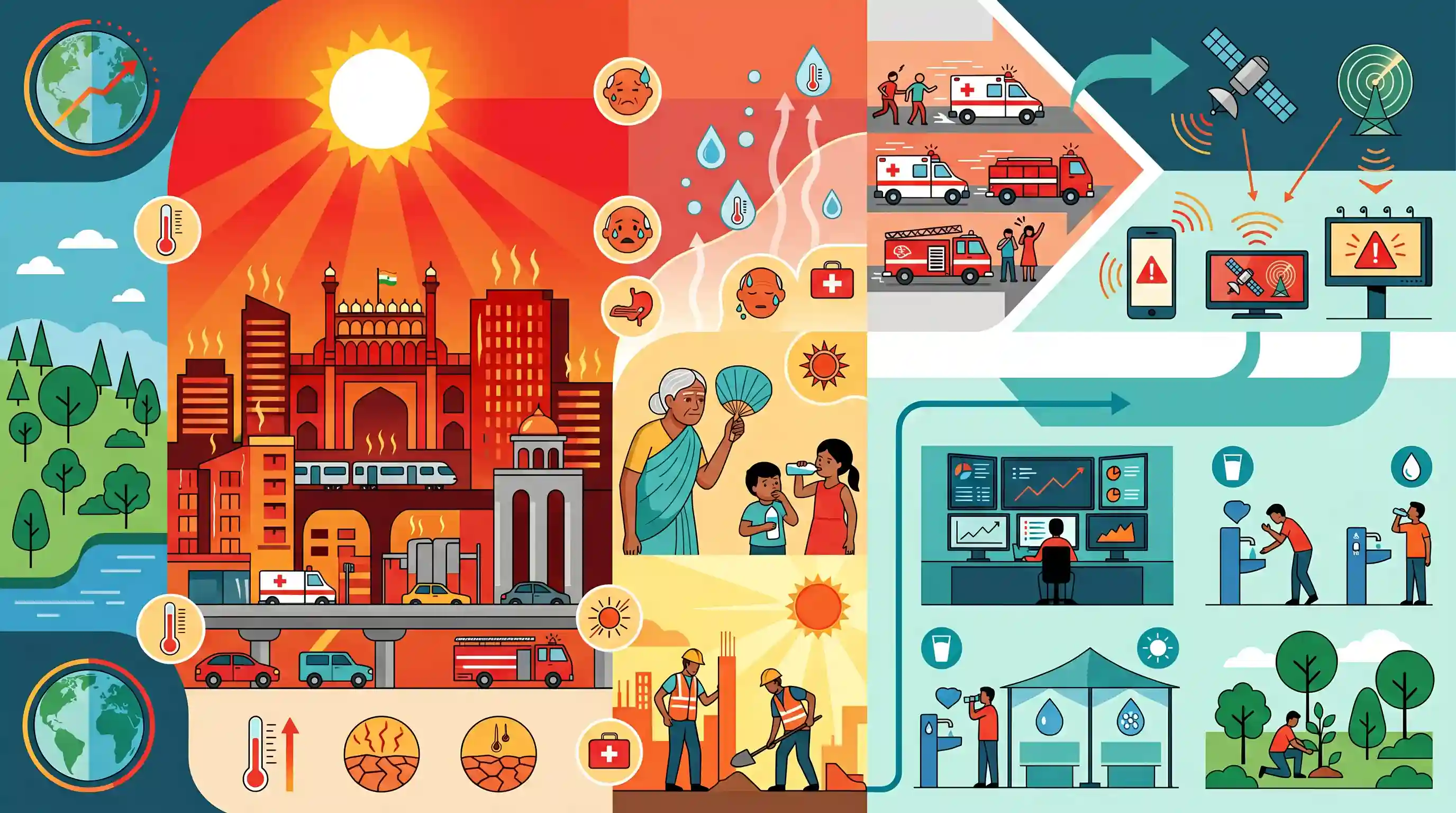
Why It Matters
Heatwaves are increasingly recognized as severe meteorological disasters exacerbated by climate change and unplanned urbanization. Understanding IMD classification criteria, the physiological impacts of wet-bulb temperatures, and proactive mitigation strategies is highly relevant for both Prelims and Mains.
Summary
The India Meteorological Department (IMD) has issued an 'Orange alert' for Delhi as temperatures are projected to exceed 45\u00b0C, marking severe heatwave conditions. The rising intensity of such heatwaves in metropolitan areas is significantly worsened by the Urban Heat Island (UHI) effect. Prolonged exposure to extreme heat and rising wet-bulb temperatures poses severe public health threats, particularly to vulnerable sections of society. The crisis underscores the necessity of transitioning from reactive to proactive disaster management approaches, emphasizing early warning systems and localized Heat Action Plans (HAPs).
Key Points
- The IMD has issued an \u2018Orange alert\u2019 for Delhi, warning of severe heatwave conditions with maximum temperatures likely to cross 45\u00b0C.
- Urban centers like Delhi face amplified heat stress due to the Urban Heat Island (UHI) effect, where concrete infrastructure absorbs and traps heat.
- Extreme heatwaves raise concerns about critical wet-bulb temperatures, a threshold where the human body can no longer cool itself through sweating, leading to severe health risks.
- The recurrent extreme weather highlights the need for proactive disaster management and the effective implementation of city-specific Heat Action Plans (HAPs) per NDMA guidelines.
Important Terms
Heat Action Plans (HAPs)

Strategic frameworks implemented at state or city levels to mitigate heatwave impacts through early warnings, public awareness, and inter-agency coordination (e.g., healthcare capacity and cooling shelters).
UPSC context
GS Paper 3 (Disaster Management); tests administrative preparedness and proactive climate adaptation strategies for extreme weather events.
India Meteorological Department (IMD)
The principal government agency under the Ministry of Earth Sciences responsible for meteorological observations, weather forecasting, and issuing warnings against severe weather phenomena like heatwaves.
UPSC context
GS Paper 1 (Geography) and Paper 3; tests knowledge of institutional frameworks for weather monitoring and early warning systems.
National Disaster Management Authority (NDMA)
The apex statutory body for disaster management in India, chaired by the Prime Minister, responsible for framing policies, plans, and guidelines for disaster prevention and mitigation.
UPSC context
GS Paper 3 (Disaster Management); tests awareness of India’s disaster governance structure under the Disaster Management Act, 2005.
Urban Heat Island (UHI)
A phenomenon where metropolitan areas experience significantly higher temperatures than surrounding rural regions due to dense infrastructure, low vegetation, and concentrated human activities.
UPSC context
GS Paper 1 (Urbanization) and Paper 3 (Environment); tests understanding of human-induced microclimate changes and urban planning challenges.
Wet-Bulb Temperature (WBT)
A composite metric of temperature and humidity that measures heat stress; it indicates the limit to which the human body can cool itself via evaporation.
UPSC context
GS Paper 1/3; tests scientific understanding of heat-health thresholds and survival limits under changing climate conditions.
Prelims Trap
IMD declares a heatwave in the plains anytime the maximum temperature simply crosses 40°C.
Crossing 40°C is only the base requirement. A heatwave also requires a departure of at least 4.5°C from normal, unless the absolute temperature reaches 45°C.
Static Concepts Connected
What are the official IMD criteria for declaring a heatwave in India?
- Base thresholds: Max temperature must reach ≥ 40°C for plains, ≥ 37°C for coastal areas, and ≥ 30°C for hilly regions.
- Departure criteria: A heatwave requires a 4.5°C to 6.4°C departure from normal. A severe heatwave requires a > 6.4°C departure.
- Absolute criteria: A heatwave is declared irrespective of the normal temperature departure if the actual maximum temperature crosses 45°C.
What is Wet-Bulb Temperature and why is it critical for human health?
- Combined metric: It measures both ambient air temperature and humidity, representing the lowest temperature attainable strictly through water evaporation.
- Sweat evaporation: It dictates how effectively the human body can cool itself. High humidity prevents sweat from evaporating, trapping body heat.
- Survivability limit: A wet-bulb temperature of 35°C is the upper limit for human survivability, beyond which even healthy resting adults cannot survive.
Cross-Topic Patterns
Wet-bulb limits & demographic dividend
Rising wet-bulb temperatures threaten outdoor informal labor and agriculture, jeopardizing India's demographic dividend and linking GS1 climatology directly to GS3 economic productivity.
UHI & Urban Planning policies
Urban heat stress exposes flaws in concrete-heavy urban planning, linking GS1 UHI mitigation with GS2 governance schemes like AMRUT and the Smart Cities Mission.

Expect a multi-statement prelims Q linking IMD heatwave criteria (plains vs coastal) with wet-bulb survivability thresholds in 2026.
Linked PYQs · 3
Linked PYQs · 3
- 2013MainsGS1
Bring out the causes for the formation of heat islands in the urban habitat of the world.
- 2025PrelimsGS1
The World Bank warned that India could become one of the first places where wet-bulb temperatures routinely exceed 35 °C. Which of the following statements best reflect(s) the implication of the above-said report? I. Peninsular India will most likely suffer from flooding, tropical cyclones and droughts. II. The survival of animals including humans will be affected as shedding of their body heat through perspiration becomes difficult. Select the correct answer using the code given below.
- 2020MainsGS3
Discuss the recent measures initiated in disaster management by the Government of India departing from the earlier reactive approach.
