Delhi High Court Recognizes Right to be Forgotten in Landmark Ruling
Source:The Hindu ↗
Why It Matters
This judgment represents a significant milestone in Indian digital jurisprudence, navigating the complex intersection between the public's right to know (open justice) and an individual's right to privacy and rehabilitation. It establishes a practical judicial framework to fill the legislative void in digital rights and sets a precedent for how commercial search engines and court registries must handle sensitive personal data in the internet age.
Summary
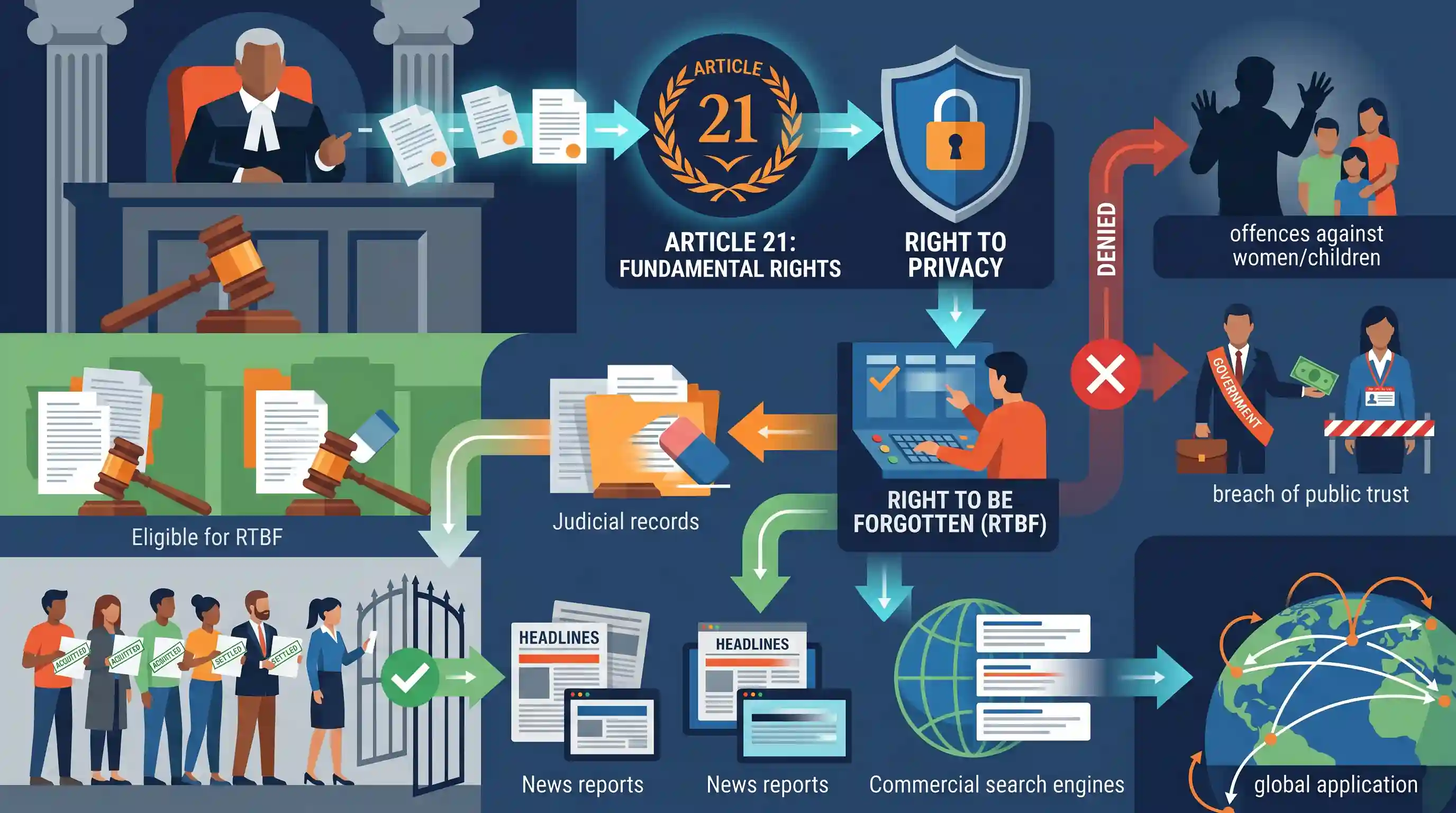
The Delhi High Court, in a landmark 144-page judgment delivered by Justice Sachin Datta, recognized the 'Right to be Forgotten' (RTBF) as a fundamental right flowing from the Right to Privacy under Article 21 of the Constitution of India. Acknowledging that India lacks a specific, comprehensive statutory framework for RTBF, the court established a framework to de-index and mask personal identifiers from judicial records, news reports, and commercial search engines. This applies to individuals who have been acquitted, discharged, or whose cases were settled or quashed. However, the court carved out crucial public-interest exceptions, denying this right to individuals convicted of offences against women/children, or breach of public trust (including public servants and elected representatives). The court also ruled that these de-indexing directions will have a global application.
Key Points
- The Delhi High Court recognized the 'Right to be Forgotten' (RTBF) as an intrinsic facet of the constitutional Right to Privacy under Article 21 of the Constitution of India.
- Justice Sachin Datta laid down a comprehensive framework governing the de-indexing of judicial records from commercial search engines and the masking of personal identifiers from public court databases and news reportage.
- The ruling protects individuals who have been acquitted, discharged, or whose cases have been quashed, settled, or involve private disputes, ensuring that their names do not serve as permanent search keys for past legal travails on search engines.
- The Court balanced the principle of open justice (transparent judicial proceedings) against individual privacy, ruling that open justice does not justify the perpetual digital amplification of a person's legal hardships.
- The right is not absolute; exceptions where de-indexing will be denied include cases involving convictions for offences against women or children, and offences involving a breach of public trust by public servants, elected representatives, or those in fiduciary roles.
- The court directed that de-indexing orders issued pursuant to this framework shall operate globally to provide effective relief to individuals.
Important Terms
Right to be Forgotten

The right of an individual to request the removal, erasure, or de-indexing of personal data from online accessibility when it is no longer relevant, necessary, or serves any legitimate public purpose.
UPSC context
GS Paper II (Polity and Fundamental Rights); tests understanding of modern privacy rights, data protection, and judicial balancing of conflicting liberties.
Article 21 of the Constitution of India
A fundamental right in Part III of the Constitution ensuring that no person shall be deprived of their life or personal liberty except according to procedure established by law.
UPSC context
GS Paper II (Constitutional Provisions); tests comprehension of the evolving scope of personal liberty, privacy, and judicial activism.
Right to Privacy
A fundamental right declared by the Supreme Court of India as intrinsic to life and liberty under Article 21, protecting personal autonomy and informational self-determination.
UPSC context
GS Paper II (Polity/Judiciary); tests awareness of landmarks like Puttaswamy judgment and its implications on state surveillance and digital rights.
Open Justice Principle
The legal doctrine that judicial proceedings, trials, and judgments should be open and accessible to the public to ensure transparency, accountability, and public trust in the judiciary.
UPSC context
GS Paper II (Judiciary); tests understanding of the conflict between public transparency and individual rights to privacy and dignity.
Delhi High Court
The principal civil court of original jurisdiction in the National Capital Territory of Delhi, established under the Delhi High Court Act, 1966, possessing power to issue writs under Article 226.
UPSC context
GS Paper II (Judiciary); tests knowledge of High Courts' jurisdiction, powers, and role in protecting fundamental rights.
Digital Personal Data Protection Act, 2023
India's primary statutory framework governing the processing of digital personal data, providing individuals rights like correction and erasure while imposing compliance duties on data fiduciaries.
UPSC context
GS Paper II & III (Data Protection/Polity); tests understanding of statutory mechanisms for privacy and data governance in India.
Google LLC
A global technology conglomerate operating the world's largest search engine, classified as a significant social media intermediary or search engine under India's IT Rules.
UPSC context
GS Paper III (IT & Cyber Security) / GS II; tests understanding of the liability of intermediaries and global tech regulations.
Prelims Trap
The Right to be Forgotten mandates the complete deletion or erasure of judicial judgments from public archives.
The framework only de-indexes names or masks personal identifiers on search engines. The ratio decidendi and legal text of the judgment remain fully intact and public.
Static Concepts Connected
What is the 'Structured Proportionality Test' under Article 21?
- Origin: Refined in the K.S. Puttaswamy (2017) judgment to evaluate state restrictions on the fundamental right to privacy.
- Four-Pronged Test: Requires a legitimate state goal, rational connection, least intrusive means (necessity), and a fair balance between the right infringed and the public purpose (proportionality).
How does the 'Right to Erasure' operate under India's DPDP Act, 2023?
- Statutory Provision: Section 12 allows data principals to request the correction, completion, or erasure of personal data that is no longer necessary for its original purpose.
- Limitation: The statutory right is consent-centric and generally does not override processing required for legal, judicial, or sovereign functions.
Cross-Topic Patterns
Privacy vs. Open Justice Doctrine
Balances Article 21 (informational privacy) with the open court principle under Article 145(4) and the status of High Courts as courts of record under Article 215.
Extraterritoriality & Tech Sovereignty
Tests the extraterritorial jurisdiction of domestic judiciaries over global tech intermediaries, intersecting with international cyber law and digital sovereignty.

UPSC is likely to test RTBF by contrasting the constitutional scope under Article 21 with the statutory limits of the DPDP Act, 2023.
Linked PYQs · 4
Linked PYQs · 4
- 2024PrelimsGS1
Under which of the following Articles of the Constitution of India, has the Supreme Court of India placed the Right to Privacy ?
- 2021PrelimsGS1
'Right to Privacy' is protected under which Article of the Constitution of India?
- 2024MainsGS2
Right to privacy is intrinsic to life and personal liberty and is inherently protected under Article 21 of the constitution. Explain. In this reference discuss the law relating to D.N.A. testing of child in the womb to establish its paternity.
- 2024MainsGS3
Describe the context and salient features of the Digital Personal Data Protection Act, 2023.
