Assisted Reproductive Technology Rules and Embryo Donation Law
Source:Indian Express ↗
Why It Matters
The regulation of assisted reproductive technologies sits at the intersection of law, medicine, and ethics. For UPSC aspirants, understanding the ART Act, 2021, and its judicial scrutiny is crucial for addressing questions on governance, fundamental rights (such as reproductive autonomy), and bioethics in the Mains examination.
Summary
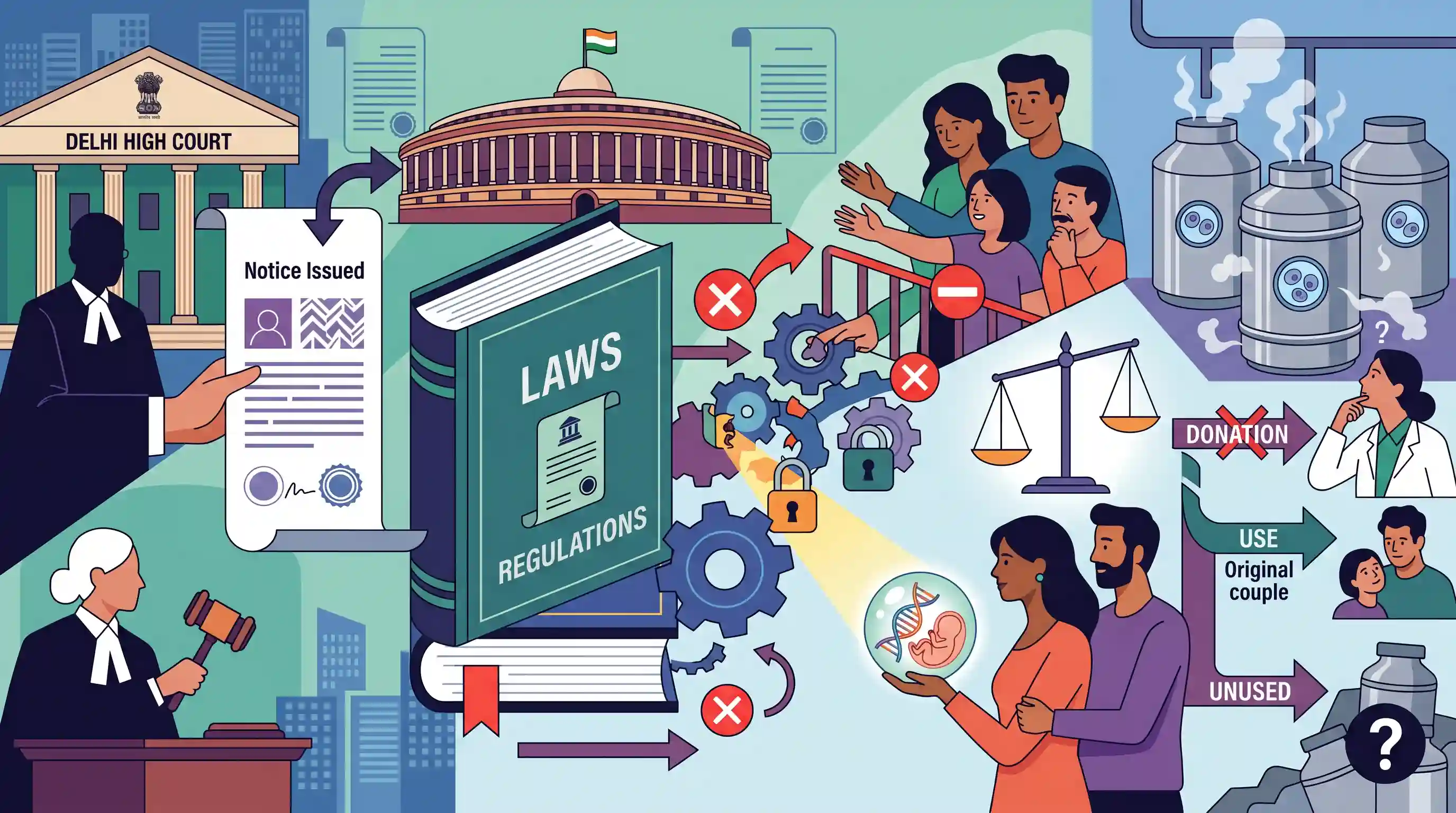
The Delhi High Court recently issued a notice to the Union Government regarding a petition challenging the current rules under the Assisted Reproductive Technology (Regulation) Act, 2021, which govern the donation of frozen embryos. The plea challenges the strict regulations surrounding who can donate embryos, particularly focusing on the legal and ethical constraints that prevent individuals from donating their frozen embryos to others or using them under specific circumstances. This case highlights the tension between state regulation of assisted reproductive technologies, the right to reproductive autonomy under Article 21, and the bioethical dilemmas surrounding the fate and ownership of unused frozen embryos.
Key Points
- Regulatory Framework: The Assisted Reproductive Technology (Regulation) Act, 2021, and its corresponding rules strictly regulate the creation, preservation, and transfer of embryos, imposing stringent conditions on gamete and embryo donation.
- Legal Challenge: A petition before the Delhi High Court has challenged specific ART Rules that restrict the donation of frozen embryos, arguing these rules arbitrarily limit options for couples or individuals who wish to donate or transfer their unused embryos to others.
- Constitutional Implications: The restrictive rules are being scrutinized against Article 21 of the Constitution, given that the Supreme Court has repeatedly recognized reproductive autonomy as an intrinsic part of the right to privacy and personal liberty.
- Bioethical Dilemmas: The legal dispute highlights the ethical complexities of determining the fate of unused frozen embryos (such as discarding versus donating) and the challenges of consent in cases of divorce, separation, or the death of a partner.
- Evolving Healthcare Law: As assisted reproductive technologies advance, there is an ongoing need for India's legal framework to balance medical and regulatory oversight with the rights of individuals seeking fertility treatments.
Important Terms
Assisted Reproductive Technology (Regulation) Act, 2021

Legislation regulating IVF clinics and banks in India. It currently permits altruistic gamete donation but prohibits the transfer of surplus frozen embryos to other couples, mandating their destruction or research use.
UPSC context
GS Paper II: Government Policies/Interventions; GS Paper III: Science & Tech. Tests understanding of reproductive laws and regulatory gaps.
Article 21 (Constitution of India)
Fundamental right ensuring that no person shall be deprived of life or personal liberty except by legal procedure. Courts interpret this to include reproductive choices, privacy, and bodily integrity.
UPSC context
GS Paper II: Indian Constitution (Fundamental Rights). Vital for questions on judicial activism and the expansion of personal liberties.
Reproductive Autonomy
The individual right to make free and informed decisions regarding one's body, fertility, and family planning. It is recognized as a facet of personal dignity and liberty.
UPSC context
GS Paper II: Social Justice/Women; GS Paper IV: Ethics. Tests concepts of individual rights versus state regulation.
Bioethics
The study of ethical issues arising from medical and biological advancements. In this context, it involves the debate over whether surplus viable embryos should be destroyed or donated.
UPSC context
GS Paper IV: Ethical dilemmas in medical technology. Relevant for Case Studies on healthcare policy and morality.
Surrogacy (Regulation) Act, 2021
Law prohibiting commercial surrogacy while allowing altruistic surrogacy for infertile Indian couples. It shares regulatory boards with the ART Act to monitor ethical practices in assisted reproduction.
UPSC context
GS Paper II: Social Justice/Health. Frequently tested alongside the ART Act regarding the legal landscape of parenthood in India.
Prelims Trap
"The ART Act 2021 permits the altruistic donation of unused frozen embryos to other infertile couples."
While the Act allows the creation of fresh embryos from donor gametes, it expressly prohibits the donation of surplus frozen embryos to other couples. They must perish or be used for research.
Static Concepts Connected
What are the statutory restrictions on gamete donation under the ART Act, 2021?
- Oocyte (Egg) rules: An egg donor must be an ever-married woman (23-35 years) with at least one alive child of her own.
- Frequency limit: An eligible woman can donate eggs only once in her lifetime, with a maximum of seven eggs retrieved.
- Storage limits: Unused embryos can be stored for a maximum of 10 years, after which they must be allowed to perish or donated for research.
How has the Supreme Court interpreted Reproductive Autonomy under Article 21?
- Suchita Srivastava (2009): The SC ruled that a woman's right to make reproductive choices (procreate or abstain) is an intrinsic part of personal liberty.
- K.S. Puttaswamy (2017): The landmark privacy judgment reaffirmed reproductive rights as an essential, protected component of personal privacy and bodily autonomy.
Cross-Topic Patterns
ART vs. Surrogacy Act overlaps
The strict parameters of the ART Act heavily overlap with the Surrogacy (Regulation) Act, 2021. Both face persistent constitutional challenges under Articles 14 and 21 for being paternalistic and exclusionary.
Bioethics of human genetic material
This connects to broader bioethical debates surrounding the ownership and moral status of human genetic material, seen similarly in discussions around stem cell research, genome editing, and the DNA Technology Bill.

ART Act limits (egg donation rules, 10-yr embryo storage) are prime candidates for a tricky multi-statement Prelims 2026 question.
Linked PYQs · 4
Linked PYQs · 4
- 2012MainsGS2
In the context of Assisted Reproductive Technologies, India has emerged as a hub of commercial surrogacy. What key biological, legal and ethical issues merit consideration while framing the regulation to govern surrogacy in India?
- 2024MainsGS2
Right to privacy is intrinsic to life and personal liberty and is inherently protected under Article 21 of the constitution. Explain. In this reference discuss the law relating to D.N.A. testing of child in the womb to establish its paternity.
- 2020PrelimsGS1
In the context of recent advances in human reproductive technology, "Pronuclear Transfer" is used for
- 2017PrelimsGS1
What is the application of Somatic Cell Nuclear Transfer Technology?
