CAQM Clarification on GRAP Stage IV Restrictions and Rumours
Source:Indian Express ↗
Why It Matters
Air pollution in the National Capital Region is a recurring environmental and public health crisis. Understanding the role of the CAQM, the specific trigger points and actions under the Graded Response Action Plan (GRAP), and the challenges of policy implementation (including countering fake news) is crucial for GS-III (Environment) and GS-II (Governance).
Summary
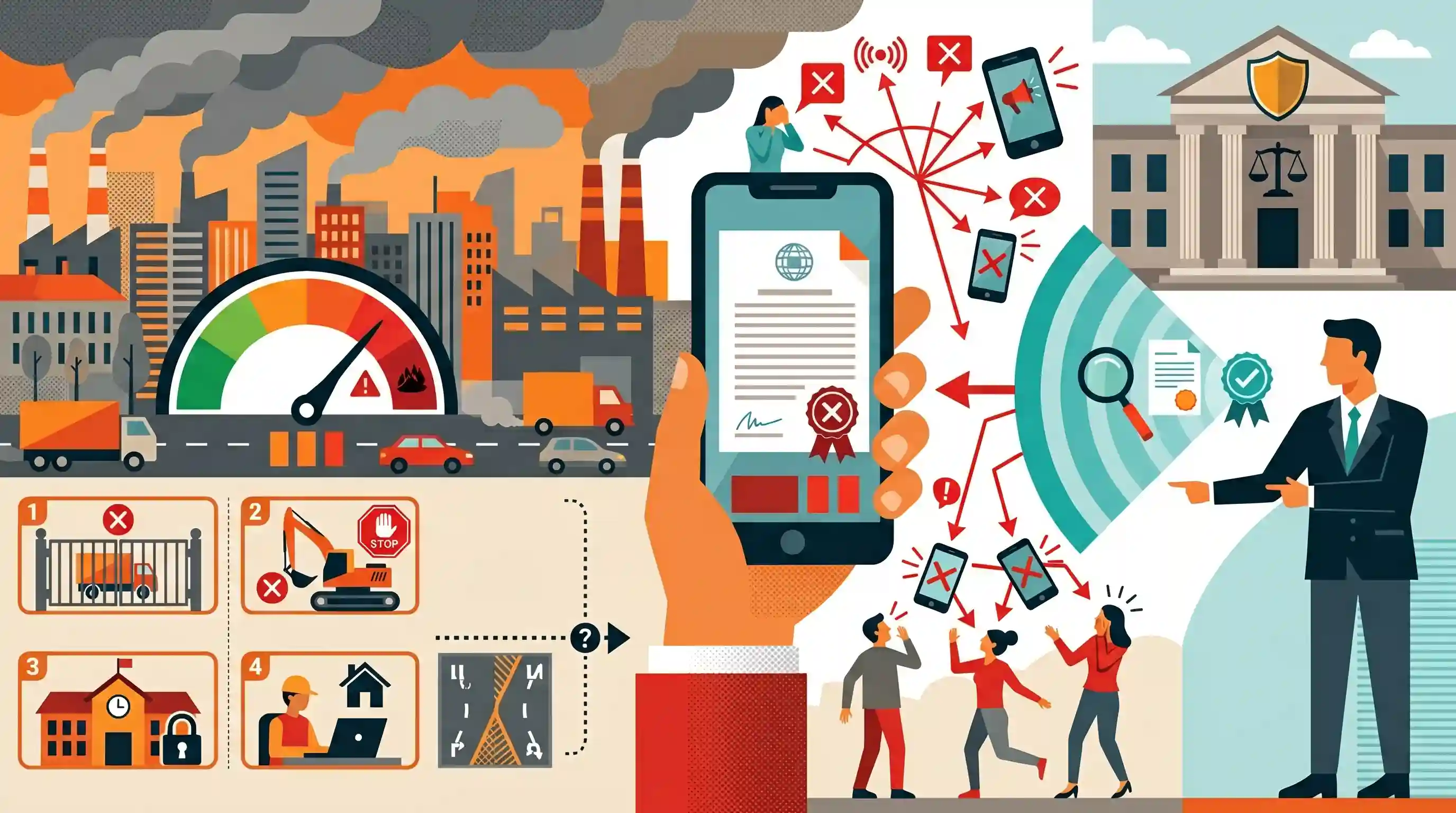
The Commission for Air Quality Management (CAQM) has issued a clarification that the Graded Response Action Plan (GRAP) Stage-IV has not been implemented in Delhi-NCR, despite a fake order circulating on social media. Currently, only GRAP Stage-III restrictions are in force as the region battles 'severe' air pollution. The CAQM outlined that if Stage-IV were to be invoked, it would mandate strict measures such as banning the entry of non-essential trucks and commercial vehicles into Delhi, halting construction on linear public projects, and potentially introducing school closures, work-from-home mandates, and the odd-even vehicle scheme by state governments.
Key Points
- The Commission for Air Quality Management (CAQM) clarified that GRAP Stage-4 has not been invoked in Delhi-NCR, debunking a fake order circulating on social media.
- Currently, only GRAP Stage-3 measures are in effect across the National Capital Region to combat 'severe' air quality.
- If invoked, GRAP Stage-4 would involve stringent measures including a ban on truck entry into Delhi, restricting non-Delhi registered light commercial vehicles, and halting linear public construction projects.
- Under GRAP Stage-4, the state government can also decide on discontinuing physical classes for school students, directing public and private offices to work from home, and implementing the odd-even vehicle rationing scheme.
Important Terms
Graded Response Action Plan (GRAP)

An emergency response framework implemented in four stages to curb air pollution in Delhi-NCR, triggering specific restrictions on transport and industry based on Air Quality Index (AQI) levels.
UPSC context
GS Paper III (Environment). Tests understanding of urban pollution mitigation strategies and administrative response protocols.
Commission for Air Quality Management (CAQM)
A statutory body established in 2021 to oversee air quality management in Delhi-NCR and adjoining states, replacing the earlier Environment Pollution (Prevention and Control) Authority.
UPSC context
GS Paper II (Statutory/Regulatory Bodies). Tests knowledge of environmental governance and inter-state administrative coordination.
BS-VI Emission Standards
India’s current vehicular emission standards (equivalent to Euro 6), which drastically reduce sulfur and nitrogen oxide emissions compared to previous norms to improve urban air quality.
UPSC context
GS Paper III (Environment/S&T). Relevant for technological transitions in transport to combat pollution.
Stage-IV (Severe+) GRAP
The most restrictive category of GRAP, triggered when AQI exceeds 450, involving bans on non-essential trucks, closure of schools, and potential implementation of the odd-even scheme.
UPSC context
GS Paper III (Pollution). Tests knowledge of specific emergency measures during peak environmental crises in India.
Communication Network Misinformation
The rapid spread of fake administrative orders or rumors via social media, which complicates governance, causes public confusion, and challenges the state's communication control.
UPSC context
GS Paper III (Internal Security). Tests awareness of digital threats to administrative stability and internal security.
Prelims Trap
CAQM's jurisdiction is limited to Delhi, and its directives are purely advisory to State Pollution Control Boards.
CAQM is a statutory body with overriding powers over state boards. Its jurisdiction explicitly covers Delhi, Punjab, Haryana, Rajasthan, and Uttar Pradesh.
Static Concepts Connected
What are the powers and jurisdiction of the CAQM?
- Statutory origin: Established under a 2021 Act, replacing the 22-year-old EPCA to manage NCR air quality.
- Overriding authority: Possesses overriding powers; its directives prevail over those of the CPCB and State Pollution Control Boards in its region.
- Penal powers: Can issue binding directions, impose fines up to ₹1 crore, and order imprisonment up to 5 years for non-compliance.
How is the Graded Response Action Plan (GRAP) structured?
- Emergency framework: GRAP acts as an emergency, rule-based framework exclusively for the Delhi-NCR region to enforce strict pollution control.
- AQI-linked stages: Stage 1 (Poor: 201-300), Stage 2 (Very Poor: 301-400), Stage 3 (Severe: 401-450), Stage 4 (Severe+: >450).
- Stage 4 measures: Severe+ includes banning non-essential trucks, halting linear construction projects (highways/pipelines), and enabling odd-even schemes.
Cross-Topic Patterns
Pollution control meets misinformation
Fake CAQM orders triggering public panic highlight how administrative mandates on public health (GS3 Environment) are increasingly vulnerable to communication network disruptions (GS3 Internal Security).
Federalism vs. Environmental Regulation
The CAQM Act gives a central statutory body overriding powers over state pollution boards across five states, creating unique federal friction and centralizing environmental governance.

Expect a 2026 Prelims question mapping GRAP stages to specific AQI levels, or testing the appellate jurisdiction of CAQM (lies with NGT).
Linked PYQs · 3
Linked PYQs · 3
- 2020MainsGS3
What are the key features of the National Clean Air Programme (NCAP) initiated by the Government of India?
- 2021MainsGS3
Describe the key points of the revised Global Air Quality Guidelines (AQGs) recently released by the World Health Organisation (WHO). How are these different from its last update in 2005? What changes in India's National Clean Air Programme are required to achieve these revised standards?
- 2022PrelimsGS1
In the context of WHO Air Quality Guidelines, consider the following statements: 1. The 24-hour mean of PM2.5 should not exceed 15 µg/m³ and annual mean of PM2.5 should not exceed 5 µg/m³. 2. In a year, the highest levels of ozone pollution occur during the periods of inclement weather. 3. PM10 can penetrate the lung barrier and enter the bloodstream. 4. Excessive ozone in the air can trigger asthma. Which of the statements given above are correct?
