Delhi Water Master Plan and urban resource management reforms
Source:Indian Express ↗
Why It Matters
Provides excellent real-world examples for UPSC Mains on tackling urban water stress, reducing non-revenue water (NRW) through PPPs, and utilizing inter-state resource exchange (cooperative federalism) as a sustainable administrative solution.
Summary
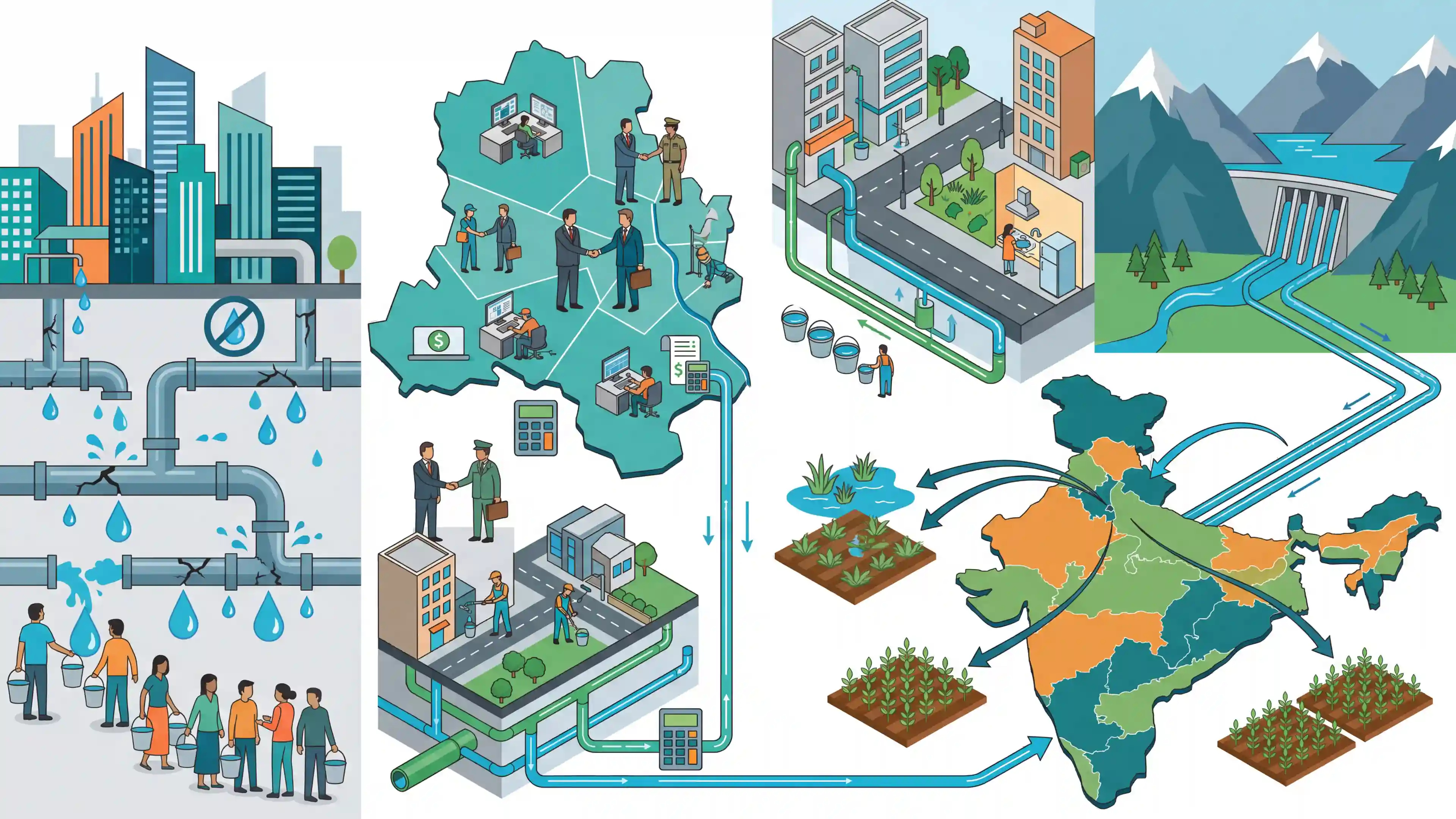
The Delhi government is formulating a comprehensive Water Master Plan to tackle the city's mounting water demand and outdated infrastructure. Addressing a stark 40% water leakage rate, the strategy embraces public-private partnerships (PPP) by decentralizing the Delhi Jal Board's operations across eight command centres for better repair, billing, and distribution. Beyond local infrastructure upgrades like dual pipelines, the plan champions cooperative federalism through inter-state water exchange—offering treated STP water to Haryana and UP farmers in return for fresh drinking water. Long-term supply augmentation is anchored on the upcoming Renuka Dam in Himachal Pradesh.
Key Points
- Delhi is drafting its first-ever Water Master Plan to bridge the gap between its 900-1000 MGD production and 1200 MGD demand.
- The plan aims to privatize and decentralize the Delhi Jal Board's distribution network to combat a severe 40% non-revenue water (NRW) leakage rate.
- TATA Group has been onboarded to consult on handing over eight DJB command centres to private entities for efficient pipeline repair, billing, and revenue collection.
- An innovative inter-state water exchange is proposed: Delhi will offer highly treated STP water to Haryana and UP for irrigation in exchange for fresh drinking water.
- Future water augmentation relies on the completion of the Renuka Dam in Himachal Pradesh by 2031, alongside laying separate pipelines for gardening to save fresh water.
Important Terms
Water Master Plan (Delhi)

A 30-year integrated strategy by the Delhi government to modernize infrastructure, reduce leakage, and ensure sustainable supply for the city’s growing population through decentralization and public-private partnerships.
UPSC context
GS Paper 3: Urban infrastructure and resource management; tests knowledge of long-term planning for water security in megacities.
Delhi Jal Board (DJB)
The statutory agency established under the Delhi Water Board Act, 1998, responsible for the production and distribution of potable water and the treatment of domestic sewage in Delhi.
UPSC context
GS Paper 2: Statutory bodies and governance; relevant for understanding the administrative structure of urban utilities.
Renuka Dam Project
A project on the Giri river (Himachal Pradesh) designated as a 'Project of National Importance.' It aims to fulfill nearly 40% of Delhi’s drinking water needs through inter-state cooperation.
UPSC context
GS Paper 1: Geography (River basins) & GS Paper 3: Infrastructure; critical for inter-state water sharing and dam safety topics.
Non-Revenue Water (NRW)
The difference between the amount of water put into a distribution system and the amount billed to consumers, often caused by leakages, theft, or metering inaccuracies.
UPSC context
GS Paper 3: Economic and technical efficiency in infrastructure; crucial for discussing urban utility losses and reforms.
Cooperative Federalism
A constitutional concept involving the collaborative relationship between the Union and States to resolve shared challenges, such as inter-state water sharing agreements between Delhi, Haryana, and Uttar Pradesh.
UPSC context
GS Paper 2: Functions and responsibilities of the Union and the States; central to inter-state water dispute resolution.
Dual Pipeline System
An infrastructure design that uses separate pipes for potable (drinking) water and treated wastewater (for non-potable uses like flushing/gardening) to conserve fresh water resources.
UPSC context
GS Paper 3: Conservation and sustainable development; tests knowledge of technical solutions for urban water scarcity.
Prelims Trap
"Renuka Dam is being constructed directly on the Yamuna River in Haryana."
Renuka Dam is actually located on the Giri River, a tributary of the Yamuna, in the Sirmaur district of Himachal Pradesh.
Static Concepts Connected
What are the key tributaries of Yamuna and the geographical location of Renuka Dam?
- Right Bank: Major tributaries joining from the south include the Chambal, Sind, Betwa, and Ken rivers.
- Left Bank: Major Himalayan and foothill tributaries joining from the north/east include the Tons, Hindon, and Giri rivers.
- Renuka Dam: Constructed on the Giri river in Himachal Pradesh; designated as a National Project primarily to supply drinking water to Delhi.
What is Non-Revenue Water (NRW) in the context of urban utility management?
- Core Definition: Water that is produced and treated but "lost" before it reaches the customer due to physical leaks, theft, or inaccurate metering.
- Financial Drain: High NRW (often 40-50% in Indian cities) severely impairs the financial viability of Urban Local Bodies, preventing infrastructure upgrades.
- PPP Mitigation: Management contracts with private entities are increasingly used to map underground assets, plug leaks, and improve revenue collection.
Cross-Topic Patterns
Barter systems in water federalism
Exchanging treated STP water for neighboring states' fresh water creates a novel cooperative federalism template, bypassing traditional, lengthy inter-state river water tribunal litigation.
PPPs solving municipal utility failures
Tackling urban Non-Revenue Water through private management contracts highlights the shift from state monopolies to public-private partnerships in securing basic civic utilities.

Expect a Prelims matching question linking Yamuna tributaries (Giri, Tons) with National Water Projects like the Renuka and Kishau dams.
Linked PYQs · 4
Linked PYQs · 4
- 2024MainsGS3
The world is facing an acute shortage of clean and safe freshwater. What are the alternative technologies which can solve this crisis? Briefly discuss any three such technologies citing their key merits and demerits.
- 2025MainsGS3
Examine the factors responsible for depleting groundwater in India. What are the steps taken by the government to mitigate such depletion of groundwater?
- 2023MainsGS1
Why is the world today confronted with a crisis of availability of and access to freshwater resources?
- 2015MainsGS2
The concept of cooperative federalism has been increasingly emphasized in recent years. Highlight the drawbacks in the existing structure and the extent to which cooperative federalism would answer the shortcomings.
