Delhi government to add electric buses under central PM E-DRIVE scheme
Source:Indian Express ↗
Why It Matters
The mass induction of electric buses highlights the practical implementation of India's e-mobility transition, crucial for meeting national climate targets and reducing urban air pollution. It showcases the utilization of the PM E-DRIVE scheme, an important piece of government policy replacing the FAME schemes, making it highly relevant for questions on sustainable urbanization, clean energy infrastructure, and environmental conservation.
Summary
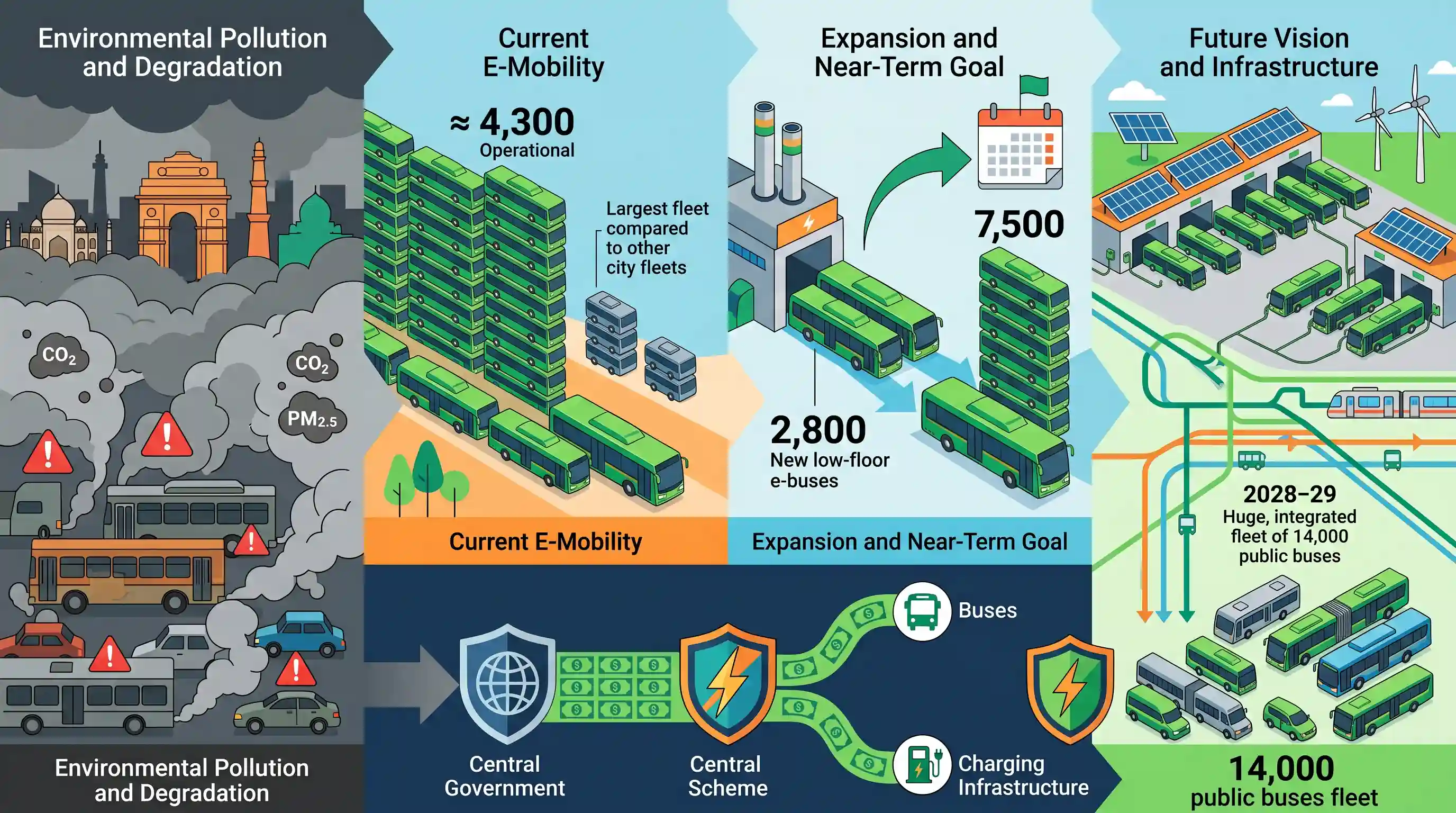
The Delhi government has announced plans to induct 2,800 low-floor electric buses into its city fleet under the Centre's PM E-DRIVE scheme. Delhi already boasts the largest electric bus fleet in the country, with approximately 4,300 operational e-buses. The state aims to increase this number to 7,500 by the end of the year, targeting an overall public bus fleet of 14,000 by 2028-29. The PM E-DRIVE scheme, replacing the FAME initiatives, allocates significant funding to accelerate EV adoption, build charging infrastructure, and tackle severe urban air pollution by modernizing public transport in major cities.
Key Points
- The Delhi government will induct 2,800 air-conditioned, low-floor electric buses into its public transport fleet under the PM E-DRIVE scheme.
- Delhi currently operates the largest electric bus fleet in India, with nearly 4,300 e-buses.
- The government aims to expand the electric bus count to 7,500 by the end of the year and the overall bus fleet to 14,000 by 2028-29.
- The PM E-DRIVE scheme is a Central flagship program that provides financial incentives to accelerate EV adoption, establish charging infrastructure, and build a local EV manufacturing ecosystem in nine major cities.
- This shift towards e-mobility is a critical measure for mitigating vehicular emissions and addressing Delhi's chronic air pollution.
Important Terms
PM E-DRIVE Scheme

Prime Minister Electric Drive Revolution in Innovative Vehicle Enhancement. A ₹10,900 crore central scheme (2024-2026/28) promoting electric vehicle (EV) adoption through demand incentives, e-vouchers, and charging infrastructure grants.
UPSC context
GS Paper II/III: Government schemes for infrastructure, sustainable urban mobility, and achieving Net-Zero 2070 climate goals.
FAME Initiatives
Faster Adoption and Manufacturing of (Hybrid &) Electric Vehicles. The predecessor to PM E-DRIVE, this flagship initiative provided financial subsidies to catalyze India's initial EV market and manufacturing ecosystem.
UPSC context
GS Paper III: Industrial policy, transition from fossil fuels, and environmental impacts of traditional transport.
E-Mobility
The integration of electric-powered technologies into transportation (2Ws, 3Ws, buses) to reduce tailpipe emissions, lower petroleum import bills, and improve urban air quality.
UPSC context
GS Paper III: Science and Technology, Infrastructure, and Energy Security.
Charging Infrastructure
A network of fast and slow chargers required for EV viability. PM E-DRIVE aims to install 72,300 public chargers to address 'range anxiety' among users.
UPSC context
GS Paper III: Physical infrastructure challenges and the critical link between energy and transport sectors.
Low-floor Buses
Buses with a floor height significantly closer to the ground, facilitating easier and faster boarding for children, the elderly, and persons with disabilities.
UPSC context
GS Paper III: Inclusive urban infrastructure and enhancing public transport efficiency.
Prelims Trap
"The PM E-DRIVE scheme provides direct financial subsidies for the purchase of private electric passenger cars."
PM E-DRIVE explicitly excludes private hybrid and electric passenger cars, focusing strictly on public and commercial mobility like e-buses, e-trucks, e-ambulances, and 2Ws/3Ws.
Static Concepts Connected
What is the core philosophy of the National Urban Transport Policy (NUTP)?
- People-centric: Focuses on "moving people, not vehicles" by prioritizing sustainable public mass transit over private vehicle infrastructure.
- NMT Priority: Encourages infrastructure for Non-Motorized Transport (NMT), such as walking and cycling, to ensure safe last-mile connectivity.
- Transit Oriented Development: Integrates land use and transport planning to minimize travel distances and improve urban sustainability.
Which critical minerals are essential for Lithium-ion EV battery manufacturing?
- Cathode materials: Lithium, Cobalt, Nickel, and Manganese are crucial for determining the battery's energy density and capacity.
- Anode materials: Graphite is the dominant material used for anodes, acting as the host structure for lithium ions during charging.
- Geopolitical concentration: Processing and refining of these minerals are heavily concentrated in China, creating geopolitical supply chain vulnerabilities.
Cross-Topic Patterns
EV Adoption vs. Critical Mineral Security
Scaling up e-buses increases demand for Li-ion batteries, linking PM E-DRIVE directly to India's strategic push for critical mineral partnerships (e.g., Minerals Security Partnership) to bypass Chinese supply chains.
Cooperative Federalism in Climate Action
A Central Sector scheme funding a state's transport fleet showcases cooperative fiscal federalism acting as a direct lever for urban pollution control and achieving COP26 Net-Zero commitments.

Expect a multi-statement Prelims question on PM E-DRIVE testing its 'Central Sector' status and its explicit exclusion of private cars.
Linked PYQs · 4
Linked PYQs · 4
- 2023MainsGS3
The adoption of electric vehicles is rapidly growing worldwide. How do electric vehicles contribute to reducing carbon emissions and what are the key benefits they offer compared to traditional combustion engine vehicles?
- 2014MainsGS3
National Urban Transport Policy emphasises on 'moving people' instead of 'moving vehicles'. Discuss critically the success of the various strategies of the Government in this regard.
- 2025PrelimsGS1
Consider the following types of vehicles : I. Full battery electric vehicles II. Hydrogen fuel cell vehicles III. Fuel cell-electric hybrid vehicles How many of the above are considered as alternative powertrain vehicles?
- 2025PrelimsGS1
In the context of electric vehicle batteries, consider the following elements : I. Cobalt II. Graphite III. Lithium IV. Nickel How many of the above usually make up battery cathodes?
