Delhi urban forests and AI decision system for air pollution
Source:The Hindu ↗
Why It Matters
Air pollution in the National Capital Region is a critical, recurring issue in UPSC Mains (GS3). This article highlights a practical governance model that integrates nature-based interventions (urban forests) with cutting-edge technology (AI, predictive analytics, sensor networks) to address environmental crises, serving as an excellent case study for answers on pollution mitigation and tech-driven governance.
Summary
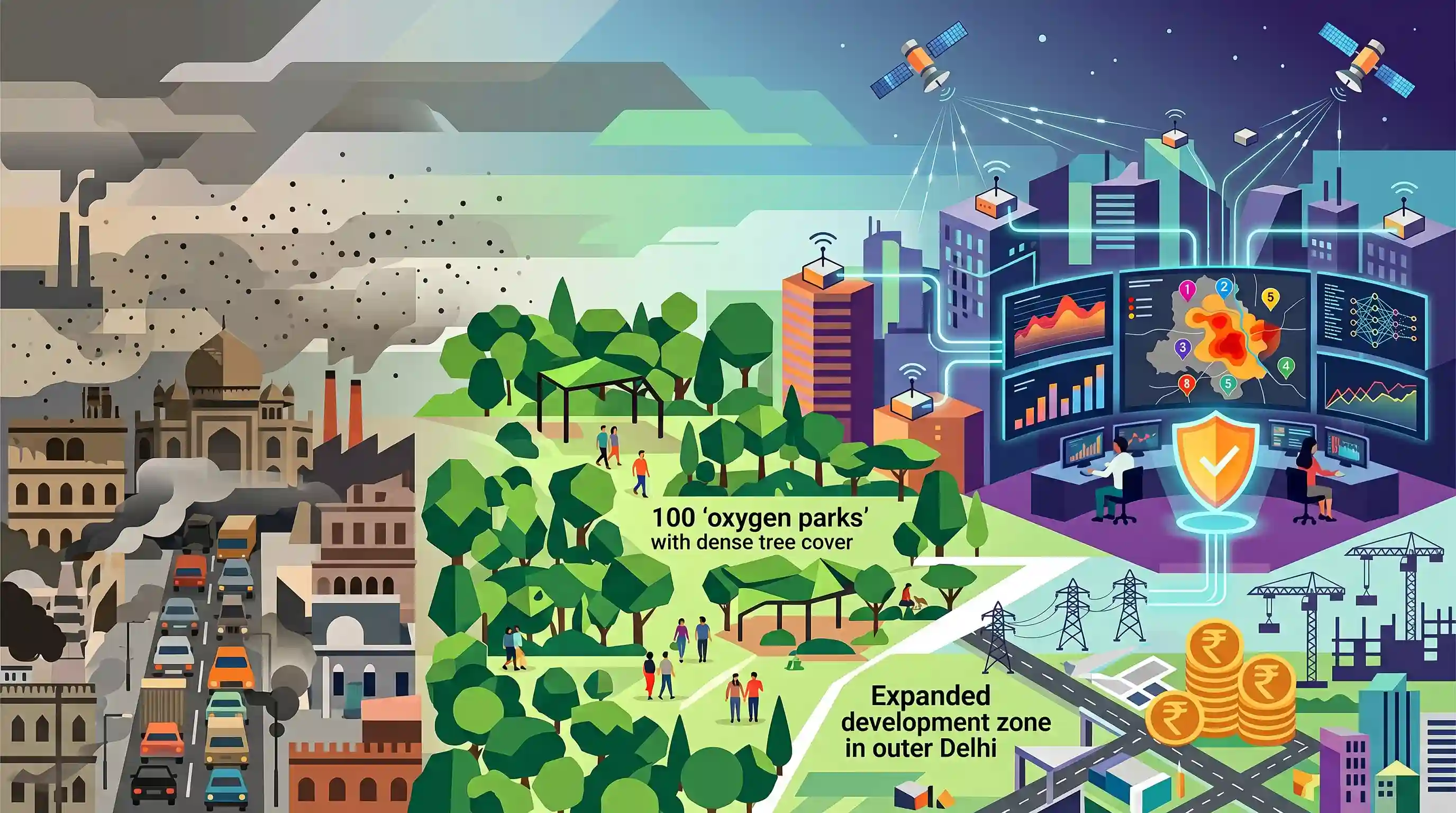
The Delhi government is launching a multi-pronged strategy to mitigate air pollution, combining nature-based solutions with advanced technology. It plans to develop 100 'oxygen parks' with dense tree cover across the city. Simultaneously, the Environment Department has partnered with IIT Kanpur's AIRAWAT Research Foundation to establish an AI-driven Decision Support System. This system will utilize satellite data, low-cost sensors, and predictive analytics to forecast air quality, identify hyperlocal pollution hotspots, and enable data-driven policy interventions. Alongside these environmental measures, a ₹10,000 crore infrastructure push is planned for outer Delhi regions.
Key Points
- The Delhi government plans to develop 100 parks with dense tree cover, starting with an 'oxygen park' in Burari, to combat severe air pollution.
- An MoU was signed between the Delhi Environment Department and IIT Kanpur's AIRAWAT Research Foundation to adopt a scientific, tech-driven approach to pollution management.
- The initiative will deploy an integrated air quality monitoring network utilizing low-cost sensors, mobile monitoring labs, and satellite data.
- An AI-based Decision Support System will be developed for hyperlocal analysis, identification of pollution hotspots, and generating air quality forecasts 48 to 72 hours in advance.
- Infrastructure projects worth nearly ₹10,000 crore have also been initiated to improve roads, drainage, and basic amenities in outer Delhi regions.
Important Terms
Decision Support System (DSS)

An AI-powered modeling tool used to identify pollution sources, analyze hyperlocal hotspots, and provide 48-72 hour air quality forecasts to enable data-driven policy interventions.
UPSC context
GS3: Environment & Technology. Tests knowledge of scientific tools for environmental governance and air quality management.
Oxygen Parks
A nature-based urban planning initiative to develop dense, tree-covered green spaces (100 planned in Delhi) designed to maximize oxygen output, enhance biodiversity, and mitigate local air pollution.
UPSC context
GS3: Environment/Conservation. Relevant for urban forestry and sustainable city-planning measures in India.
AIRAWAT Research Foundation (ARF)
An IIT Kanpur-associated entity serving as an AI Centre of Excellence for Sustainable Cities, specializing in advanced data analytics and AI-driven solutions for urban environmental challenges.
UPSC context
GS3: Science & Tech. Highlights institutional partnerships and indigenous AI research for public policy.
Source Apportionment
The scientific process of identifying and quantifying the various sources (e.g., vehicular emissions, road dust, biomass burning) contributing to air pollution in a specific area.
UPSC context
GS3: Environmental Pollution. Tests technical understanding of how pollution origins are pinpointed for targeted action.
Hyperlocal Monitoring
A granular approach to environmental monitoring that uses sensors and AI to track pollution levels at the neighborhood or street level rather than relying on city-wide averages.
UPSC context
GS3: Science & Technology/Urbanization. Key for modern governance and identifying specific "pollution hotspots."
Prelims Trap
"AI-based Decision Support Systems actively reduce PM2.5 levels through real-time atmospheric scrubbing."
The AI system (DSS) is strictly a forecasting and analytical tool for policy interventions, not a physical pollution filtration or scrubbing technology like a smog tower.
Static Concepts Connected
How do nature-based solutions like urban parks mitigate particulate matter?
- Dry deposition: Leaves act as physical barriers, trapping and settling suspended particulate matter from the air onto their surfaces.
- Microclimate regulation: Tree transpiration cools ambient air, mitigating the Urban Heat Island (UHI) effect and reducing winter temperature inversions that trap smog.
- Stomatal uptake: Trees absorb gaseous pollutants (NOx, SO2) through leaf stomata during photosynthesis, complementing PM reduction.
What role do low-cost sensors play in modern Air Quality Management?
- Hyperlocal mapping: They provide high-density spatial data, identifying localized pollution hotspots that standard, widely-spaced CAAQMS stations might miss.
- Algorithmic integration: Their high-volume data is calibrated using AI and satellite imagery to create highly accurate, predictive models for preemptive policy action.
Cross-Topic Patterns
AI in predictive urban governance
Using AI for 48-72 hour AQI forecasting mirrors its rising use in disaster management (e.g., early flood warnings), shifting urban governance from reactive to preemptive.
Fugitive dust and peri-urban infra
Improving drainage and paving outer Delhi roads directly targets fugitive dust, highlighting how peripheral urban infrastructure deficits paralyze metropolitan air quality.

Expect a 2026 prelims statement pairing AI-driven AQI forecasting (Decision Support Systems) with GRAP implementation triggers.
Linked PYQs · 4
Linked PYQs · 4
- 2020MainsGS3
What are the key features of the National Clean Air Programme (NCAP) initiated by the Government of India?
- 2021MainsGS3
Describe the key points of the revised Global Air Quality Guidelines (AQGs) recently released by the World Health Organisation (WHO). How are these different from its last update in 2005? What changes in India's National Clean Air Programme are required to achieve these revised standards?
- 2023MainsGS3
Introduce the concept of Artificial Intelligence (AI). How does Al help clinical diagnosis? Do you perceive any threat to privacy of the individual in the use of Al in healthcare?
- 2016PrelimsGS1
In the cities of our country, which among the following atmospheric gases are normally considered in calculating the value of Air Quality Index? 1. Carbon dioxide 2. Carbon monoxide 3. Nitrogen dioxide 4. Sulfur dioxide 5. Methane Select the correct answer using the code given below.
