Delhi Overage Vehicles Scrappage and Uniform Norms Plea
Source:The Hindu ↗
Why It Matters
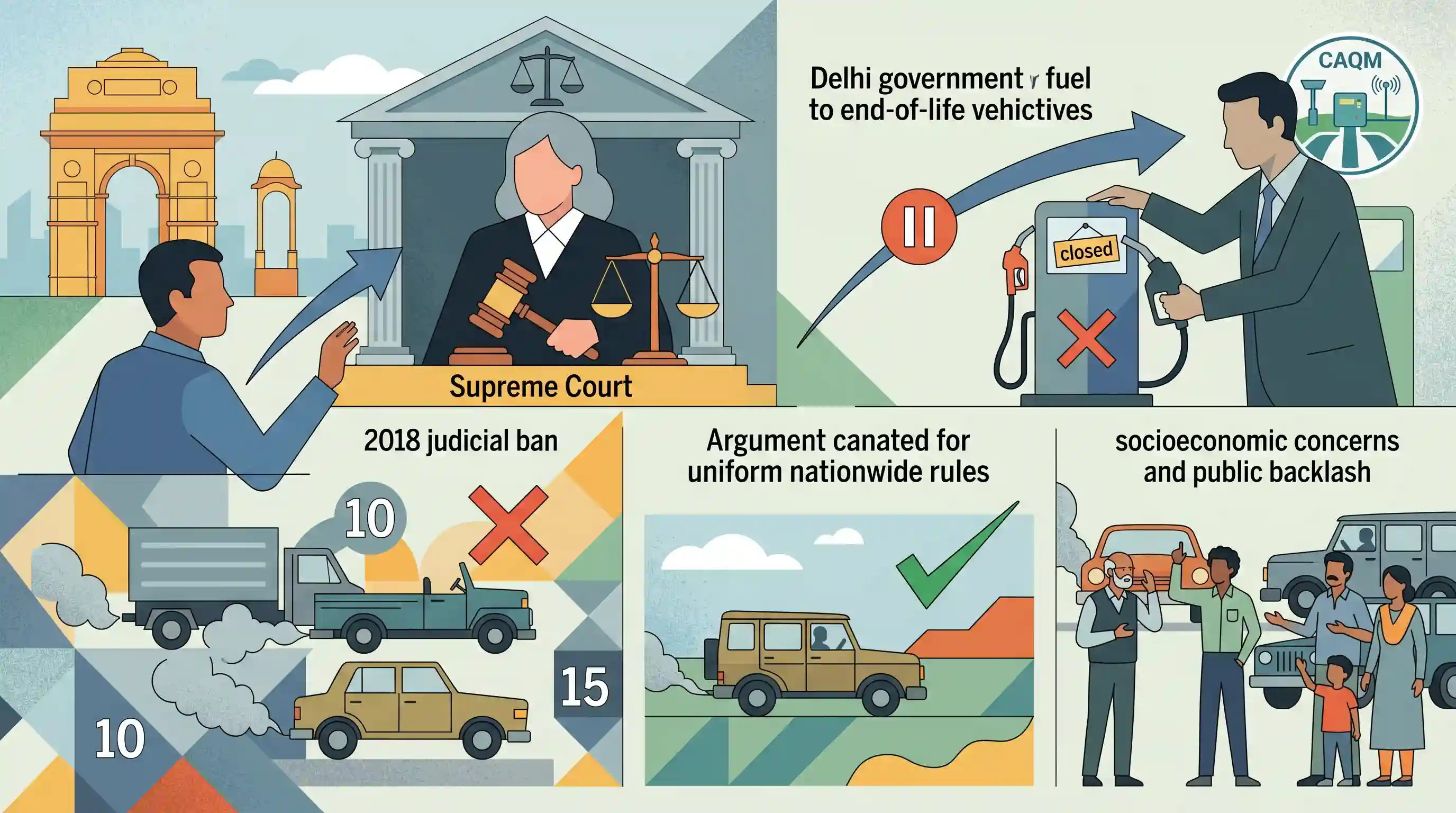
The issue underscores the complexity of environmental governance, where strict judicial and statutory mandates (like CAQM rules) clash with socioeconomic realities and public resistance. It also presents a rare instance of alignment between the Delhi L-G and the elected government on modifying environmental policies.
Summary
The Delhi government, supported by the Lieutenant Governor, plans to approach the Supreme Court to seek uniform nationwide rules for overage vehicles. They aim to review a 2018 judicial ban on 10-year-old diesel and 15-year-old petrol vehicles in Delhi, arguing it is irrational if the vehicles remain roadworthy elsewhere. Simultaneously, the state government has urged the Commission for Air Quality Management (CAQM) to pause its directives denying fuel to end-of-life vehicles, citing socioeconomic concerns and public backlash.
Key Points
- Delhi CM Rekha Gupta announced plans to urge the Supreme Court to implement uniform rules for overage vehicles across India, ending the exclusive restrictions imposed on Delhi.
- Lieutenant Governor Vinai Kumar Saxena backed the move, advising the Delhi government to file a review petition against the 2018 SC judgment that banned 10-year-old diesel and 15-year-old petrol vehicles in the capital.
- The CAQM previously mandated the use of Automatic Number Plate Recognition (ANPR) cameras at fuel stations to deny fuel to end-of-life vehicles (ELVs) and impound them.
- Environment Minister Manjinder Singh Sirsa has asked the CAQM to put this directive on hold, citing public backlash, systemic challenges, and socioeconomic sensitivity.
Important Terms
Commission for Air Quality Management (CAQM)

A statutory body established in 2021 to coordinate, research, and resolve air quality issues in the National Capital Region (NCR) and adjoining states, with powers overriding other pollution boards.
UPSC context
GS Paper 3: Environment and Pollution; tests statutory bodies and environmental governance in NCR.
End-of-Life Vehicles (ELVs) Rules, 2025
Notified under the Environment Protection Act, 1986, these rules mandate the formal recycling of unfit vehicles and set steel recycling targets for manufacturers to promote a circular economy.
UPSC context
GS Paper 3: Environment; tests knowledge of waste management and circular economy initiatives.
2018 Supreme Court Judgment on Overage Vehicles
A judicial directive in the M.C. Mehta case that banned 10-year-old diesel and 15-year-old petrol vehicles in Delhi-NCR due to extreme air pollution, recently modified to exclude BS-IV+ vehicles.
UPSC context
GS Paper 2/3: Judiciary and Environment; relevant for judicial activism and pollution control.
Vehicle Scrappage Policy
A policy aimed at phasing out old, unfit, and polluting vehicles by incentivizing scrapping at Registered Vehicle Scrapping Facilities (RVSFs) through tax rebates and registration fee waivers.
UPSC context
GS Paper 3: Infrastructure and Economic Development; tests government schemes for sustainable mobility.
Extended Producer Responsibility (EPR)
A policy approach where producers are made responsible for the entire lifecycle of a product, specifically used in ELV rules to mandate manufacturer recycling of vehicle scrap.
UPSC context
GS Paper 3: Environment; essential concept for waste management and industrial accountability.
Bharat Stage VI (BS-VI) Norms
Emission standards based on European regulations, implemented in India in 2020, significantly reducing nitrogen oxides (NOx) and particulate matter compared to previous BS-IV standards.
UPSC context
GS Paper 3: Science & Tech and Environment; tests technological solutions to air pollution.
Prelims Trap
The National Vehicle Scrappage Policy mandates the compulsory scrapping of all 10-year-old diesel and 15-year-old petrol vehicles across India.
The national policy relies on automated fitness tests to determine roadworthiness, not strict age limits. The absolute 10/15-year age-based ban is specific to Delhi-NCR via a 2018 Supreme Court order.
Static Concepts Connected
What is the statutory mandate and jurisdiction of the CAQM?
- Statutory Origin: Created under the CAQM Act 2021 to manage air quality, effectively superseding the Environment Pollution (Prevention and Control) Authority (EPCA).
- Broad Jurisdiction: Covers the National Capital Region (NCR) and adjoining areas in Punjab, Haryana, Rajasthan, and Uttar Pradesh affecting NCR air quality.
- Overriding Authority: Possesses legally binding powers; its orders and directives explicitly supersede those of state-level pollution control boards in case of conflict.
How does the National Vehicle Scrappage Policy evaluate end-of-life vehicles?
- Fitness-Based Criteria: Evaluates actual roadworthiness through mandatory automated fitness centers rather than imposing arbitrary age-based bans.
- Financial Incentives: Offers road tax rebates, registration fee waivers, and scrap value to incentivize voluntary modernization of old vehicles.
- Disincentives: Imposes a Green Tax and increased renewal fees for older vehicles that manage to pass the fitness tests.
Cross-Topic Patterns
Judicial activism vs Executive policy
The friction between the SC's rigid age-based vehicle ban in Delhi and the Centre's fitness-based scrappage policy exemplifies the tension between judicial environmentalism and nuanced executive policymaking.
AI surveillance in pollution control
The CAQM's mandate to use ANPR cameras at fuel pumps links vehicular pollution management with digital surveillance, raising governance questions on socioeconomic impacts and technological enforcement.

Expect a 2026 Prelims MCQ on CAQM's statutory powers overriding State boards, or a Mains Q on judicial overreach in environmental policy.
Linked PYQs · 4
Linked PYQs · 4
- 2021MainsGS3
Describe the key points of the revised Global Air Quality Guidelines (AQGs) recently released by the World Health Organisation (WHO). How are these different from its last update in 2005? What changes in India's National Clean Air Programme are required to achieve these revised standards?
- 2023MainsGS3
The adoption of electric vehicles is rapidly growing worldwide. How do electric vehicles contribute to reducing carbon emissions and what are the key benefits they offer compared to traditional combustion engine vehicles?
- 2022MainsGS2
“The most significant achievement of modern law in India is the constitutionalization of environmental problems by the Supreme Court.” Discuss this statement with the help of relevant case laws.
- 2018MainsGS2
“Policy contradictions among various competing sectors and stakeholders have resulted in inadequate 'protection and prevention of degradation' to environment.” Comment with relevant illustrations.
