Delhi Government to Move Supreme Court on Green Firecrackers
Source:The Hindu ↗
Why It Matters
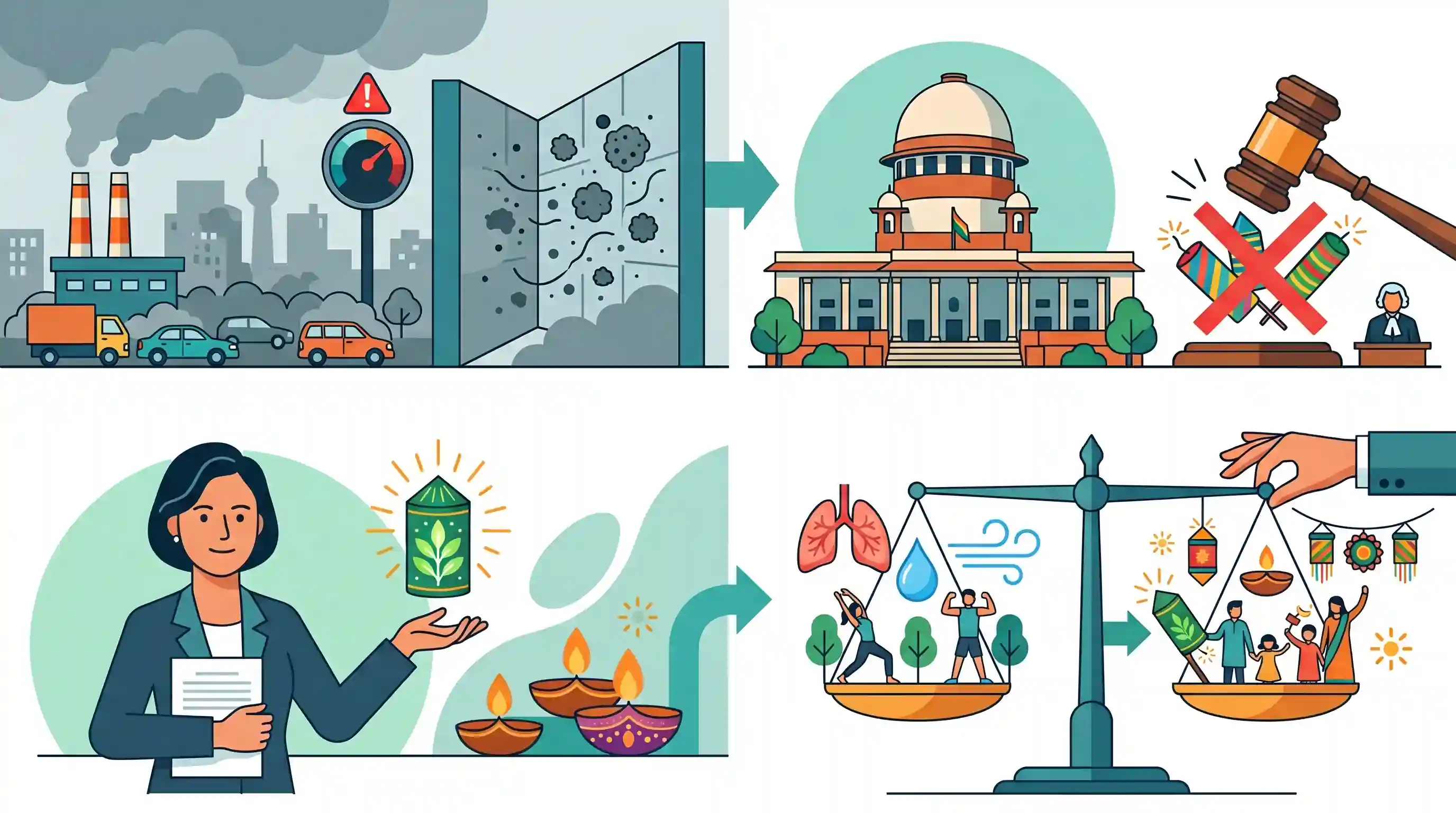
Highlights the ongoing judicial and executive struggle to balance the Right to Clean Air (Article 21) with cultural and religious freedoms (Article 25), reflecting a key theme in environmental jurisprudence in India.
Summary
The Delhi government, led by Chief Minister Rekha Gupta, plans to approach the Supreme Court to lift the existing blanket ban on firecrackers and allow the use of certified "green firecrackers" during Deepavali. The government aims to strike a balance between allowing public participation in cultural festivities and addressing Delhi's severe winter air pollution. In its plea, the government will reiterate its commitment to environmental protection while requesting relief for green firecrackers, which are designed to be less polluting.
Key Points
- The Delhi government will approach the Supreme Court to seek permission for the use of certified green firecrackers during Deepavali.
- Chief Minister Rekha Gupta emphasized the need to balance environmental protection with the cultural celebrations of millions.
- The Delhi government plans to submit a written plea arguing that green firecrackers cause significantly less pollution than conventional ones.
- The Supreme Court had previously imposed a blanket ban on all firecrackers in Delhi to curb severe winter air pollution.
Important Terms
Green Firecrackers

Eco-friendly fireworks developed by CSIR-NEERI that reduce emissions (PM, SO2, NO2) by at least 30%, eliminate barium compounds, and may release water vapor to settle dust.
UPSC context
GS Paper III: Environmental Pollution; crucial for balancing public health with cultural rights in judicial discourse.
Article 21 of the Indian Constitution
Guarantees the Right to Life and Personal Liberty. The Supreme Court interprets this to include the right to a clean, pollution-free environment and health, often giving it primacy over other rights.
UPSC context
GS Paper II: Fundamental Rights; tested via judicial interpretations regarding environmental justice versus religious freedom.
Article 25 of the Indian Constitution
Guarantees freedom of conscience and the right to freely profess, practice, and propagate religion. It is subject to public order, morality, and health.
UPSC context
GS Paper II: Secularism and Fundamental Rights; central to debates on state intervention in religious celebrations.
CSIR-NEERI
A premier research institute under CSIR that develops "green" formulations for firecrackers and certifies manufacturers to ensure reduced environmental impact and compliance with emission standards.
UPSC context
GS Paper III: Science & Technology; relevant for institutional roles in pollution control and innovation.
Precautionary Principle
An environmental law doctrine stating that if an action or policy has a suspected risk of causing harm to the public or environment, protective measures should be taken even without full scientific certainty.
UPSC context
GS Paper III: Environmental Governance; a key legal tool used by the judiciary to justify environmental bans.
National Capital Territory (NCT) of Delhi
A unique administrative region in India governed by the Delhi Legislative Assembly and the Lieutenant Governor, with specific legal frameworks like Article 239AA.
UPSC context
GS Paper II: Federalism and Governance; relevant for state-center jurisdictional issues and local environmental management.
Prelims Trap
Green crackers eliminate particulate matter emissions completely and are certified by the Central Pollution Control Board (CPCB).
Green crackers only reduce PM emissions by about 30% (they do not eliminate them) and are certified by the Petroleum and Explosives Safety Organisation (PESO), not CPCB.
Static Concepts Connected
What are the three variants of Green Crackers developed by CSIR-NEERI?
- SWAS: Safe Water Releaser. Releases water vapour during the explosion to act as a dust suppressant, significantly reducing particulate matter.
- STAR: Safe Thermite Cracker. Completely eliminates potassium nitrate and sulfur, leading to reduced particulate matter and lower sound intensities.
- SAFAL: Safe Minimal Aluminium. Replaces traditional aluminium with magnesium, reducing toxic metal emissions and lowering sound output compared to commercial crackers.
How do Fundamental Rights intersect in the Supreme Court's firecracker judgments?
- Article 21 (Health): The SC maintains that the right to a clean environment falls under Article 21, holding primacy when public health is severely threatened by toxic smog.
- Article 25 (Religion): The freedom to practice religion is explicitly subject to public order, morality, and health, justifying state restrictions on polluting festivities.
- Article 19(1)(g) (Trade): The SC ruled that the right to trade for firecracker manufacturers cannot override the fundamental right to life and health of the general population.
Cross-Topic Patterns
Winter Smog + CAQM's GRAP
The Deepavali firecracker debate routinely intersects with the statutory enforcement of the Graded Response Action Plan (GRAP) by the CAQM during Delhi's winter temperature inversion.
PESO’s regulatory span + Commerce Ministry
PESO, which certifies green crackers, operates under the Ministry of Commerce (DPIIT). It is frequently tested for regulating both festive explosives and critical industrial materials like liquid oxygen.

Expect a Prelims question mixing green cracker chemistry (barium exclusion/SWAS) with the regulatory mandate of PESO vs CPCB in 2026.
Linked PYQs · 3
Linked PYQs · 3
- 2015MainsGS2
Does the right to clean environment entail legal regulations on burning crackers during Diwali? Discuss in the light of Article 21 of the Indian Constitution and Judgement(s) of the Apex Court in this regard.
- 2022MainsGS2
“The most significant achievement of modern law in India is the constitutionalization of environmental problems by the Supreme Court.” Discuss this statement with the help of relevant case laws.
- 2020MainsGS3
What are the key features of the National Clean Air Programme (NCAP) initiated by the Government of India?
