State Conservation Measures and EV Transition Amid Energy Disruptions
Source:Indian Express ↗
Why It Matters
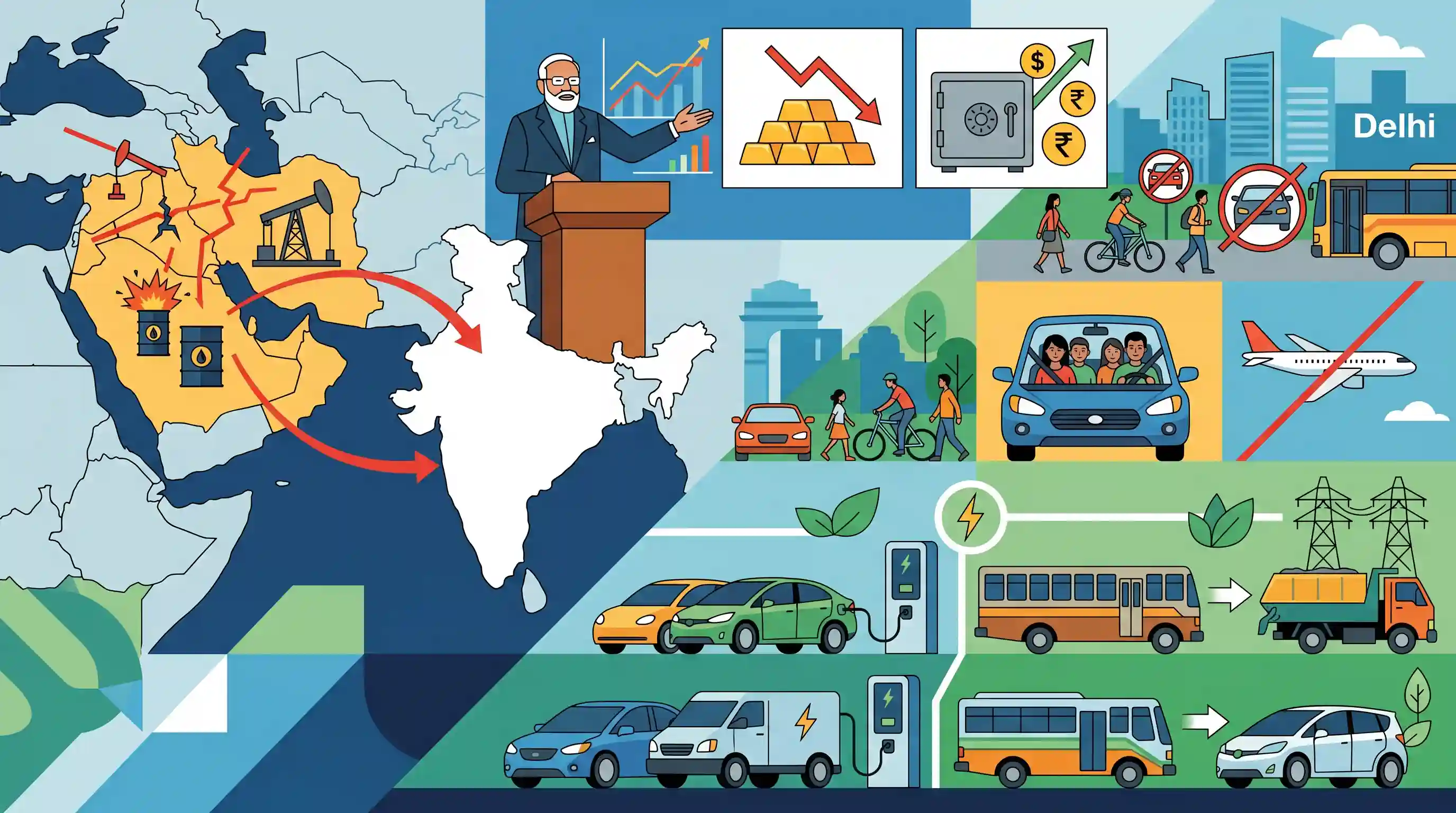
Illustrates the cascading effects of global geopolitical conflicts on domestic macroeconomic stability and energy security, and highlights the role of state-level interventions and sustainable mobility transitions (like EV adoption) in mitigating these shocks.
Summary
The Delhi government has announced measures to curb petrol and diesel consumption to mitigate the economic impact of global energy disruptions caused by the West Asia crisis. Following Prime Minister Narendra Modi's appeal for fuel conservation and reduced gold imports to safeguard foreign exchange reserves, Delhi's Environment Department proposed several initiatives. These include a mandatory 'No Car Day' for officials, carpooling, restricting foreign travel, and expanding electric vehicle charging infrastructure. Additionally, departments like the Delhi Jal Board and PWD are transitioning from diesel-powered equipment and vehicles to electric alternatives, accelerating the capital's shift towards sustainable mobility.
Key Points
- The Delhi government is formulating plans to reduce petrol, diesel, and LPG consumption in response to energy disruptions caused by the West Asia crisis.
- Measures proposed include a 'No Car Day' for government officials, promoting carpooling, and restricting non-essential foreign travel to save foreign exchange.
- Government departments are accelerating EV adoption; the Delhi Jal Board is replacing diesel tankers with EV tankers, and the PWD is transitioning to electric pumps.
- The initiatives align with Prime Minister Modi's appeal to citizens to conserve fuel and reduce gold purchases to protect India's foreign exchange reserves amidst global instability.
Important Terms
Foreign Exchange Reserves (Forex)

Assets held by the central bank in foreign currencies, gold, and SDRs to manage external payments, stabilize the exchange rate, and provide a buffer against economic shocks.
UPSC context
GS Paper III (Economy). Tests understanding of the external sector, balance of payments, and RBI's role in maintaining currency stability.
Energy Security
The uninterrupted availability of energy sources at an affordable price, crucial for a nation's economic growth and strategic autonomy, especially given India's high import dependence.
UPSC context
GS Paper III (Energy/Infrastructure). Relates to energy diversification, strategic petroleum reserves, and reducing fossil fuel dependence.
Current Account Deficit (CAD)
A measurement of a country's trade where the value of the goods and services it imports exceeds the value of the products it exports.
UPSC context
GS Paper III (Economy). Crucial for analyzing macroeconomic stability, trade balances, and the impact of global oil price volatility.
West Asia Crisis
Ongoing geopolitical instability in the Middle East—specifically involving the Strait of Hormuz—impacting global supply chains, energy prices, and India's remittance inflows.
UPSC context
GS Paper II (International Relations). Analyzes the impact of regional conflicts on India's interests, diaspora, and strategic autonomy.
Sustainable Mobility
Transportation systems that are environmentally friendly, low-carbon, and resource-efficient, including electric vehicles (EVs), carpooling, and improved public transit infrastructure.
UPSC context
GS Paper III (Environment/S&T). Focuses on climate change mitigation, EV policies (like FAME/Delhi EV Policy), and urban planning.
Austerity Measures
Official government policies aimed at reducing public spending and consumption to improve fiscal health or respond to economic crises, such as fuel-saving and import restrictions.
UPSC context
GS Paper III (Economy/Governance). Tests understanding of fiscal policy responses to external shocks and government expenditure management.
Prelims Trap
Gold imports are categorized under the Capital Account of the Balance of Payments.
Physical gold imports are trade in goods (visibles) and fall strictly under the Current Account. They directly widen the Current Account Deficit (CAD).
Static Concepts Connected
What are the primary components of India's Current Account?
- Trade in Goods: Net export/import of physical commodities like crude oil, electronics, and gold (Visibles).
- Trade in Services: Net earnings from invisibles such as software services, travel, and transportation.
- Net Transfers: Unilateral transfers including remittances from Indians working abroad, gifts, and foreign aid.
- Net Income: Interest, profits, and dividends earned or paid on foreign investments.
What constitutes India's official Foreign Exchange Reserves?
- FCA: Foreign Currency Assets (major currencies like USD, Euro, Yen, Pound) form the largest component.
- Monetary Gold: Monetary physical gold held directly by the Reserve Bank of India.
- SDRs: Special Drawing Rights, the supplementary foreign exchange reserve assets defined and maintained by the IMF.
- RTP: Reserve Tranche Position, representing India's liquid claim or emergency quota access at the IMF.
Cross-Topic Patterns
Geopolitics accelerating green transition
Sub-national shifts to EVs driven by Middle East instability echo the 1970s oil shocks, which historically catalyzed global energy efficiency standards and early renewable research.
Sovereign Gold Bonds (SGB) rationale
The PM's appeal to reduce gold imports reinforces the macroeconomic logic behind Sovereign Gold Bonds: substituting physical gold demand with paper assets to prevent CAD widening.

Expect a 2026 Prelims multi-statement question linking West Asian chokepoints directly to CAD expansion and Forex components.
Linked PYQs · 4
Linked PYQs · 4
- 2025MainsGS2
"Energy security constitutes the dominant kingpin of India's foreign policy, and is linked with India's overarching influence in Middle Eastern countries.” How would you integrate energy security with India's foreign policy trajectories in the coming years?
- 2017MainsGS2
The question of India's Energy Security constitutes the most important part of India's economic progress. Analyze India's energy policy cooperation with West Asian countries.
- 2023MainsGS3
The adoption of electric vehicles is rapidly growing worldwide. How do electric vehicles contribute to reducing carbon emissions and what are the key benefits they offer compared to traditional combustion engine vehicles?
- 2013PrelimsGS1
Which one of the following groups of items is included in India's foreign-exchange reserves?
