Urban Homelessness Rehabilitation and State Civil Society Action
Source:The Hindu ↗
Why It Matters
This initiative serves as a practical example of government and NGO collaboration (civil society engagement) in welfare administration and public service delivery, relevant for GS2 questions on the role of non-state actors in development processes and welfare policies for the vulnerable sections.
Summary
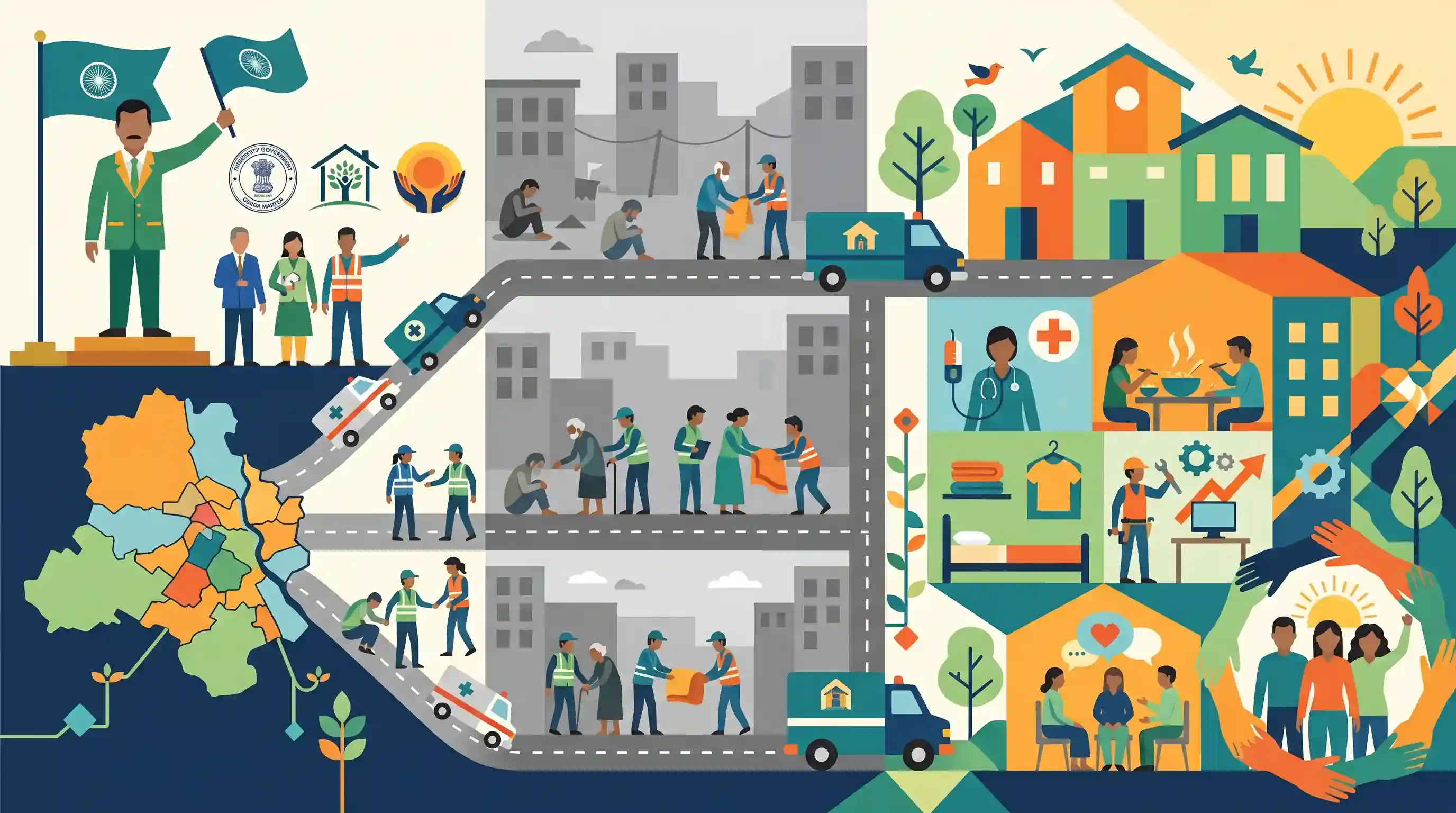
The Delhi government has initiated a five-day rescue campaign aimed at identifying and assisting homeless and destitute people across the national capital's 13 districts. Flagged off by Chief Minister Rekha Gupta, the drive involves shifting these vulnerable individuals to shelter homes for proper treatment, care, and rehabilitation. The campaign is jointly organized by the Department of Social Welfare, Apna Ghar Ashram, and Seva Bharti Delhi Prant, showcasing a collaborative approach between the state and civil society organizations to address urban homelessness.
Key Points
- The Delhi government launched a five-day rescue drive across its 13 districts to identify and assist homeless and destitute individuals.
- Rescued individuals will be shifted to shelter homes operated by the Apna Ghar Ashram for treatment, care, and rehabilitation.
- The initiative is a collaborative effort between the Delhi government\'s Department of Social Welfare, Apna Ghar Ashram, and Seva Bharti Delhi Prant.
- Nineteen rescue vans have been deployed with the expectation of providing assistance to over 300 homeless people during the drive.
Important Terms
Urban Homelessness

The condition of individuals in urban areas lacking stable, safe, and adequate housing, often residing in public spaces or non-residential structures.
UPSC context
GS Paper I (Urbanization) and GS Paper II (Social Justice); critical for analyzing urban poverty and fundamental rights.
Department of Social Welfare
The state-level administrative body responsible for formulating and implementing welfare policies for vulnerable groups, including the elderly, disabled, and destitute.
UPSC context
GS Paper II (Governance); highlights the role of executive machinery in welfare delivery.
Rehabilitation of Destitutes
A holistic process involving medical care, mental health support, and family reunification to restore the dignity and social status of abandoned or helpless individuals.
UPSC context
GS Paper II (Social Justice) and GS Paper IV (Ethics); emphasizes humanitarian state responsibilities.
Apna Ghar Ashram
A prominent non-profit organization specializing in rescuing abandoned, sick, and destitute people, providing them with shelter, medical treatment, and long-term care across India.
UPSC context
GS Paper II (NGOs and Civil Society); illustrates public-private partnerships in social welfare.
Seva Bharti Delhi Prant
A volunteer-driven social organization that collaborates with government agencies to provide healthcare, education, and disaster relief to marginalized communities.
UPSC context
GS Paper II (Governance); demonstrates the role of voluntary sectors in institutionalizing social service.
Shelter for Urban Homeless (SUH)
A sub-component of the National Urban Livelihoods Mission (NULM) aimed at providing 24x7 all-weather shelters and essential services to the urban poor.
UPSC context
GS Paper II (Government Schemes); key for evaluating state interventions for urban livelihood security.
Prelims Trap
"Shelter for Urban Homeless (SUH) is administered by the Ministry of Social Justice and Empowerment."
SUH is a sub-component of DAY-NULM, which is administered by the Ministry of Housing and Urban Affairs (MoHUA), not the Ministry of Social Justice.
Static Concepts Connected
How has the Supreme Court interpreted the Right to Shelter?
- Fundamental Right: The Supreme Court expanded Article 21 (Right to Life) to include the Right to Shelter in landmark cases like Chameli Singh and Olga Tellis.
- State Obligation: It obligates states to provide more than just a roof, ensuring adequate living space, dignity, and basic infrastructure for the destitute.
- Mandatory Quota: The SC mandated urban local bodies to establish at least one permanent night shelter with a capacity of 100 persons for every 1 lakh urban population.
What are the key features of the Shelter for Urban Homeless (SUH)?
- Nodal Mission: It is a vital sub-component of the Centrally Sponsored Scheme, Deendayal Antyodaya Yojana-National Urban Livelihoods Mission (DAY-NULM).
- Target Goal: It aims to provide permanent, 24x7 all-weather shelters for the urban poorest, equipped with essential services like water, sanitation, and safety.
- Implementing Ministry: MoHUA is the nodal ministry implementing this scheme in collaboration with State governments and Urban Local Bodies.
Cross-Topic Patterns
State-NGO synergy in welfare delivery
The Delhi drive highlights the GS2 theme of civil society organizations acting as non-state enablers to execute state rehabilitation functions and ensure last-mile service delivery.
Urban poverty and the documentation barrier
Homeless populations suffer an 'invisibility' crisis. Their lack of foundational IDs (like Aadhaar) creates systemic barriers to affirmative action, overlapping with GS2 issues of exclusion errors in welfare.

Expect a multi-statement Prelims question linking DAY-NULM (SUH scheme) with SC guidelines on state obligations for urban night shelters.
Linked PYQs · 4
Linked PYQs · 4
- 2021MainsGS2
Can Civil Society and Non-Governmental Organizations present an alternative model of public service delivery to benefit the common citizen? Discuss the challenges of this alternative model.
- 2025MainsGS2
Civil Society Organizations are often perceived as being anti-State actors than non-State actors. Do you agree? Justify.
- 2023MainsGS1
Does urbanization lead to more segregation and/or marginalization of the poor in Indian metropolises?
- 2025MainsGS1
How does smart city in India, address the issues of urban poverty and distributive justice?
