Delhi Flyover Green Zones via Corporate Social Responsibility
Source:Indian Express ↗
Why It Matters
It provides a practical, real-world case study of leveraging Corporate Social Responsibility (CSR) and Public-Private Partnership (PPP) models to solve urban space management challenges and fund infrastructure beautification without relying on the public exchequer.
Summary
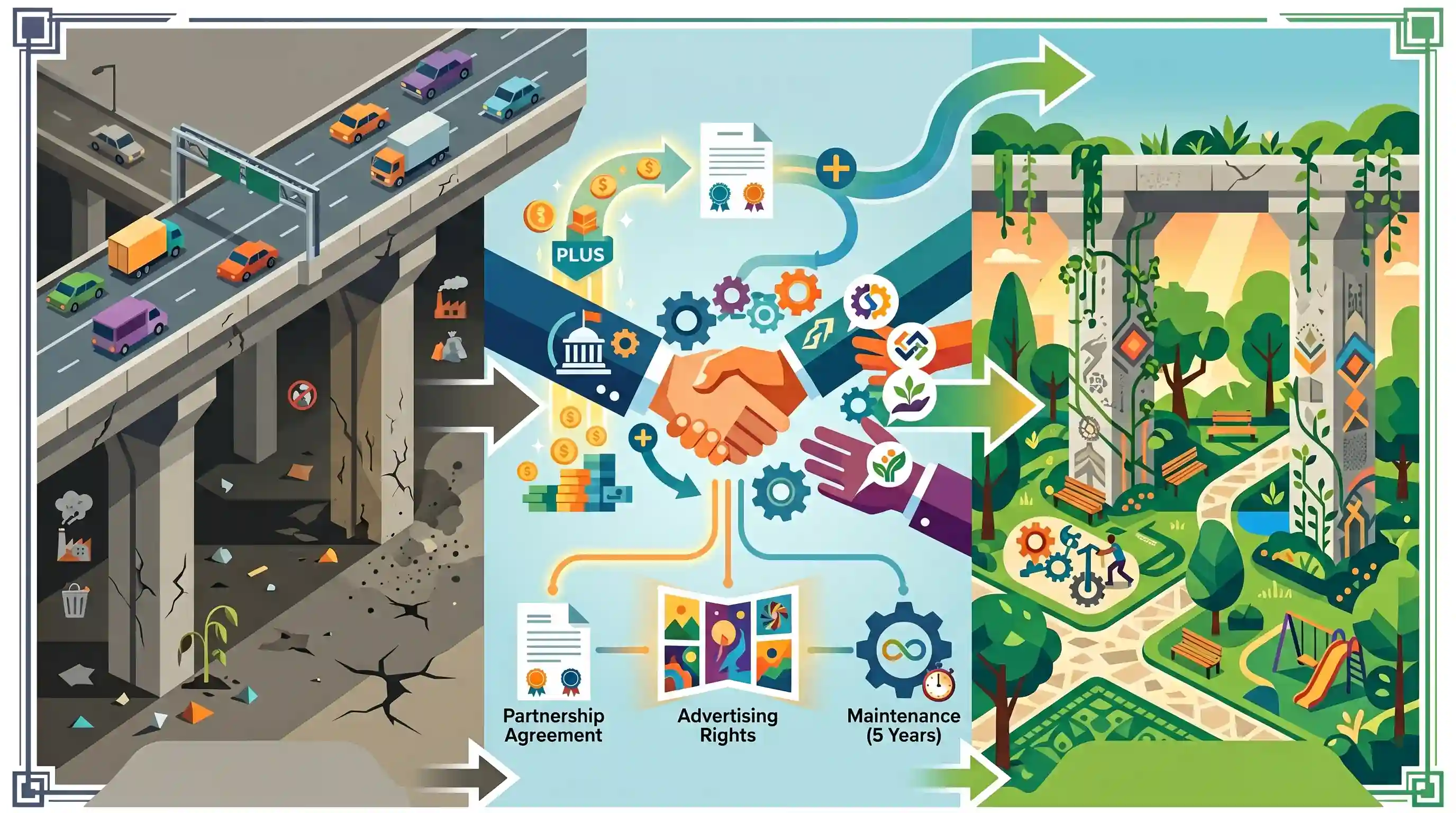
To optimize unused urban space, the Delhi Government's Public Works Department (PWD) is partnering with private firms under a Corporate Social Responsibility (CSR) initiative to develop 'green zones' beneath city flyovers. Companies including Dalmia Bharat Limited, Godrej Industries, and EaseMyTrip will fund the transformation of these neglected areas into recreational spaces with public amenities. In exchange, the firms gain advertising rights and will maintain the zones for up to five years, providing an innovative, zero-cost urban beautification model for the government.
Key Points
- The Delhi PWD is collaborating with private firms to transform unused spaces beneath five city flyovers into aesthetic 'green zones'.
- The project leverages Corporate Social Responsibility (CSR) funds from companies like Dalmia Bharat, Godrej Industries, and EaseMyTrip to cover design and execution costs.
- The developed areas will feature greenery, seating, children's play zones, and walkways, helping to alleviate recreational space constraints in the densely populated capital.
- Private partners will not acquire land ownership but will receive branding and advertising rights, along with the responsibility to maintain the spaces for up to five years.
- This model functions as a zero-cost public-private partnership for the government, allowing for urban beautification and civic improvements without straining public finances.
Important Terms
Public-Private Partnership (PPP)

A collaborative arrangement between a government agency and the private sector to fund, build, and operate projects such as public infrastructure or services.
UPSC context
GS Paper 3: Investment models and infrastructure development; critical for leveraging private efficiency for public welfare projects.
Corporate Social Responsibility (CSR)
A legal mandate under Section 135 of the Companies Act, 2013, requiring companies to spend at least 2% of their average net profits on social and environmental causes.
UPSC context
GS Paper 2 & 4: Governance and Ethics; involves corporate accountability and statutory requirements for social impact.
Public Works Department (PWD)
The primary state government agency responsible for the planning, construction, and maintenance of public infrastructure, including roads, bridges, and government buildings.
UPSC context
GS Paper 2: Role and functioning of government departments in executive governance and service delivery.
Urban Infrastructure
The physical structures and systems—such as transport, sanitation, and green spaces—essential for the functioning of a city and the quality of life for residents.
UPSC context
GS Paper 3: Issues relating to urbanization, infrastructure development, and sustainable city planning.
Dalmia Bharat Limited
An Indian industrial conglomerate and private player involved in infrastructure projects, currently partnering with the Delhi PWD to redevelop specific flyover stretches through CSR funds.
UPSC context
GS Paper 3: Acts as a case study for private sector participation in urban beautification and PPP models.
Prelims Trap
Private companies acquire leasehold ownership of the land beneath the flyovers for five years in exchange for developing green zones.
The government merely exchanges short-term advertising rights for maintenance. No land ownership or leasehold alienation occurs, preventing long-term public asset loss.
Static Concepts Connected
What are the statutory CSR requirements under the Companies Act, 2013?
- Applicability: Applies to companies with a net worth of ₹500cr+, turnover of ₹1000cr+, or net profit of ₹5cr+ in the preceding financial year.
- Spending Mandate: Mandates spending at least 2% of the average net profits made during the three immediately preceding financial years on eligible activities.
- Schedule VII: Eligible activities are listed under Schedule VII, including environmental sustainability, education, poverty eradication, and rural development.
What drives the Urban Heat Island (UHI) effect and how is it mitigated?
- Primary Cause: Triggered by replacing natural land cover with dense pavement and buildings (like asphalt flyovers) that absorb and retain solar heat.
- Impact: Leads to higher daytime temperatures, reduced nighttime cooling, and exacerbated local air pollution compared to surrounding rural areas.
- Mitigation: Mitigated by micro-level ecological interventions like tactical urbanism, increasing urban tree canopy, cool pavements, and green infrastructure beneath concrete structures.
Cross-Topic Patterns
Tactical Urbanism and ULB Finances
This zero-cost model addresses the chronic underfunding of Urban Local Bodies (stuck at ~1% of GDP) by leveraging private capital for micro-level civic improvements without adding public debt.
Innovative PPP via CSR synergy
Merging public-private partnerships (exchanging ad rights for service) with CSR mandates marks a shift from traditional philanthropy to active corporate involvement in urban ecological restoration.

Expect Mains GS1/GS3 questions blending 'Tactical Urbanism' for UHI mitigation with alternative municipal financing mechanisms like CSR.
Linked PYQs · 4
Linked PYQs · 4
- 2022MainsGS3
Why is Public Private Partnership (PPP) required in infrastructural projects ? Examine the role of PPP model in the redevelopment of Railway Stations in India.
- 2013MainsGS3
Adoption of PPP model for infrastructure development of the country has not been free of criticism. Critically discuss pros and cons of the model.
- 2022MainsGS4
In contemporary world, corporate sector's contribution in generating wealth and employment is increasing. In doing so, they are bringing in unprecedented onslaught on the climate, environmental sustainability and living conditions of human beings. In this background, do you find that Corporate Social Responsibility (CSR) is efficient and sufficient enough to fulfill the social roles and responsibilities needed in the corporate world for which the CSR is mandated? Critically examine.
- 2017MainsGS4
Corporate social responsibility makes companies more profitable and sustainable. Analyse.
