Electoral Populism and Fiscal Sustainability of Welfare Sops
Source:Indian Express ↗
Why It Matters
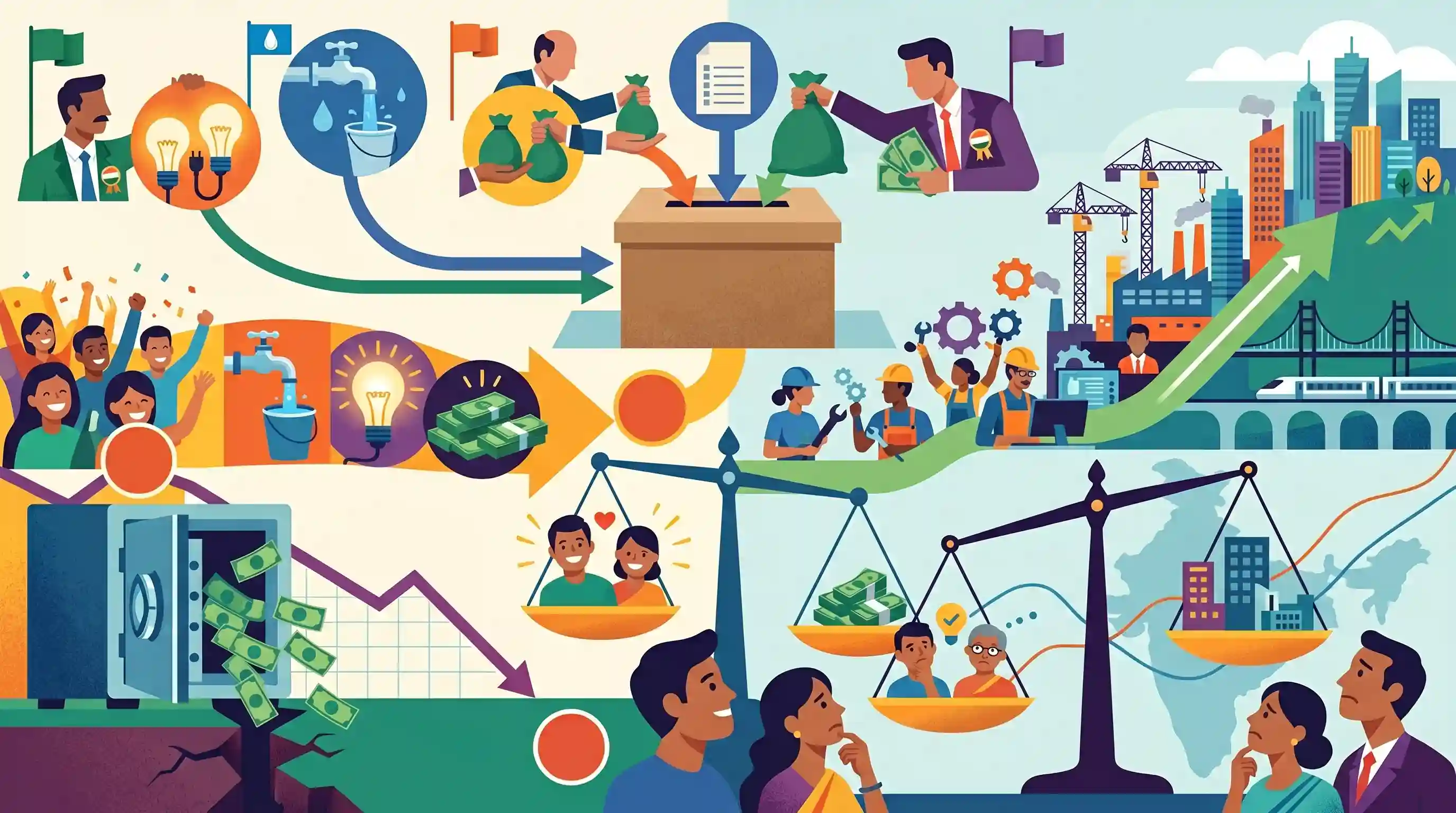
The growing reliance on 'freebies' is a central issue for UPSC aspirants, linking directly to GS Paper 2 (welfare schemes, voter behaviour in electoral democracy) and GS Paper 3 (state finances, fiscal deficit, and public expenditure management). It illustrates the persistent tension between short-term political populism and long-term economic sustainability.
Summary
The political landscape in Delhi reflects a shifting paradigm in electoral strategies, where the promise of immediate welfare benefits ('sops' or 'freebies') consistently overshadows long-term aspirational pitches based on infrastructure and job creation. As Delhi approaches elections, mainstream national parties like the BJP and Congress are increasingly adopting the Aam Aadmi Party's (AAP) playbook of promising free electricity, water, and cash transfers. This highlights a broader trend in Indian politics where competitive populism shapes electoral outcomes, raising critical questions about voter behavior, developmental priorities, and the long-term fiscal sustainability of state governments.
Key Points
- Electoral Dominance of Sops: The effectiveness of immediate welfare promises (freebies/subsidies) over aspirational narratives (infrastructure, growth) in securing voter support in Delhi.
- Convergence of Political Manifestos: National parties like the BJP and Congress are increasingly mirroring AAP's welfare-centric playbook, leading to a homogenization of electoral promises around direct benefits.
- Fiscal Implications: The rise of competitive populism raises serious concerns regarding the fiscal health of state exchequers, as funding massive sops often crowds out capital expenditure required for long-term development.
- Welfare vs. Development Debate: The article highlights the persistent governance challenge of balancing immediate social safety nets with prudent public expenditure management for sustainable economic growth.
Important Terms
Competitive Populism

A political strategy where rival parties outbid each other with immediate welfare promises or subsidies to secure votes, often risking long-term economic stability.
UPSC context
GS Paper II (Elections) and III (Economy); tests understanding of electoral dynamics versus sustainable public expenditure.
Fiscal Prudence
The practice of managing government finances responsibly by controlling deficits and debt to ensure long-term macroeconomic stability.
UPSC context
GS Paper III (Economy); core to topics like the FRBM Act and fiscal deficit management.
Freebies (Revdi Culture)
Short-term, non-merit goods (e.g., cash, gadgets) promised for electoral gain, distinguished from merit-based 'welfare' like healthcare and education.
UPSC context
GS Paper II (Governance); involves Supreme Court observations on 'irrational freebies' and the Representation of the People Act.
Aam Aadmi Party (AAP)
A national political party in India that redefined Delhi's electoral landscape through its 'Delhi Model' of free electricity, water, and mohalla clinics.
UPSC context
GS Paper II (Political Parties); relevant for studying the rise of regional-turned-national parties and welfare-centric governance.
Aspirational Pitch
An electoral strategy focusing on long-term developmental goals like infrastructure, economic growth, and job creation rather than immediate individual sops.
UPSC context
GS Paper II (Governance); tests the balance between immediate relief and sustainable developmental priorities in a democracy.
Representation of the People Act, 1951
The primary legislation governing the conduct of elections in India, including the definition of 'corrupt practices' during campaigning.
UPSC context
GS Paper II (Polity/Elections); central to debates on whether poll promises constitute 'bribery' or 'gratification'.
Prelims Trap
"Promises of freebies in an election manifesto constitute a 'corrupt practice' under the Representation of the People Act, 1951."
In the S. Subramaniam Balaji case (2013), the Supreme Court ruled that manifesto promises, including freebies, do NOT amount to a corrupt practice under Section 123.
Static Concepts Connected
What distinguishes merit goods from non-merit goods in public finance?
- Merit Goods: Items like primary education, healthcare, and targeted PDS that generate positive externalities, creating broad societal benefits beyond the direct recipient.
- Non-Merit Goods: Untargeted freebies, such as blanket free electricity or loan waivers, which cause market distortions and strain state exchequers without ensuring long-term socioeconomic upliftment.
What are the prudential limits on state debt under the FRBM framework?
- N.K. Singh Committee: The Committee recommended a combined debt-to-GDP limit of 60%, specifically capping the Centre's share at 40% and the States' combined share at 20%.
- Capex Crowding Out: The RBI notes that rising untargeted subsidies frequently push states beyond this 20% threshold, severely crowding out capital expenditure needed for infrastructure and long-term growth.
Cross-Topic Patterns
ECI's MCC constraints on manifestos
Under Part VIII of the Model Code of Conduct, the Election Commission now requires political parties to explain the financial rationale and funding sources for their manifesto promises.
Article 282 and discretionary grants
States frequently leverage discretionary spending under Article 282 of the Constitution to fund competitive populism, prompting debates over whether Finance Commissions should penalize fiscal profligacy.

Expect a multi-statement Prelims question testing the SC's Balaji judgment, RPA Section 123, and FRBM state-debt targets together.
Linked PYQs · 4
Linked PYQs · 4
- 2022MainsGS2
Besides the welfare schemes, India needs deft management of inflation and unemployment to serve the poor and the underprivileged sections of the society. Discuss.
- 2025MainsGS3
Explain how the Fiscal Health Index (FHI) can be used as a tool for assessing the fiscal performance of states in India. In what way would it encourage the states to adopt prudent and sustainable fiscal policies?
- 2024MainsGS3
Examine the pattern and trend of public expenditure on social services in the post-reforms period in India. To what extent this has been in consonance with achieving the objective of inclusive growth?
- 2019MainsGS3
The public expenditure management is a challenge to the Government of India in the context of budget making during the post-liberalization period. Clarify it.
