NEERI study highlights inadequate wastewater treatment in Delhi
Source:Indian Express ↗
Why It Matters
The article provides a practical case study of the challenges in managing industrial wastewater in megacities. It is highly relevant for GS3 questions concerning river pollution, the efficacy of Common Effluent Treatment Plants (CETPs), and the enforcement capabilities of environmental regulators.
Summary
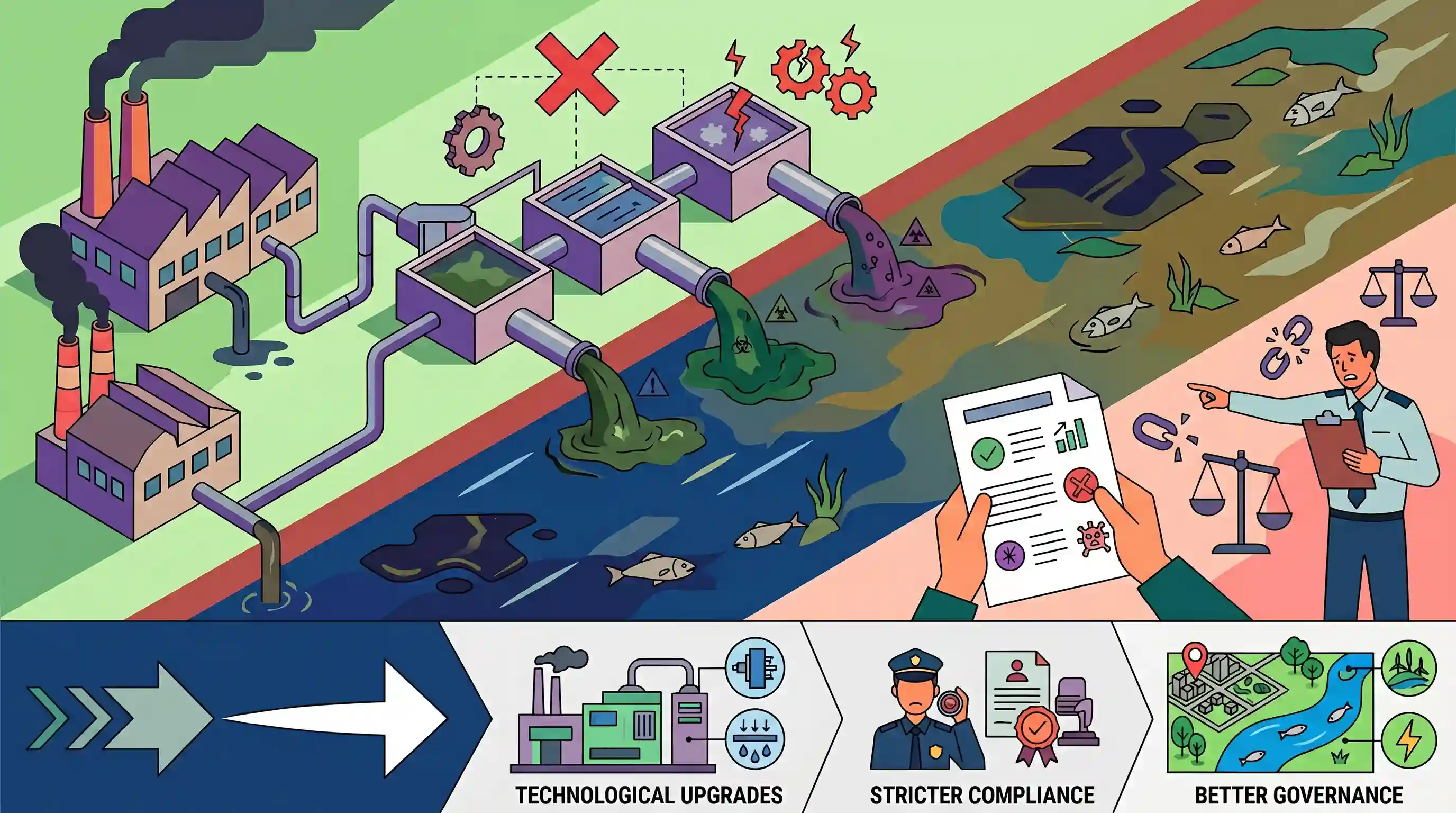
A recent assessment by the National Environmental Engineering Research Institute (NEERI) has exposed critical inadequacies in Delhi's industrial wastewater treatment infrastructure. The study highlights that the city's Common Effluent Treatment Plants (CETPs) frequently fail to meet environmental standards, leading to the discharge of toxic industrial effluents. This systemic failure severely exacerbates the pollution of the Yamuna River, emphasizing the urgent need for technological upgrades, stricter regulatory compliance, and better urban environmental governance.
Key Points
- A study by the National Environmental Engineering Research Institute (NEERI) reveals systemic underperformance and inadequacy in Delhi's industrial wastewater treatment facilities.
- Many Common Effluent Treatment Plants (CETPs) in the city are operating below capacity, lacking modern technology, or failing to meet prescribed environmental standards.
- The discharge of untreated or partially treated industrial effluents contributes significantly to the severe chemical and heavy metal pollution of the Yamuna River.
- The findings underscore the urgent need for technological upgrades, better maintenance of CETPs, and stricter regulatory enforcement by pollution control boards.
Important Terms
Common Effluent Treatment Plant (CETP) Scheme

A collective system designed to treat effluents from small-scale industrial clusters. It helps MSMEs achieve 'economies of scale' in pollution control where individual treatment plants are not financially or spatially viable.
UPSC context
GS Paper 3: Environmental Pollution. Relevant for industrial waste management and sustainable urban infrastructure topics.
Water (Prevention and Control of Pollution) Act
The primary legislation for maintaining water quality and establishing pollution control boards. A 2024 amendment notably decriminalized minor offenses, replacing imprisonment with fines to improve ease of doing business.
UPSC context
GS Paper 2 & 3: Environment Laws. Important for statutory frameworks and recent legislative shifts in environmental governance.
National Environmental Engineering Research Institute (NEERI)
A CSIR constituent laboratory specializing in environmental science and engineering research. It provides technical solutions, conducts environmental audits, and often assists the judiciary in assessing pollution impacts.
UPSC context
GS Paper 3: Science & Technology. Tested for its role in innovative solutions like green crackers and pollution audits.
Central Pollution Control Board (CPCB)
A statutory body under the MoEFCC that serves as the apex authority for pollution control in India. It coordinates State boards, sets national standards, and monitors air and water quality.
UPSC context
GS Paper 2: Statutory Bodies. A key organization for environmental monitoring and regulatory compliance.
Delhi Pollution Control Committee (DPCC)
An autonomous regulatory body that implements environmental laws specifically within the National Capital Territory of Delhi. It exercises the powers of a State Pollution Control Board to monitor and control regional pollution.
UPSC context
GS Paper 3: Urbanization/Pollution. Vital for understanding regional environmental governance and the Yamuna pollution crisis.
Prelims Trap
NEERI is a statutory body operating under the Ministry of Environment, Forest and Climate Change.
NEERI is a constituent laboratory of CSIR under the Ministry of Science and Technology, not MoEFCC. Do not confuse its research role with statutory regulators.
Static Concepts Connected
What are the foundational differences between NEERI and CPCB?
- NEERI (Research): A constituent laboratory of CSIR under the Ministry of Science and Technology, headquartered in Nagpur, focused on environmental engineering research.
- CPCB (Statutory): A statutory organization constituted under the Water Act (1974), tasked with setting standards and advising MoEFCC on pollution control.
How do Common Effluent Treatment Plants (CETPs) function in urban ecosystems?
- Shared Infrastructure: Pools and treats wastewater from Small and Medium Enterprise (SME) clusters that lack the capital and technical expertise to run individual treatment plants.
- Bioremediation processes: Utilizes specific naturally occurring or engineered microorganisms to metabolize and degrade complex industrial pollutants and heavy metals before river discharge.
Cross-Topic Patterns
MSME Economics vs. Environmental Compliance
Environmental norms often act as financial burdens for MSMEs. CETPs were designed as a subsidy-driven infrastructure bridge for small clusters, but frequent operational failures highlight gaps in urban industrial governance.
River Pollution & Federal Water Governance
Yamuna's extreme pollution in Delhi (76% load in just 2% length) frequently triggers upstream-downstream political conflicts, linking urban environmental degradation with federal water allocation and ecological flow mandates.

Expect a 2026 Prelims question pairing NEERI/CPCB institutional mandates with bioremediation techniques used in CETP wastewater treatment.
Linked PYQs · 1
Linked PYQs · 1
- 2024MainsGS3
Industrial pollution of river water is a significant environmental issue in India. Discuss the various mitigation measures to deal with this problem and also the government's initiatives in this regard.
