Delhi Court discharges Accused in Excise Policy Corruption Case
Source:Indian Express ↗
Why It Matters
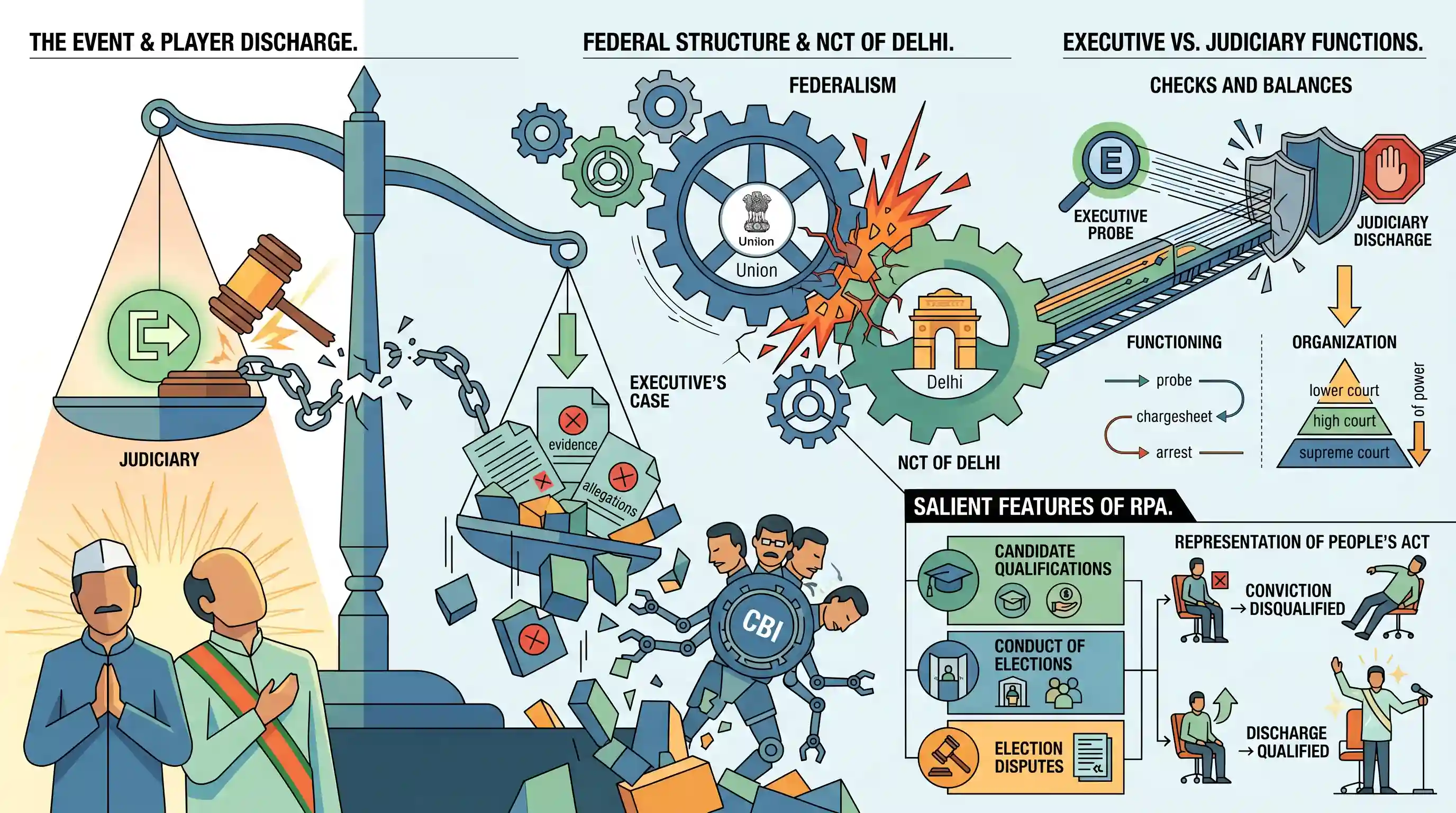
The case exemplifies the frequent administrative and legal friction between the Centre and the NCT of Delhi, putting the spotlight on the independence, credibility, and evidentiary standards of premier investigative agencies like the CBI. It is highly relevant for GS Paper 2 questions on federalism, governance, and the role of statutory bodies.
Summary
Former Delhi Chief Minister Arvind Kejriwal, Manish Sisodia, and others were discharged by the trial court in the CBI's case concerning the alleged Delhi Excise Policy scam. Legal expert Dhruv Gupta characterized the outcome as an "honourable exoneration" following the collapse of the CBI’s prosecution due to a lack of substantive evidence. The discharge is a critical development in the prolonged political and legal battle between the Aam Aadmi Party-led Delhi government and central agencies. From a UPSC perspective, the event underscores the debates surrounding the role and efficacy of the CBI, the use of central investigative agencies in federal structures, and the broader constitutional tussle regarding the administration of the National Capital Territory of Delhi.
Key Points
- The CBI court discharged Arvind Kejriwal, Manish Sisodia, and other accused in the Delhi excise policy case, marking a significant legal and political development.
- The legal outcome is being described as an 'honourable exoneration', indicating a complete clearing of charges rather than a mere technical acquittal.
- Advocate Dhruv Gupta's dissection highlights the collapse of the CBI's prosecution, pointing to insufficient substantive evidence to prove the alleged corruption.
- The discharge brings attention to the functioning of central investigative agencies, their independence, and the burden of proof required in high-profile political cases.
- The case intersects with the ongoing political and administrative friction between the elected Delhi government and the Centre, raising questions on federalism.
Important Terms
Central Bureau of Investigation (CBI)

India's premier investigative agency under the Ministry of Personnel. It derives powers from the Delhi Special Police Establishment (DSPE) Act, 1946, rather than being a statutory or constitutional body.
UPSC context
GS Paper 2: Statutory, regulatory and various quasi-judicial bodies; tests understanding of agency autonomy and federal challenges.
Delhi Excise Policy 2021-22
A 2021 reform aimed at privatizing liquor retail in Delhi to increase revenue and eliminate the liquor mafia. It was withdrawn in 2022 amid allegations of procedural irregularities and corruption.
UPSC context
GS Paper 2: Government policies and interventions; tests ability to analyze governance failures and executive accountability.
Honourable Exoneration
A judicially coined term for cases where the prosecution fails miserably to prove charges, implying the accused is cleared on merits rather than receiving a mere 'benefit of doubt.'
UPSC context
GS Paper 2: Structure and functioning of the Judiciary; distinguishes between procedural relief and substantive vindication of innocence.
Discharge (Criminal Procedure)
A legal outcome under the CrPC/BNSS where the court finds no sufficient grounds to proceed to trial. It occurs before charges are framed, unlike an acquittal which follows a full trial.
UPSC context
GS Paper 2: Criminal justice system; tests knowledge of pre-trial judicial processes and rights of the accused.
Article 239AA
The constitutional provision added by the 69th Amendment (1991) granting special status to Delhi. It established an elected assembly while reserving land, police, and public order for the Union.
UPSC context
GS Paper 2: Indian Constitution and Federal Structure; central to disputes over the division of powers in the National Capital.
Aam Aadmi Party (AAP)
A recognized national political party in India. Its role in this context highlights the intersection of political leadership, executive governance, and legal accountability of public representatives.
UPSC context
GS Paper 2: Salient features of the Representation of People's Act; pertains to political party functioning and criminalization of politics.
Prelims Trap
"The term 'honourable acquittal' is explicitly defined in the Code of Criminal Procedure for cases lacking evidence."
'Honourable acquittal' or 'honourable exoneration' are judicial constructs evolved through Supreme Court judgements, not statutory terms defined in the CrPC/BNSS or IPC/BNS.
Static Concepts Connected
How does the CBI derive its investigative powers?
- Non-statutory body: The CBI is not a statutory body; it draws its powers from the Delhi Special Police Establishment (DSPE) Act, 1946.
- State consent requirement: Under Section 6 of the DSPE Act, the CBI requires the consent of State Governments to exercise jurisdiction within their territories.
- Constitutional court exception: The Supreme Court and High Courts can order CBI investigations anywhere in the country without requiring the consent of the respective state government.
What differentiates a 'Discharge' from an 'Acquittal' in criminal law?
- Discharge (Pre-trial): It is a pre-trial termination. A judge orders a discharge if there are insufficient grounds or evidence to even frame formal charges against the accused.
- Acquittal (Post-trial): It is a formal post-trial verdict declaring the accused not guilty after examining witnesses, evidence, and completing the full trial process.
- Double Jeopardy implication: A discharged person can potentially be charged again if fresh evidence emerges, whereas an acquittal generally attracts 'double jeopardy' protections against retrial.
Cross-Topic Patterns
Pre-trial discharge vs. RPA Section 8
A 'discharge' halts trial proceedings entirely, protecting sitting lawmakers from statutory disqualification under Section 8 of the Representation of the People Act, 1951, which requires formal conviction and sentencing.
Federal friction and Article 239AA
The persistent use of DSPE-backed agencies in Article 239AA jurisdictions (Delhi) highlights the friction between elected sub-national governments and Centre-controlled investigative mechanisms.

Expect a 2026 prelims statement testing the legal distinction between 'discharge' and 'acquittal', or CBI's general consent rules.
Linked PYQs · 3
Linked PYQs · 3
- 2021MainsGS2
The jurisdiction of the Central Bureau of Investigation (CBI) regarding lodging an FIR and conducting probe within a particular State is being questioned by various States. However, the power of the States to withhold consent to the CBI is not absolute. Explain with special reference to the federal character of India.
- 2018MainsGS2
Whether the Supreme Court Judgement (July 2018) can settle the political tussle between the Lt. Governor and elected government of Delhi? Examine.
- 2016MainsGS2
Discuss the essentials of the 69th Constitutional Amendment Act and anomalies, if any, that have led to recent reported conflicts between the elected representatives and the institution of the Lieutenant Governor in the administration of Delhi. Do you think that this will give rise to a new trend in the functioning of the Indian federal politics?
