Digital governance and regulatory extension of state excise licensing
Source:Indian Express ↗
Why It Matters
Demonstrates state-level reliance on excise revenue and the use of digital tools (e-Abkari) to improve transparency and accountability in government licensing, tying into broader e-governance themes in GS2.
Summary
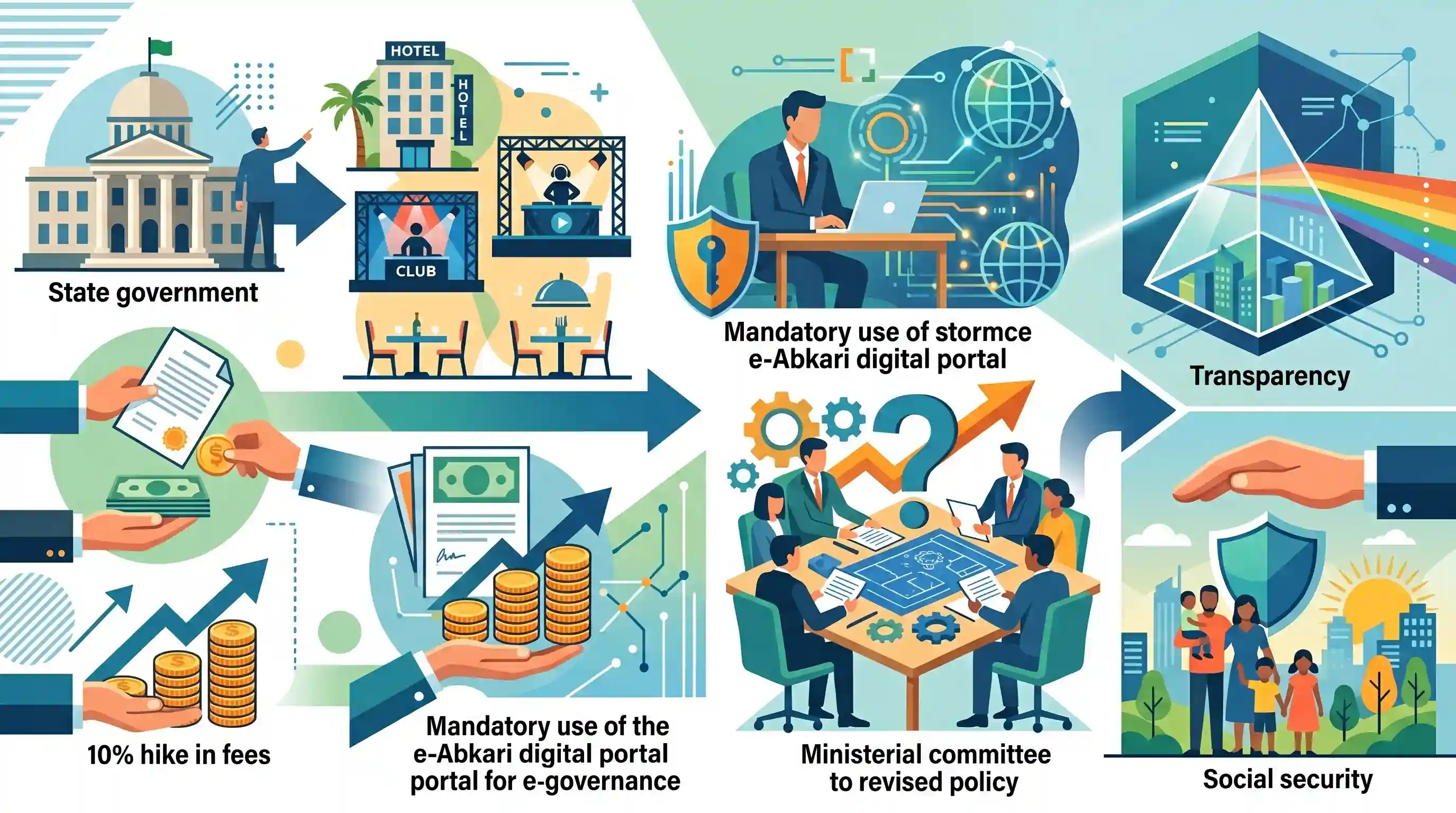
Pending the finalization of a new framework, the Delhi government has directed hotels, clubs, and restaurants to renew their liquor licenses under the existing excise policy for the 2026-27 financial year. The renewal incorporates a 10% hike in license fees and mandates the use of the e-Abkari digital portal. Meanwhile, a ministerial committee is working on a revised policy aimed at ensuring transparency and social security.
Key Points
- The Delhi government has extended the existing excise policy for hotels, clubs, and restaurants (HCRs) for the 2026-27 financial year to avoid a licensing gap.
- License fees for the serving of Indian and foreign liquor at these establishments have been increased by 10% on a pro-rata basis.
- A ministerial committee headed by PWD Minister Parvesh Sahib Singh is currently drafting a new, transparent, and socially secure excise policy.
- Renewals must be applied for strictly online via the e-Abkari portal, showcasing a shift towards e-governance for public-facing regulatory approvals.
Important Terms
Delhi Excise Act, 2009

The primary legislation regulating the production, manufacture, possession, sale, transport, and consumption of liquor and other intoxicants within the National Capital Territory (NCT) of Delhi.
UPSC context
GS Paper 2 (Governance/Statutory Bodies); tests understanding of state-level legislative frameworks for public health and revenue regulation.
Delhi Excise Rules, 2010
Rules framed under the 2009 Act that detail administrative procedures, including the issuance of liquor licenses, fee structures, and the mandatory distance of vends from educational or religious institutions.
UPSC context
GS Paper 2 (Governance); tests knowledge of delegated legislation and regulatory compliance in state administration.
e-Abkari Portal
A digital e-governance portal developed by the National Informatics Centre (NIC) for the Delhi Excise Department to track the liquor supply chain, manage licenses, and enhance revenue transparency.
UPSC context
GS Paper 2 (E-governance/Public Service Delivery); tests understanding of ICT applications in government and administrative transparency.
DSIIDC
A Delhi government undertaking that acts as one of the four authorized state entities managing the retail sale of liquor in the capital following the withdrawal of private retail.
UPSC context
GS Paper 3 (Economic Development/Revenue); relevant for state-led resource mobilization and the role of Public Sector Undertakings (PSUs).
DTTDC
One of Delhi's four government agencies tasked with operating retail liquor vends; it was originally established to develop tourism and transport infrastructure in the city.
UPSC context
GS Paper 3 (Economic Development); tests the diversification of state corporations and their role in revenue generation.
DCCWS
A cooperative agency under the Delhi government that operates retail liquor stores, including specialized 24/7 outlets at major commercial hubs like IGI Airport.
UPSC context
GS Paper 2 (Governance); relevant for understanding cooperative models and state-controlled retail infrastructure.
DSCSC
A state-owned corporation responsible for the supply of essential commodities in Delhi, which also functions as a major retail distributor of liquor under current government mandates.
UPSC context
GS Paper 3 (Economic Development); relates to the management of state revenue and the administration of civil supplies.
Prelims Trap
Alcoholic liquor for human consumption is taxed under the highest GST slab of 28%.
It is explicitly excluded from the GST regime by the Constitution (Article 366). States exclusively levy State Excise Duty and VAT on it.
Static Concepts Connected
How is alcohol for human consumption taxed in India?
- GST Exclusion: It is constitutionally kept completely outside the Goods and Services Tax (GST) framework under Article 366(12A).
- State Subject: The production, manufacture, possession, transport, and sale of intoxicating liquors fall exclusively under Entry 8 of the State List.
- Revenue Source: States independently levy State Excise Duty and VAT on it, making it one of the largest contributors to a State's Own Tax Revenue (SOTR).
Which Constitutional provision governs the State's stance on intoxicating drinks?
- Article 47: Part IV (DPSP) directs the State to endeavor to prohibit the consumption of intoxicating drinks and drugs which are injurious to health.
- Non-justiciable Nature: Like all DPSPs, this is not legally enforceable, allowing states the discretion to regulate and tax liquor rather than implementing blanket bans.
Cross-Topic Patterns
Article 47 vs. State Own Tax Revenue
The tension between the DPSP mandate to prohibit alcohol (Article 47) and the heavy reliance of state budgets on liquor excise duties remains a classic paradox in Indian federal finance.
e-Abkari & Digital Supply Chains
Mandating NIC-developed portals like e-Abkari reflects a wider governance push to plug state revenue leakages and minimize corruption via end-to-end digital supply chain tracking.

Expect a Prelims question matching State List entries or GST-exempt items (like alcohol & petroleum) with their constitutional articles.
Linked PYQs · 2
Linked PYQs · 2
- 2024MainsGS2
e-governance is not just about the routine application of digital technology in service delivery process. It is as much about multifarious interactions for ensuring transparency and accountability. In this context evaluate the role of the 'Interactive Service Model' of e-governance.
- 2023MainsGS2
e-governance, as a critical tool of governance, has ushered in effectiveness, transparency and accountability in governments. What inadequacies hamper the enhancement of these features ?
