EV Charging Station Safety Hazards and Thermal Runaway
Source:Indian Express ↗
Why It Matters
As India rapidly expands its EV infrastructure, urban planners and disaster management bodies face new challenges regarding fire safety and battery hazards. The concept of 'thermal runaway' in lithium-ion batteries requires specific emergency response protocols, such as continuous cooling, which is essential knowledge for GS-III (S&T and Disaster Management).
Summary
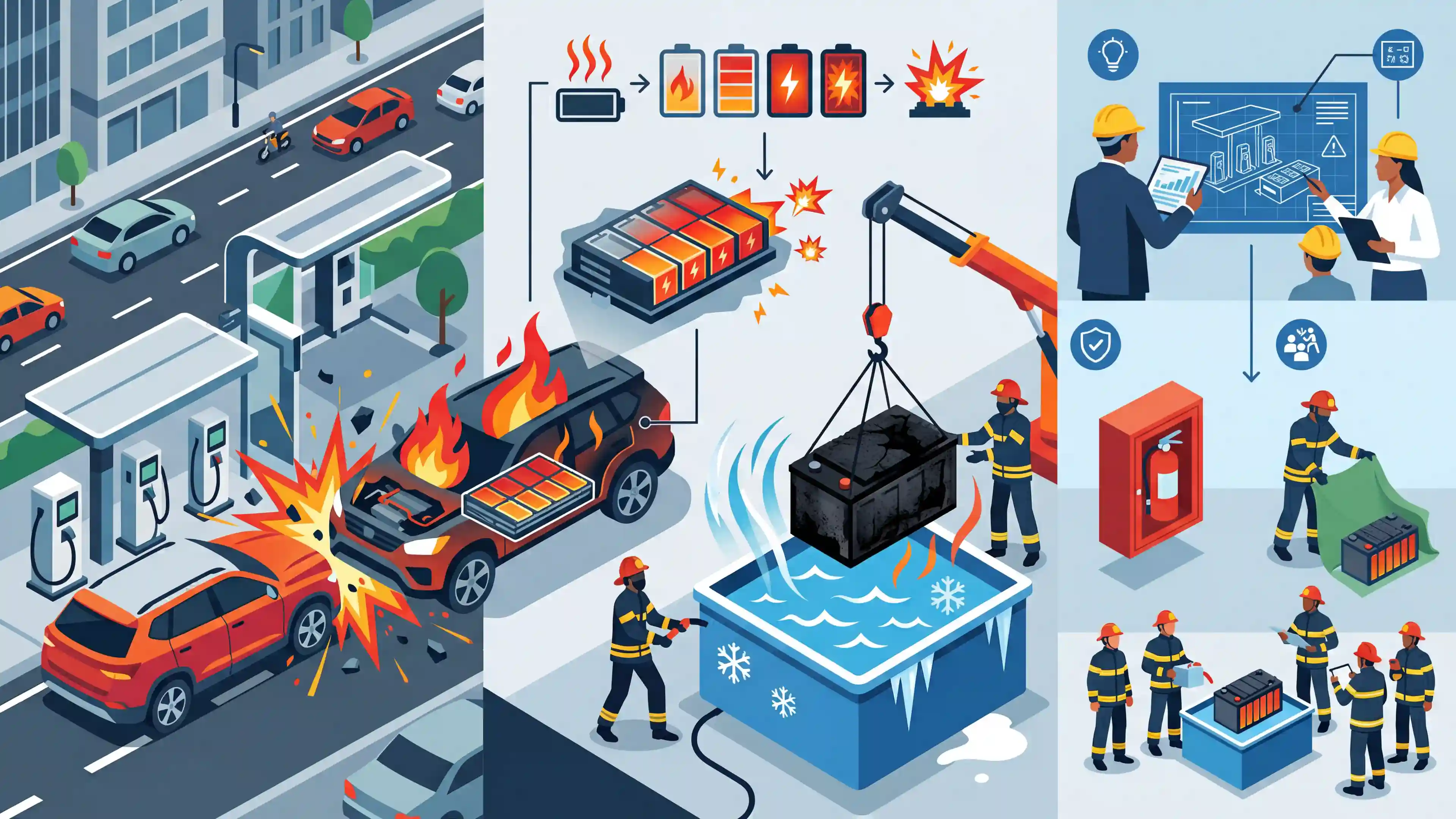
A significant fire incident at an EV charging station in Delhi's Aurobindo Marg underscores emerging urban disaster management challenges related to electric vehicles. The fire, triggered when a burning SUV crashed into the facility, destroyed the station and necessitated specialized response measures. To prevent thermal runaway—a dangerous chain reaction in damaged lithium-ion batteries—firefighters submerged the charred battery packs in cold water. This event brings attention to the safety protocols required for urban EV infrastructure and the proper handling of lithium-ion batteries post-accident.
Key Points
- A major fire broke out at an EV charging station in South Delhi's Aurobindo Marg after a burning SUV crashed into it.
- The fire destroyed the charging station, which was operated by Honda Power Pack Energy.
- To prevent secondary hazards like thermal runaway, fire department workers submerged the charred lithium-ion batteries in a metal box filled with cold water.
- The incident highlights the cascading risks of urban infrastructure accidents, specifically concerning the vulnerabilities and specialized handling required for EV charging stations and high-density battery storage.
Important Terms
Thermal Runaway

A self-sustaining, uncontrollable chain reaction in battery cells where excessive heat generation triggers further chemical reactions, often leading to intense fires or explosions.
UPSC context
GS Paper 3: Science & Technology and Disaster Management; crucial for understanding EV safety and hazard mitigation strategies.
Lithium-ion Battery
A rechargeable battery utilizing lithium ions for electrochemical energy storage; favored for EVs due to high energy density but requires sophisticated thermal management systems.
UPSC context
GS Paper 3: Energy and Infrastructure; relevant for EV adoption goals and critical mineral dependency (Lithium Triangle).
Delhi Fire Service (DFS)
The state-run agency responsible for firefighting and rescue operations in Delhi, serving as a critical Emergency Support Function (ESF) under NDMA guidelines.
UPSC context
GS Paper 3: Disaster Management; tests knowledge of urban response capabilities and multi-agency coordination during emergencies.
Battery Swapping Policy
A NITI Aayog framework promoting 'Battery-as-a-Service' to decouple battery costs from vehicle prices, facilitating rapid exchange of discharged batteries for charged ones.
UPSC context
GS Paper 3: Infrastructure and Economic Development; essential for understanding government initiatives to boost EV penetration and interoperability.
Urban Fire Management
The branch of disaster management focused on preventing and mitigating fires in high-density areas through building codes, safety audits, and specialized response infrastructure.
UPSC context
GS Paper 3: Disaster Management; addresses systemic vulnerabilities and the implementation of the National Building Code (NBC) 2016.
Honda Power Pack Energy India
A subsidiary of Honda Motor Co. providing battery swapping and charging services in India, focused on building a standardized, reliable e-mobility ecosystem.
UPSC context
GS Paper 3: Industry and Infrastructure; illustrates private sector participation in India's green energy transition.
Prelims Trap
"Water should never be used on Lithium-ion EV battery fires due to explosive reactions."
While raw lithium reacts violently with water, EV lithium-ion batteries use lithium salts. Copious water or submersion is actually the standard firefighting protocol to cool the battery and stop thermal runaway.
Static Concepts Connected
What drives the 'thermal runaway' phenomenon in Lithium-ion batteries?
- Definition: A dangerous positive feedback loop where internal heat generation exceeds the battery's ability to dissipate it, causing exponentially rising temperatures.
- Triggers: Commonly initiated by physical impact (accidents), overcharging, manufacturing defects, or internal short-circuiting.
- Consequences: Results in the vaporization of the liquid electrolyte, release of toxic gases (like hydrogen fluoride), and uncontrollable fire or explosion.
What are the AIS-156 safety norms for Electric Vehicles in India?
- Mandate: A set of rigorous safety standards formulated by the Ministry of Road Transport and Highways (MoRTH) following a spate of EV fires.
- Cell-level safety: Mandates mandatory thermal propagation tests, ensuring that a fire in one cell does not immediately spread to adjacent cells.
- System upgrades: Requires advanced Battery Management Systems (BMS), pressure release vents, and adequate spacing in battery pack designs.
Cross-Topic Patterns
EV infrastructure as an urban HAZMAT
The dense clustering of high-voltage EV charging stations in residential zones introduces complex chemical (HAZMAT) and electrical hazard risks, demanding updated NDMA guidelines for urban disaster management.
Solid-State Batteries as the safety successor
Frequent thermal runaway events in liquid-electrolyte Li-ion cells accelerate the industry push for solid-state batteries, which use non-flammable solid electrolytes and offer significantly higher thermal stability.

Thermal runaway triggers and EV battery fire toxicity (e.g., hydrogen fluoride release) are prime candidates for Science & Tech MCQs in 2026.
Linked PYQs · 3
Linked PYQs · 3
- 2023MainsGS3
The adoption of electric vehicles is rapidly growing worldwide. How do electric vehicles contribute to reducing carbon emissions and what are the key benefits they offer compared to traditional combustion engine vehicles?
- 2025PrelimsGS1
In the context of electric vehicle batteries, consider the following elements : I. Cobalt II. Graphite III. Lithium IV. Nickel How many of the above usually make up battery cathodes?
- 2019MainsGS3
Disaster preparedness is the first step in any disaster management process. Explain how hazard zonation mapping will help disaster mitigation in the case of landslides.
