Delhi Orders Probe into Septic Waste in Yamuna
Source:The Hindu ↗
Why It Matters
This event illustrates the chronic challenges in urban river rejuvenation and highlights the practical application of environmental concepts like Biochemical Oxygen Demand (BOD). It also underscores the active role of statutory bodies like the NGT and state pollution control boards in enforcing environmental compensation and accountability.
Summary
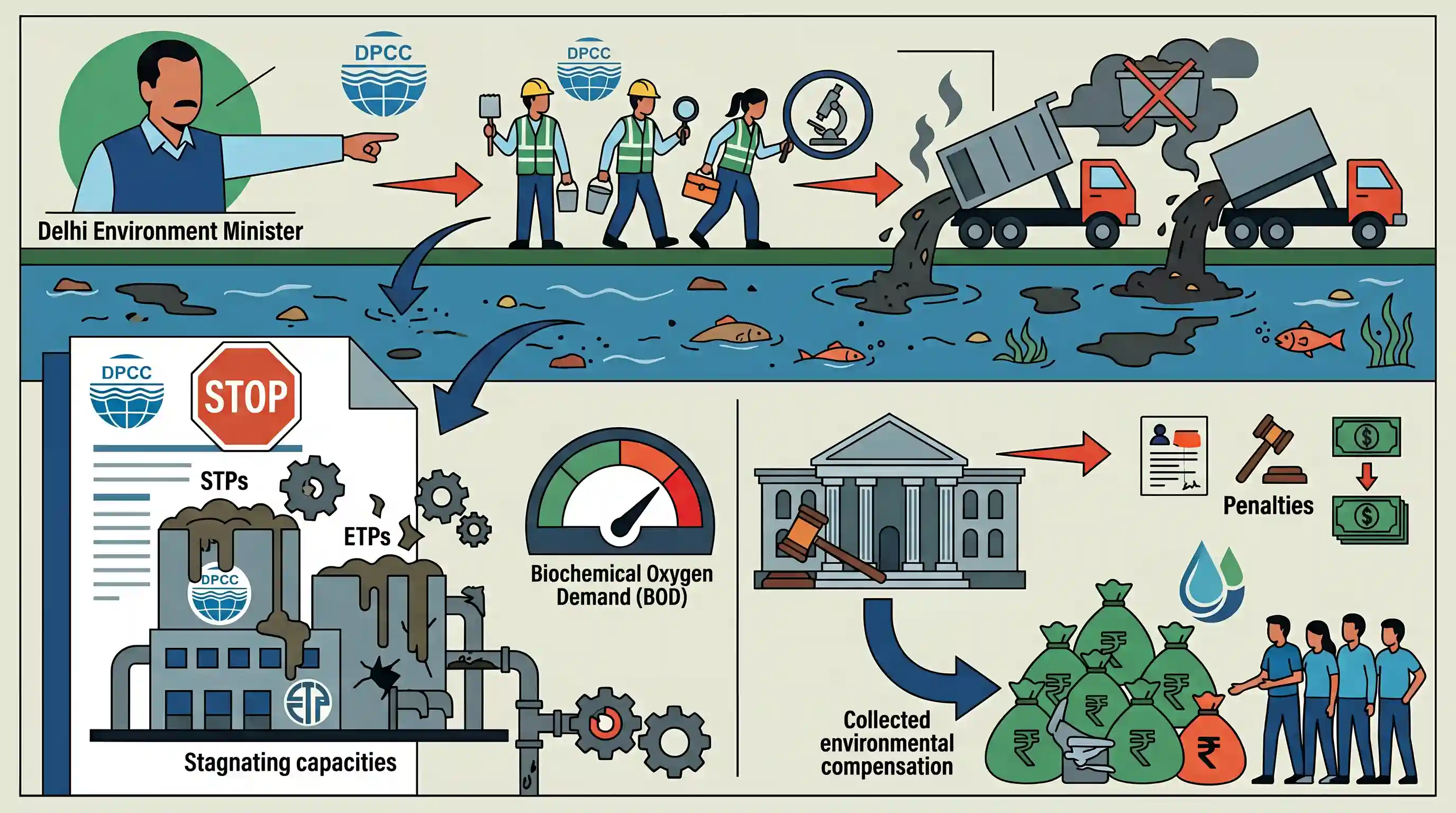
Delhi's Environment Minister has directed the Delhi Pollution Control Committee (DPCC) to investigate the illegal discharge of septic waste into the Yamuna River. A recent DPCC report pointed to stagnating capacities at local sewage and effluent treatment plants, which has hindered efforts to lower the river's Biochemical Oxygen Demand (BOD). Following intervention by the National Green Tribunal (NGT), the Delhi Jal Board has collected ₹18.54 crore in environmental compensation to penalize the illegal dumping of waste.
Key Points
- The Delhi Environment Minister has ordered a DPCC probe into the illegal dumping of septic waste into the Yamuna River.
- A DPCC report revealed that the capacity of Sewage Treatment Plants (STPs) and Effluent Treatment Plants (ETPs) in Delhi is stagnating, preventing a reduction in the river's Biochemical Oxygen Demand (BOD).
- In response to the crisis, the National Green Tribunal (NGT) has intervened.
- The Delhi Jal Board (DJB) has imposed ₹18.54 crore in environmental compensation as a deterrent against unauthorized waste dumping.
Important Terms
National Green Tribunal (NGT)

Statutory body established under the NGT Act, 2010, for the effective and expeditious disposal of environmental cases. It follows principles of natural justice rather than strict civil procedure.
UPSC context
GS II (Statutory Bodies) & GS III (Conservation); vital for environmental governance and judicial overreach topics.
Biochemical Oxygen Demand (BOD)
The amount of dissolved oxygen required by aerobic bacteria to break down organic matter in water. Higher values indicate severe organic pollution and lower oxygen availability for aquatic life.
UPSC context
GS III (Environment - Pollution); used as a primary indicator for assessing river health and STP efficiency.
Delhi Pollution Control Committee (DPCC)
An autonomous regulatory body that enforces the Water Act (1974) and Air Act (1981) within Delhi. It monitors pollution levels and issues 'consent to operate' for industries.
UPSC context
GS II (Regulatory Bodies); demonstrates state-level implementation of central environmental laws.
Delhi Jal Board (DJB)
A statutory authority under the Delhi Water Board Act, 1998, tasked with supplying potable water and managing sewage treatment and disposal in the National Capital Territory.
UPSC context
GS II (Urban Governance); relevant for infrastructure management and the right to sanitation.
Environmental Compensation
A financial penalty levied on polluters based on the 'Polluter Pays Principle' to cover the costs of environmental restoration and compensation for ecological damage.
UPSC context
GS III (Environment & Economy); relates to environmental jurisprudence and fiscal tools for pollution abatement.
Prelims Trap
"High Biochemical Oxygen Demand (BOD) in a river indicates high levels of dissolved oxygen and a healthy aquatic ecosystem."
Aspirants often confuse BOD with Dissolved Oxygen (DO). High BOD actually indicates severe organic pollution and severely depleted dissolved oxygen.
Static Concepts Connected
What is Biochemical Oxygen Demand (BOD)?
- Definition: The amount of dissolved oxygen required by aerobic microorganisms to break down organic material present in a given water sample at a specific temperature.
- Pollution Indicator: Higher BOD values indicate higher concentrations of organic pollutants (like sewage) in the water body.
- Inverse to DO: High BOD directly corresponds to lower Dissolved Oxygen (DO) levels, which can lead to hypoxic conditions harmful to fish and other aquatic life.
What are the core principles and jurisdiction of the NGT?
- Statutory Mandate: Established under the NGT Act, 2010. It is guided by principles of natural justice rather than the Code of Civil Procedure.
- Guiding Principles: Statutorily mandated to apply the Precautionary Principle, Sustainable Development, and the Polluter Pays Principle in its orders.
- Jurisdiction Exceptions: Hears civil cases under 7 environmental laws, but notably excludes the Wildlife (Protection) Act, 1972 and the Forest Rights Act, 2006.
Cross-Topic Patterns
Urban Governance & River Pollution
The stagnation of STP capacities highlights systemic challenges under the 74th Amendment, where Urban Local Bodies often lack the financial autonomy and capacity for adequate waste management infrastructure.
Polluter Pays Principle in Action
The ₹18.54 crore compensation levied by the DJB exemplifies the 'Polluter Pays Principle', a statutory requirement under the NGT Act and a core tenet of international environmental law.

A Prelims question linking BOD/COD water quality indicators with the specific statutory bounds of NGT vs SPCBs is highly probable.
Linked PYQs · 3
Linked PYQs · 3
- 2017PrelimsGS1
Biological Oxygen Demand (BOD) is a standard criterion for
- 2018PrelimsGS1
How is the National Green Tribunal (NGT) different from the Central Pollution Control Board (CPCB)? 1. The NGT has been established by an Act whereas the CPCB has been created by an executive order of the Government. 2. The NGT provides environmental justice and helps reduce the burden of litigation in the higher courts whereas the CPCB promotes cleanliness of streams and wells, and aims to improve the quality of air in the country. Which of the statements given above is/are correct?
- 2024MainsGS3
Industrial pollution of river water is a significant environmental issue in India. Discuss the various mitigation measures to deal with this problem and also the government's initiatives in this regard.
