Delhi government signs MoU for scientific road management to curb dust
Source:Indian Express ↗
Why It Matters
The article provides a practical case study of using scientific, data-driven management (RAMS) to solve intertwined urban challenges like air pollution, traffic congestion, and urban flooding, which are frequent themes in GS1 (Urbanisation) and GS3 (Infrastructure, Environment & Disaster Management).
Summary
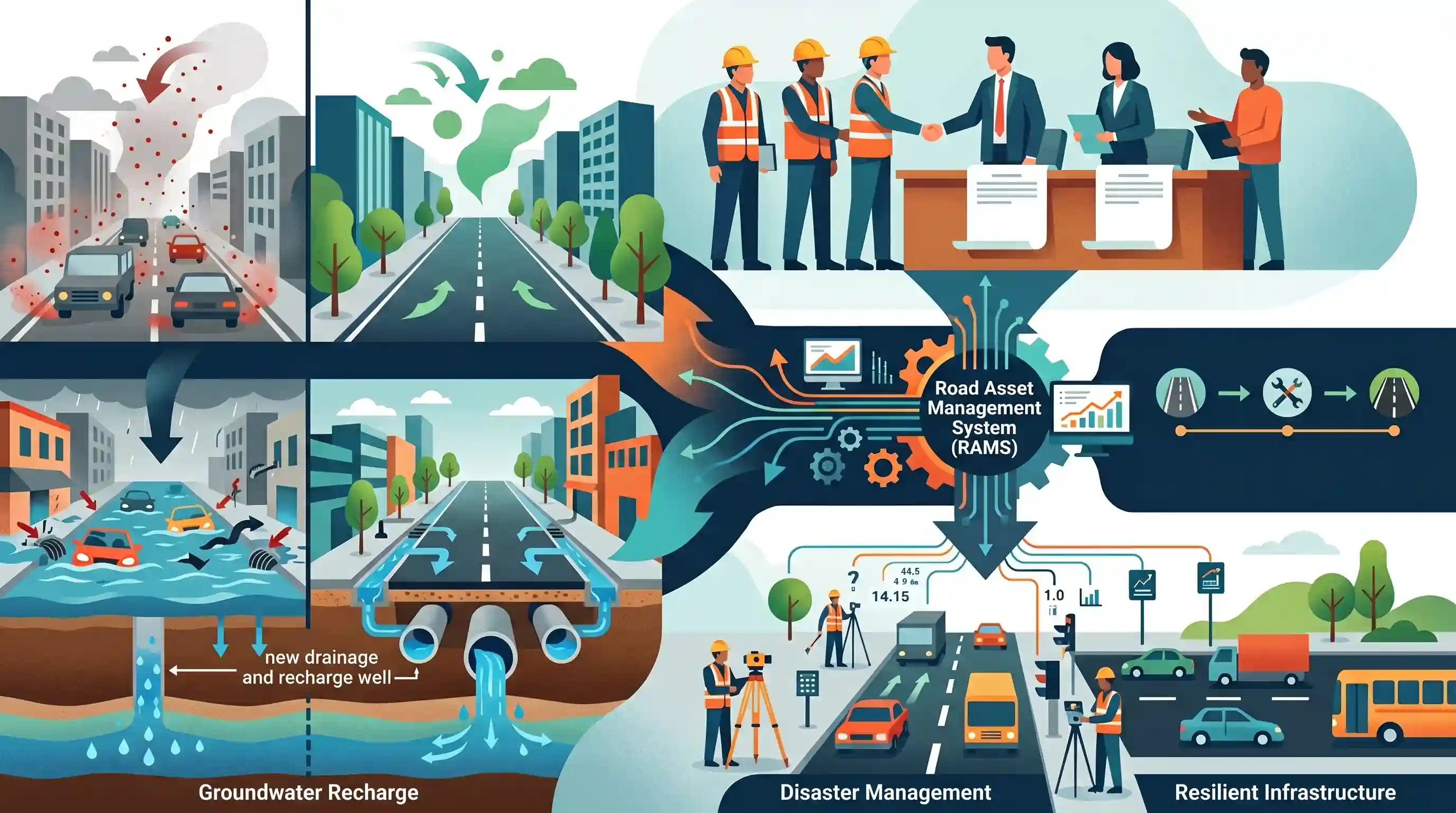
The Delhi government's Public Works Department (PWD) has signed a Memorandum of Agreement (MoA) with the Central Road Research Institute (CRRI) and the School of Planning and Architecture (SPA) to implement a scientific Road Asset Management System (RAMS). The initiative seeks to comprehensively address urban infrastructure challenges by making roads dust-free to combat air pollution, redesigning stormwater drainage to prevent waterlogging, and facilitating groundwater recharge. RAMS will leverage data to assess traffic loads and maintenance needs, ensuring more resilient and sustainable road infrastructure in the capital.
Key Points
- The Delhi government's PWD signed a Memorandum of Agreement with CRRI and SPA to develop a scientific Road Asset Management System (RAMS).
- The initiative primarily aims to tackle Delhi's severe dust and air pollution by making roads dust-free and establishing scientific green belts.
- RAMS will also address urban waterlogging through the redesign of stormwater drainage systems and mechanisms for groundwater recharge.
- The system will enable data-driven urban infrastructure management by assessing traffic load, road structural capacity, and predicting maintenance requirements.
Important Terms
Road Asset Management System (RAMS)

A data-driven framework used to scientifically assess road conditions, traffic loads, and maintenance needs. It leverages digital records and GIS for preventive and predictive infrastructure upkeep.
UPSC context
GS-III (Infrastructure and Environment); tests data-driven urban governance and pollution mitigation strategies through scientific road maintenance.
Central Road Research Institute (CRRI)
A premier national laboratory under the Council of Scientific and Industrial Research (CSIR) specializing in road engineering, pavement technology, and traffic management research.
UPSC context
GS-III (Science and Technology); relevant for national institutions developing sustainable transport and disaster-resilient infrastructure.
School of Planning and Architecture (SPA)
An "Institution of National Importance" under the Ministry of Education, providing specialized education and research in architecture, urban planning, and sustainable infrastructure design.
UPSC context
GS-I (Urbanization) and GS-III (Smart Cities); focuses on institutional capacity for sustainable urban planning and development.
Commission for Air Quality Management (CAQM)
A statutory body responsible for coordinating and overseeing air quality management in the National Capital Region (NCR) and adjoining areas to combat air pollution.
UPSC context
GS-III (Environment); tests understanding of institutional frameworks and inter-state coordination to tackle air pollution in NCR.
Public Works Department (PWD)
A state-level government agency responsible for the planning, construction, management, and maintenance of public infrastructure, including roads, bridges, and government buildings.
UPSC context
GS-II (Governance) and GS-III (Infrastructure); examines the executive machinery responsible for building and maintaining public assets.
Prelims Trap
"Road dust exclusively generates coarse PM10 particles and does not contribute to fine PM2.5 urban pollution."
While primarily known for PM10, resuspended road dust is also a major source of PM2.5 (up to 30% during dry seasons) in Indian urban centers.
Static Concepts Connected
What differentiates Urban Flooding from traditional riverine flooding?
- Peak Flow: Urban flooding features significantly faster and higher peak flows (up to 3 times) due to widespread concretization and impermeable surfaces.
- Anthropogenic Causes: Caused heavily by anthropogenic factors like overburdened stormwater drains, loss of wetlands, and improper road slopes, rather than just heavy rainfall.
What are 'line-source' and 'point-source' pollutants?
- Line-source Pollutants: Emissions occurring along a narrow, continuous route. Examples include vehicle exhaust or resuspended road dust along a highway.
- Point-source Pollutants: Localized, stationary, and easily identifiable sources of pollution, such as industrial smokestacks, factory discharge pipes, or power plants.
Cross-Topic Patterns
Sponge Cities & Stormwater Management
Linking road drainage redesign to the 'Sponge City' concept, prioritizing permeable pavements and built-in groundwater recharge to simultaneously fight urban floods and aquifer depletion.
AQI & Structural Asset Management
Shifting urban pollution control from reactive, end-of-pipe measures (like smog towers) to proactive, structural asset management (dust-free roads via RAMS).

Integrated infrastructure (roads doubling as groundwater rechargers and dust-mitigators) is highly likely for GS3 Mains urban planning.
Linked PYQs · 4
Linked PYQs · 4
- 2020MainsGS1
Account for the huge flooding of million cities in India including the smart ones like Hyderabad and Pune. Suggest lasting remedial measures.
- 2020MainsGS3
What are the key features of the National Clean Air Programme (NCAP) initiated by the Government of India?
- 2021MainsGS3
“Investment in infrastructure is essential for more rapid and inclusive economic growth.” Discuss in the light of India's experience.
- 2024MainsGS3
Flooding in urban areas is an emerging climate-induced disaster. Discuss the causes of this disaster. Mention the features of two such major floods in the last two decades in India. Describe the policies and frameworks in India that aim at tackling such floods.
