Delhi Winter Fog and Very Poor Air Quality Index Challenges
Source:The Hindu ↗
Why It Matters
Delhi's winter air pollution is a recurring administrative, environmental, and public health crisis. It tests candidates' knowledge of AQI classifications, meteorological causes like temperature inversion, and institutional responses by agencies such as the CPCB and IMD.
Summary
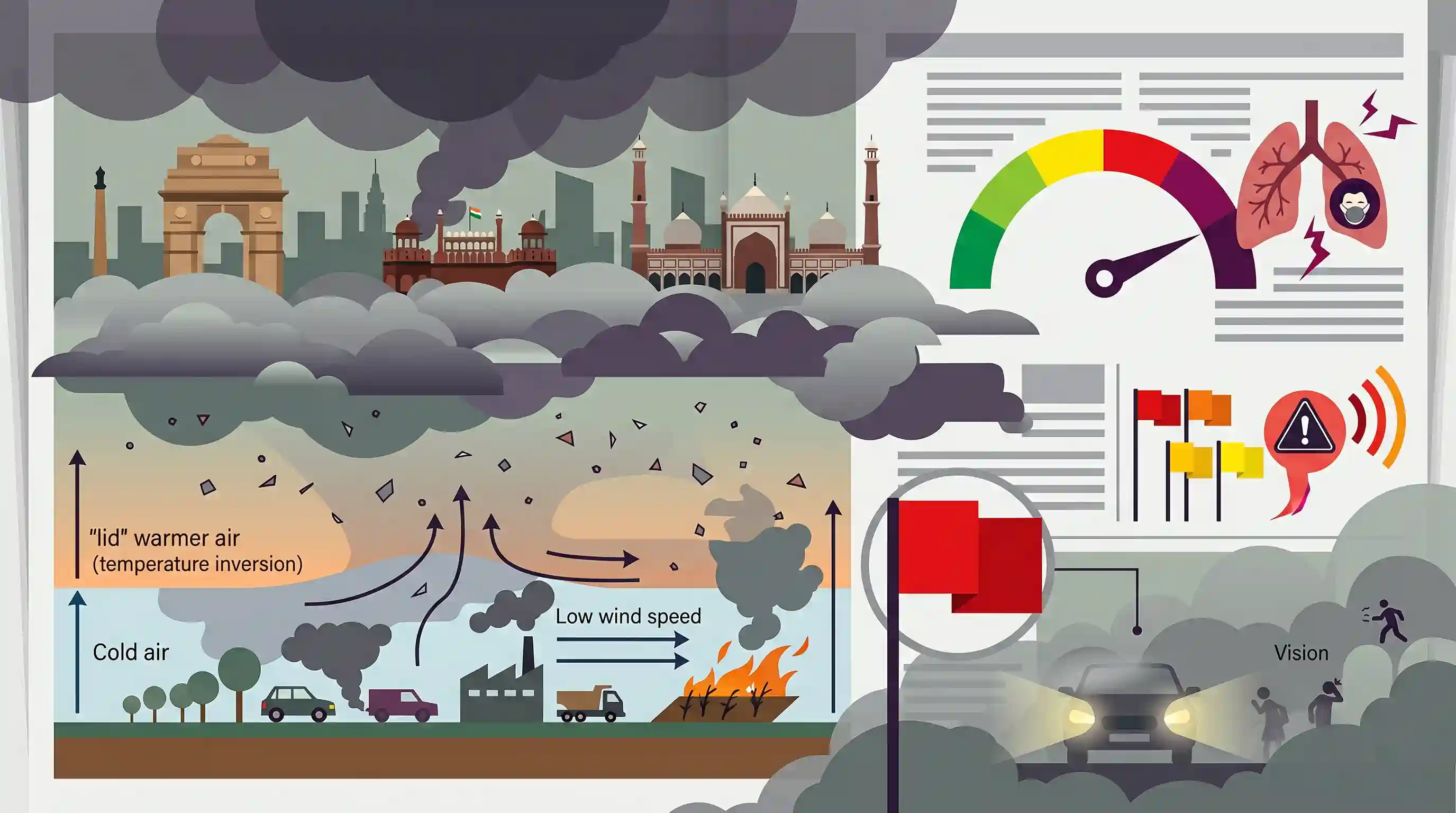
Delhi experienced dense winter fog accompanied by marginally improved but still 'very poor' air quality, with an AQI of 388. The India Meteorological Department (IMD) issued colour-coded alerts as visibility dropped severely across the city. The situation highlights the annual winter meteorological phenomena in North India, where temperature inversions and low wind speeds trap regional pollutants, leading to prolonged smog and hazardous breathing conditions.
Key Points
- Delhi witnessed a blanket of dense fog, which significantly reduced visibility and disrupted transit operations at key hubs like IGI Airport (Palam).
- The Air Quality Index (AQI) showed marginal improvement, settling in the 'very poor' category (388) after previously threatening to breach the 'severe' threshold.
- The India Meteorological Department (IMD) issued colour-coded weather warnings (yellow/orange alerts) owing to dropping minimum temperatures and prevailing fog conditions.
- Meteorological factors such as winter temperature inversion and low wind speeds continue to trap regional pollutants, resulting in persistent smog and poor air quality in the NCR.
Important Terms
Air Quality Index (AQI)

A numerical scale (0–500) used to communicate daily air quality and its health impacts. In India, it monitors eight major pollutants including PM2.5, PM10, and Nitrogen Dioxide.
UPSC context
GS Paper III (Environment). Essential for understanding environmental monitoring standards and public health communication.
Graded Response Action Plan (GRAP)
An emergency response framework for Delhi-NCR that activates specific restrictive measures (Stages I-IV) based on AQI thresholds to prevent further deterioration of air quality.
UPSC context
GS Paper III (Environment). Key for pollution mitigation strategies and urban governance in the National Capital Region.
Central Pollution Control Board (CPCB)
A statutory body established under the Water Act 1974; it serves as the apex organization for pollution control and coordinates with State Pollution Control Boards.
UPSC context
GS Paper II (Statutory Bodies) and GS III (Environment). Tests knowledge of institutional frameworks for environmental protection.
India Meteorological Department (IMD)
The principal government agency for meteorological observations and forecasting. It issues color-coded alerts (Yellow, Orange, Red) to warn of hazardous weather like dense fog.
UPSC context
GS Paper I (Geography) and GS III (Disaster Management). Relevant for weather phenomena and disaster preparedness.
Air Quality Early Warning System (AQEWS)
A predictive tool developed by IITM and IMD that forecasts extreme pollution events 3-10 days in advance to enable proactive implementation of emergency measures.
UPSC context
GS Paper III (S&T/Environment). Highlights the role of modeling and technology in proactive environmental management.
Temperature Inversion
A meteorological phenomenon where air temperature increases with altitude, trapping cooler air and pollutants near the surface, often leading to dense fog and smog.
UPSC context
GS Paper I (Physical Geography). Fundamental concept explaining seasonal pollution spikes and atmospheric stability in North India.
National Clean Air Programme (NCAP)
A national strategy launched in 2019 to reduce PM2.5 and PM10 concentrations by 20-30% by 2024, now revised to a 40% reduction target by 2026.
UPSC context
GS Paper III (Environment). Critical for understanding national policy targets and long-term air pollution management.
Prelims Trap
Carbon dioxide and Methane are among the key pollutants measured to calculate India's National Air Quality Index (AQI).
The National AQI measures 8 specific pollutants. It does not include primary greenhouse gases like Carbon Dioxide (CO2) or Methane.
Static Concepts Connected
What is Temperature Inversion and how does it worsen winter smog?
- Reversed Gradient: Normally, temperature decreases with altitude in the troposphere. Inversion reverses this, making surface air colder than the air above.
- Radiation Cooling: During calm winter nights, rapid radiation cooling of the earth's surface creates this cold lower layer.
- Trapping Effect: The warmer air above acts as a lid, preventing vertical mixing and trapping vehicular and industrial particulate matter near the ground.
What is the Graded Response Action Plan (GRAP)?
- Statutory Backing: It is enforced by the Commission for Air Quality Management (CAQM), a statutory body established for the NCR and adjoining areas.
- Four Stages: It features four stages based on AQI: Poor (201-300), Very Poor (301-400), Severe (401-450), and Severe+ (>450).
- Forecast-driven: Instead of waiting for air quality to deteriorate, CAQM now triggers GRAP measures proactively based on IMD and IITM forecasts.
Cross-Topic Patterns
Interstate pollution & Federal friction
Delhi's air crisis frequently exposes gaps in cooperative federalism, pitting upwind states' agricultural policies (paddy MSPs and free electricity) against the NCR's environmental health.
Geography dictates pollution severity
The Himalayas block northern winds while the landlocked nature of the Indo-Gangetic plain restricts the oceanic dispersion of pollutants that coastal cities like Mumbai enjoy.

Expect a 2026 Prelims multi-statement question mixing the physics of temperature inversion with the statutory powers of the CAQM under GRAP.
Linked PYQs · 4
Linked PYQs · 4
- 2021MainsGS3
Describe the key points of the revised Global Air Quality Guidelines (AQGs) recently released by the World Health Organisation (WHO). How are these different from its last update in 2005? What changes in India's National Clean Air Programme are required to achieve these revised standards?
- 2022MainsGS3
Discuss in detail the photochemical smog emphasizing its formation, effects and mitigation. Explain the 1999 Gothenburg Protocol.
- 2022MainsGS1
Discuss the meaning of colour-coded weather warnings for cyclone prone areas given by India Meteorological Department.
- 2013MainsGS1
What do you understand by the phenomenon of 'temperature inversion' in meteorology? How does it affect weather and the habitants of the place?
