National Common Mobility Card Implementation in Delhi
Source:Indian Express ↗
Why It Matters
Highlights the practical implementation of the 'One Nation, One Card' (NCMC) initiative, which is crucial for modernizing urban transport infrastructure, enhancing commuter convenience, and promoting interoperable digital payment systems across India.
Summary
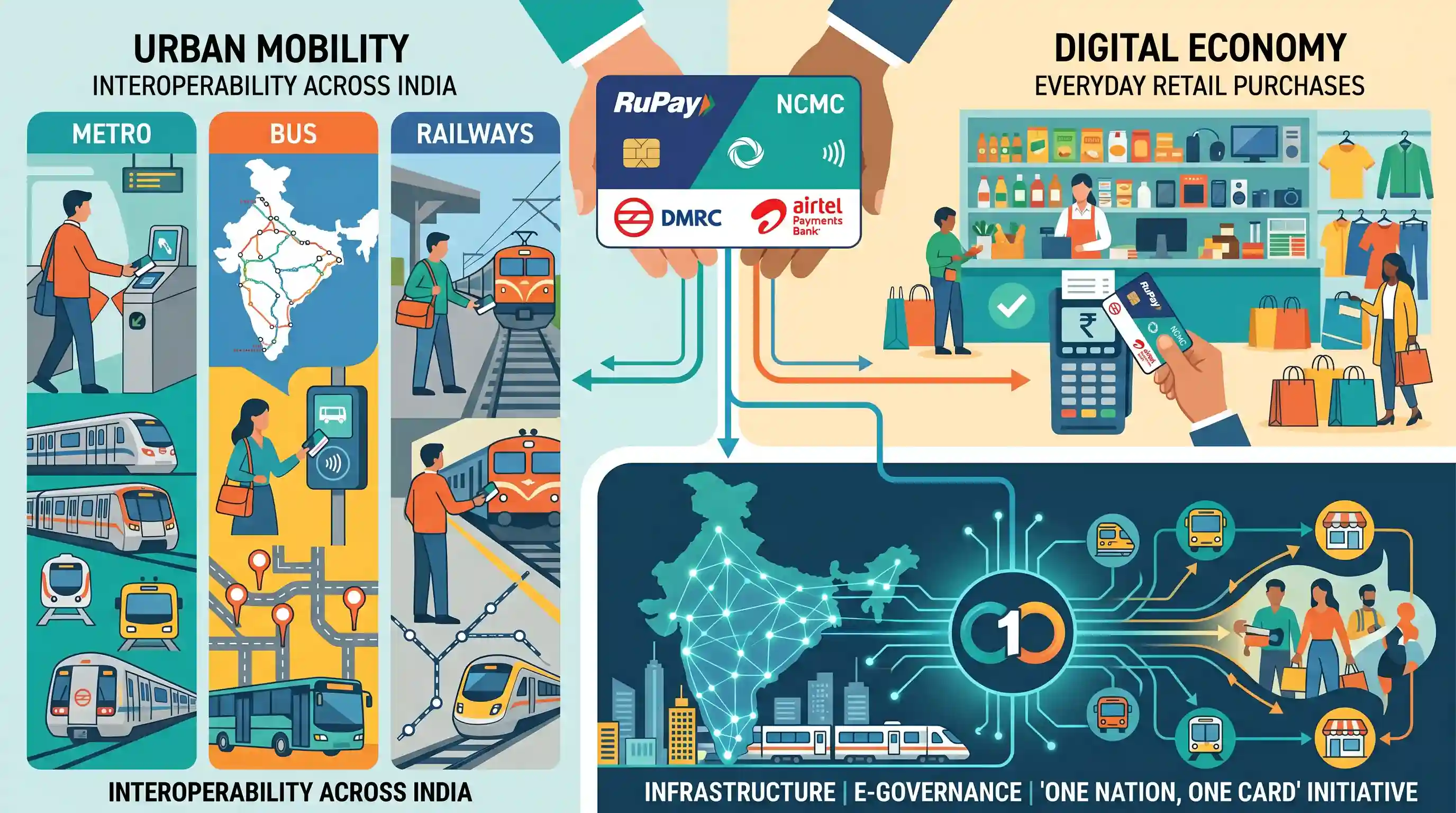
Delhi commuters can now utilize a unified 'One Card' system following the launch of the co-branded RuPay National Common Mobility Card (NCMC) by the DMRC and Airtel Payments Bank. This interoperable, open-loop prepaid card facilitates seamless travel across various transport modes throughout India, such as metros, buses, and railways. Additionally, it can be used for everyday retail purchases, supporting the 'One Nation, One Card' initiative by integrating urban mobility with digital payments.
Key Points
- The DMRC, in collaboration with Airtel Payments Bank, has launched a co-branded RuPay National Common Mobility Card (NCMC) for commuters.
- The 'One Card' is an interoperable, open-loop prepaid card that enables seamless travel across multiple transit systems nationwide, including metros, buses, and railways.
- Beyond transit, the NCMC also functions as a general prepaid card, allowing users to make everyday retail purchases.
- The initiative advances the 'One Nation, One Card' vision, promoting integrated urban mobility and bolstering India's digital payment ecosystem.
Important Terms
National Common Mobility Card (NCMC)

An interoperable, contactless smart card launched in 2019 for seamless travel across India's metro, bus, and rail networks, while also supporting retail payments.
UPSC context
GS Paper 3: Infrastructure and Urban Mobility; tests knowledge of indigenously-developed digital payment ecosystems.
One Nation, One Card
A government initiative aiming to integrate diverse public transport and retail payment systems into a single, unified digital platform for nationwide ease of access.
UPSC context
GS Paper 2: E-governance; evaluates understanding of policy initiatives for digitizing public services and administrative efficiency.
National Payments Corporation of India (NPCI)
An umbrella organization for operating retail payments and settlement systems in India, established by the RBI and IBA to create robust payment infrastructure.
UPSC context
GS Paper 3: Indian Economy (Financial Inclusion); critical for understanding the architecture of India's digital payment revolution (UPI, RuPay).
RuPay
India's indigenous global card network developed by NPCI, providing the technological backbone for the NCMC through its 'On-The-Go' contactless payment functionality.
UPSC context
GS Paper 3: Science and Technology (Indigenization); tests awareness of domestic financial technology alternatives to global networks like Visa/Mastercard.
Delhi Metro Rail Corporation (DMRC)
A public sector entity managing the Delhi Metro; it acts as a lead implementer for urban transport innovations like open-loop ticketing systems.
UPSC context
GS Paper 3: Infrastructure; relevant for case studies on successful Public-Private Partnerships and urban infrastructure modernization.
Airtel Payments Bank
A digital-first bank that issues co-branded NCMC cards (Debit and PPI-MTS), facilitating the integration of fintech with mass transit systems.
UPSC context
GS Paper 3: Indian Economy (Banking); tests knowledge of differentiated banking models and their role in the digital economy.
Prelims Trap
"NCMC is a closed-loop payment instrument launched by the RBI exclusively for public transit systems."
NCMC is an open-loop card usable for both retail and transit. It was conceptualized by the Ministry of Housing and Urban Affairs (MoHUA), not the RBI.
Static Concepts Connected
How do Open-Loop and Closed-Loop payment systems differ?
- Closed-loop: Restricted to a single merchant or service provider (e.g., older dedicated metro cards, brand gift cards). Cannot be used elsewhere.
- Open-loop: Supported by a broader payment network (like RuPay or Visa) allowing widespread use for general retail, tolls, and transit (e.g., NCMC).
What is the organizational structure and mandate of NPCI?
- Origin: A joint initiative of RBI and the Indian Banks' Association (IBA) under the Payment and Settlement Systems Act, 2007.
- Legal Status: Incorporated as a "Not for Profit" company under Section 8 of the Companies Act 2013 to operate retail payment systems.
- Flagship Products: Operates core digital infrastructure including UPI, RuPay, IMPS, NETC (FASTag), and supports the NCMC ecosystem.
Cross-Topic Patterns
NCMC as Digital Public Infrastructure
NCMC extends India's Digital Public Infrastructure (DPI) into urban transit, mirroring how UPI revolutionized financial transfers by dismantling closed-loop, proprietary corporate silos.
The 'One Nation' Interoperability Push
Matches the broader e-governance theme of national portability (e.g., One Nation One Ration Card), ensuring migrant and mobile populations do not face localized, state-level access barriers.

Open vs closed-loop systems + NCMC (NFC) + FASTag (RFID) are prime candidates for a comparative digital payments question in Prelims 2026.
Linked PYQs · 2
Linked PYQs · 2
- 2014MainsGS3
National Urban Transport Policy emphasises on 'moving people' instead of 'moving vehicles'. Discuss critically the success of the various strategies of the Government in this regard.
- 2024PrelimsGS1
With reference to the Pradhan Mantri Jan Dhan Yojana (PMJDY), which of the following statements is/are correct? 1. The scheme aims to open bank accounts for unbanked households. 2. There is a minimum balance requirement for accounts opened under this scheme. 3. Beneficiaries get a Rupay Debit Card with an inbuilt accident insurance cover. Select the correct answer using the code given below.
